01Why the Distinction Matters More Than You Might Think
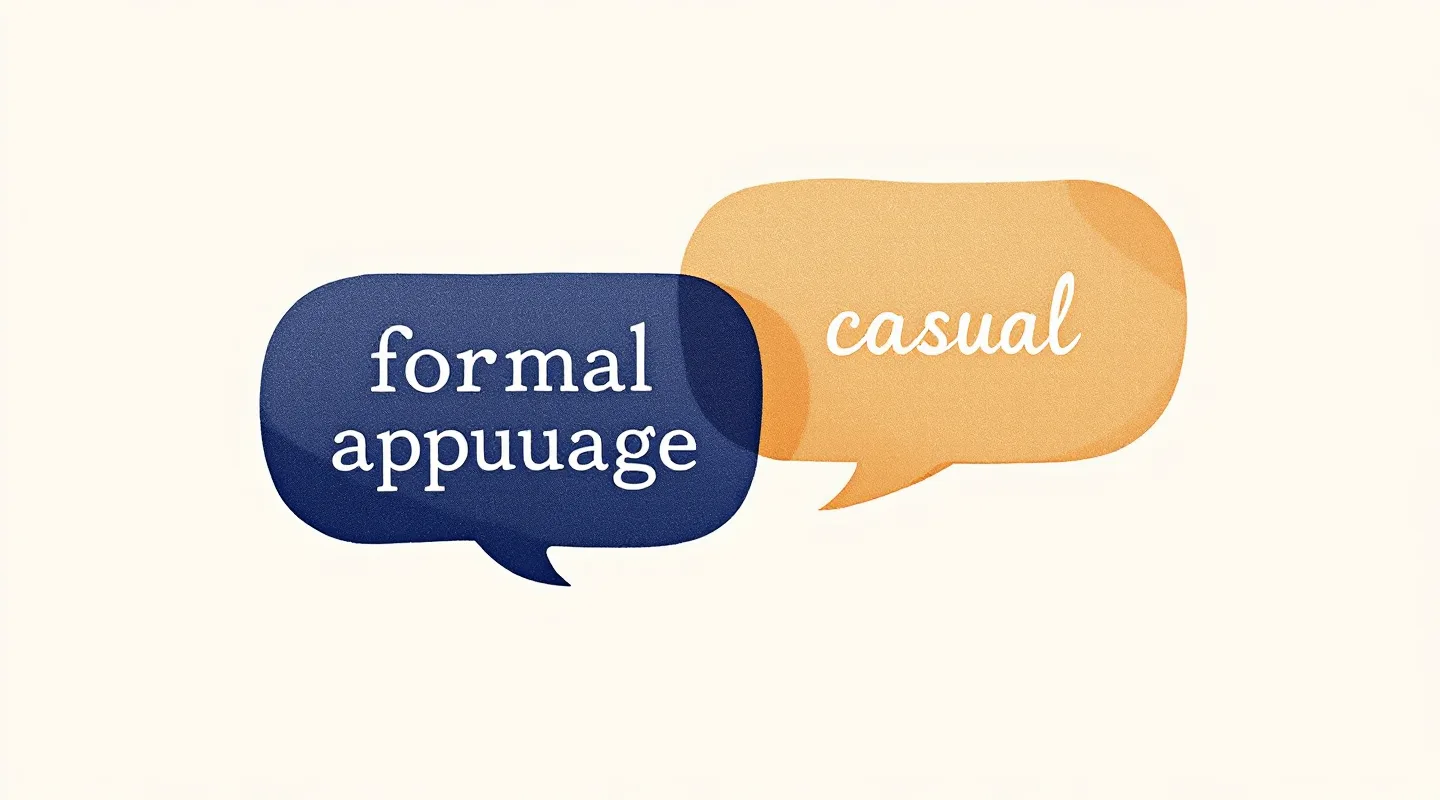
Most professors who teach writing-heavy courses will tell you the same thing: the number-one mistake students make is not about argument, structure, or even evidence — it is about register. Register is the term linguists use to describe the level of formality suited to a particular context, audience, and purpose. When a student submits a term paper written in the same voice they use to text a friend or post on social media, the mismatch is immediately obvious to any experienced reader, and it undermines everything else the student has worked hard to communicate.
This is not a niche concern. Students today toggle constantly between informal digital communication — texting, messaging apps, social media captions, comment threads — and the formal demands of academic prose. The mental shift required to move between those two registers is real, and without conscious effort it often does not happen. The result is essays peppered with contractions, vague colloquialisms, and a stream-of-consciousness structure that reads more like a casual conversation than a scholarly argument.
Understanding the difference between formal and informal writing is therefore one of the most practical skills you can develop as a student. It is not about memorizing arbitrary rules. It is about recognizing that different contexts have different conventions, and that meeting those conventions is a form of intellectual respect — for your reader, for your discipline, and for your own argument.
Register mismatch — writing informally in a formal context — is one of the most common and most correctable mistakes in student academic writing.
02What Informal Writing Actually Looks Like
Before you can correct a problem, you need to be able to see it clearly. Informal writing is not bad writing in every context — it is perfectly suited to many purposes. A heartfelt personal email, a casual blog post, a text to a friend, a social media caption: all of these call for an informal register, and using stiff, formal language in those situations would feel cold and strange. The problem arises specifically when informal habits bleed into contexts that demand formality.
Here is what informal writing typically looks like in practice:
- Contractions: "It's," "don't," "can't," "we're," and "they've" are natural in speech and casual writing, but they signal a conversational tone that is out of place in an academic essay. Write out "it is," "do not," "cannot," "we are," and "they have" instead.
- Slang and colloquialisms: Phrases like "a lot," "kind of," "sort of," "basically," "stuff," "things," and "get" are vague and informal. In academic writing, precision matters — say "a significant portion," "approximately," "fundamentally," "material," "evidence," and "obtain" or "achieve" instead.
- Abbreviated spellings and text-speak: "bc," "tbh," "rn," "gonna," "wanna" — these belong in a text thread, not an essay.
- First-person opinion markers without academic grounding: "I think," "I feel," "I believe," "in my opinion" — these phrases tend to weaken an argument by framing it as personal preference rather than reasoned analysis.
- Loose, stream-of-consciousness organization: Informal writing often follows the natural flow of thought — one idea drifts into another without clear transitions or logical structure. Academic writing requires deliberate, visible architecture.
- Simple, repetitive sentence structure: Short, choppy sentences read well in casual content but can suggest a lack of analytical depth in a formal paper. Varying sentence structure and using subordinate clauses demonstrates more sophisticated reasoning.
03The Core Features of Formal Academic Writing
Formal academic writing is not simply informal writing with the contractions removed. It represents a distinct mode of communication with its own logic, vocabulary, structure, and purpose. Think of it as a specialized professional language — the same way doctors, lawyers, and engineers have technical vocabularies specific to their fields, scholars in every academic discipline have a shared register that marks serious intellectual engagement.
1Objective, Evidence-Centered Tone
In formal academic writing, the argument is built on evidence, logic, and analysis — not on how the writer personally feels about the topic. This means avoiding language that foregrounds subjective emotional reactions. Instead of writing "I think this policy is really unfair," a formal version might read: "Critics of this policy have argued that its implementation disproportionately affects lower-income households, raising significant questions of equity." The second version is still making a point — a stronger one, in fact — but it grounds the claim in verifiable reasoning rather than personal sentiment.
This does not mean academic writing must be cold or robotic. The best scholarly prose is engaging and even elegant. It simply means that your feelings about a topic are secondary to your analysis of it.
2Consistent Third-Person Perspective (Unless Told Otherwise)
A general rule in most academic disciplines is to avoid the first person — "I," "me," "my," "we" — unless your professor explicitly invites it. Some disciplines, particularly in the humanities and in reflective or narrative assignments, do permit and even encourage first-person voice. But the default expectation in the vast majority of term papers, research essays, and analytical assignments is third person. If you are unsure, ask your professor directly before you write a single page.
The reason behind this convention is worth understanding: third-person perspective signals that the argument stands on its own merits, independent of who is making it. It is an invitation to judge the reasoning and the evidence, not the writer's personality or preferences.
3Precise, Discipline-Specific Vocabulary
Formal writing favors precise, specific language over vague generalities. Every academic discipline has its own technical vocabulary — its own set of terms that carry specific, agreed-upon meanings within that field. Using that vocabulary correctly signals that you understand not just the surface of a topic but its deeper conceptual framework. Misusing it — or defaulting to vague everyday language when a precise term exists — signals the opposite.
For example, in a psychology paper, writing "people sometimes act differently when they're being watched" is far weaker than writing "observable behavior may shift under conditions of social evaluation, a phenomenon consistent with social facilitation theory." Both sentences describe the same phenomenon, but only one demonstrates genuine engagement with the field's conceptual tools.
4Logical, Coherent Structure
One of the sharpest distinctions between formal and informal writing is organizational logic. Informal writing — a text thread, a journal entry, a casual email — often follows the natural, associative flow of thought. Ideas arrive in the order they occur to the writer, connected by loose transitions like "also," "and then," or "anyway." This is fine for casual communication, but it is not acceptable in academic writing.
Formal academic writing has a visible, deliberate architecture. Every paragraph has a clear purpose. Topic sentences announce the paragraph's central claim. Evidence is introduced, cited, and analyzed. Transitions connect one idea to the next in a way that makes the logical relationship explicit. The overall argument builds toward a conclusion that is earned, not just asserted. If you can remove a paragraph from your essay without the argument collapsing or losing anything important, that paragraph either does not belong or is not doing enough work.
5Complex, Varied Sentence Structure
Sentence structure is a subtle but powerful signal of register. Informal writing tends to rely on short, simple sentences — which are easy to read and appropriate for quick digital consumption, but which can suggest shallow analysis in an academic context. Formal academic writing uses a range of sentence structures: simple sentences for emphasis, compound sentences to connect related ideas, and complex sentences with subordinate clauses to express nuanced relationships between ideas.
Consider the difference between these two passages:
- Informal: "The economy got worse. Unemployment went up. People had less money. They couldn't spend as much."
- Formal: "As economic conditions deteriorated, rising unemployment reduced household purchasing power, resulting in a significant contraction of consumer spending."
Both describe the same sequence of events, but the formal version demonstrates the causal relationships between them — which is, after all, the intellectual work the essay is supposed to be doing.
Formal academic writing is defined by an objective tone, third-person perspective, precise vocabulary, logical structure, and varied sentence construction — not just the absence of contractions.
04The "Clothing Analogy" — And Why It Works
A useful way to think about formal versus informal writing is through a clothing analogy: the jeans that are perfectly appropriate for a casual dinner with friends would not be appropriate for a job interview. No one would say there is anything wrong with jeans — they are comfortable, practical, and widely acceptable in many contexts. But wearing them to a formal interview signals that you have not read the situation correctly, and that misreading reflects on your judgment regardless of how qualified you actually are.
The same logic applies to writing style. Informal writing is not bad — it is contextually mismatched when used in academic settings. A professor reading a term paper full of contractions, slang, and first-person opinion markers is not just noticing stylistic quirks; they are receiving a signal about whether the student understands the conventions of academic discourse. Meeting those conventions is one way of demonstrating that you take the assignment — and the discipline — seriously.
This is also why the solution is not to simply "sound smarter" by using unnecessarily long or obscure words. Formal academic writing is not about showing off a vocabulary. It is about choosing the most accurate and precise language for your meaning — which sometimes means a shorter, clearer word is the better choice.
05A Practical Self-Check: Is Your Writing Formal Enough?
Once you have a draft, run it through the following practical self-check before you submit. These questions are designed to catch the most common register mistakes before your professor does.
Fig. 1 — Take a single sentence from your draft and ask: (1) Would I say this to my professor in class? (2) Is every word as precise as it can be? (3) Does this sentence connect logically to the one before and after it? Revising with these three questions transforms weak prose into strong academic writing.
1The "Professor Test"
Read a sentence from your essay aloud and ask: would I use this exact phrasing when speaking to my professor in a classroom discussion? Not to a friend in the hallway, not in a group chat — to a professor, in a formal academic setting. If the answer is no, revise. This simple mental test catches contractions, slang, and overly casual phrasing almost immediately.
2The "Stranger Test"
Ask yourself whether someone who does not know you personally — a scholar in your field from another university, for example — could follow your argument and find it convincing purely on its own merits. Informal writing often relies on shared context, assumed knowledge, or personal familiarity. Academic writing must be self-contained and comprehensible to any informed reader in the discipline.
3The "Contraction Scan"
Do a simple search in your word processor for apostrophes used in contractions. Each time you find one — "don't," "it's," "can't," "they're" — expand it to its full form. This takes two minutes and immediately elevates the formality of your prose.
4The "Vague Word Hunt"
Search for the most common vague informal words: "things," "stuff," "a lot," "very," "really," "kind of," "sort of," "basically," "get," "big," "small." Every time you find one, replace it with the most precise term available. "Things" becomes "factors," "elements," or "components." "A lot of" becomes "a significant number of" or a specific quantity if you have one. "Very important" becomes "critical," "essential," or "pivotal."
5The "I Think / I Feel" Check
Unless your assignment specifically calls for personal reflection, remove phrases like "I think," "I feel," "I believe," and "in my opinion." Replace them with assertive, evidence-based claims. Instead of "I think Shakespeare uses imagery to convey ambition," write "Shakespeare deploys a sustained pattern of imagery to convey the corrupting nature of ambition." The second version is more confident, more precise, and more academically appropriate.
Run the Professor Test, the Stranger Test, and a quick contraction scan on every draft before submitting — these three checks catch the most common formality errors in minutes.
06Academic Writing as Scholarly Conversation
Perhaps the most useful frame for understanding formal academic writing is to think of it not as a performance for your professor, but as a contribution to an ongoing scholarly conversation. Every academic discipline is, in a sense, a community of people who have agreed to engage with a set of questions using a shared set of methods, standards of evidence, and conventions of expression. When you write a term paper, you are not just completing an assignment — you are practicing the moves that real scholars make when they contribute to that conversation.
This means your audience is not just your professor, and it is certainly not just your classmates. Ideally, you are writing for any informed, intelligent reader who shares a background in your discipline. Your argument should be rigorous enough to hold up to scrutiny, your evidence should be credible and properly cited, your reasoning should be transparent and followable, and your language should signal that you are a participant in the scholarly community — not an outsider looking in.
When you think of formal writing in these terms, the rules stop feeling like arbitrary restrictions and start feeling like invitations. Using precise vocabulary is not about showing off — it is about communicating exactly what you mean to readers who will understand and appreciate that precision. Citing your sources is not just a formality — it is how you situate your argument within the larger conversation and give credit to the scholars whose work you are building on. Maintaining an objective, evidence-based tone is not about suppressing your voice — it is about ensuring that your ideas are evaluated on their merits.
Think of every academic paper as your entry into a scholarly conversation — write for any informed reader in your discipline, not just for your professor or your peers.
07Putting It All Together: A Quick-Reference Summary
Mastering the shift from informal to formal writing is a skill that develops over time, but it always begins with awareness. Here is a consolidated reference of the key distinctions to keep in mind every time you sit down to write an academic paper:
- Person: Avoid first person ("I," "we") unless your professor specifies otherwise. Default to third person.
- Contractions: Never use them in formal academic prose. Write out every contraction in full.
- Slang and colloquialisms: Replace vague, casual language with precise, discipline-appropriate terminology.
- Tone: Objective and evidence-centered, not subjective or emotionally driven.
- Organization: Logically coherent and deliberate — not stream-of-consciousness. Every paragraph has a clear purpose and a clear place in the argument.
- Sentence structure: Varied and complex enough to express nuanced analytical reasoning — not limited to short, simple statements.
- Audience: Write for any informed reader in your discipline, not just for your immediate social circle or your professor alone.
- Purpose: To contribute a reasoned, evidence-based argument to a scholarly conversation — not to express personal opinion or recount personal experience (unless the assignment specifically calls for it).
Keep these principles in mind from the moment you begin drafting, and revisit them during every revision pass. Over time, making these choices will become instinctive — and your academic writing will be stronger, clearer, and far more persuasive for it.