How to Write Effective Essay Conclusions

Your conclusion is your last shot to make the argument stick — here's how to close strong, avoid common traps, and leave readers thinking.
📋 Table of Contents (7 sections) ▼
Introduction
So, you've made it to the end—now what?
Writing an effective conclusion is one of the most important aspects of essay writing. The reason is that a conclusion does a lot of things all at once:
- It ties together the main ideas of the essay
- Reiterates the thesis without sounding repetitious
- Offers a compelling final thought for the reader to take home
- Doesn't go outside the parameters of the essay by bringing up something entirely new
- Leaves the reader with a clear sense of why the argument matters beyond the page
For many students, crafting a strong conclusion can be a challenge. They often struggle with either summarizing the essay or with finding new words to resay the same old ideas. They might even be tempted to introduce new points that support the thesis but that they simply forgot or failed to bring up in the body of essay—so they mistakenly try to stuff them in here.
But, of course, that's a big no-no.
A well-written conclusion is essential for leaving a lasting impact on the reader and reinforcing the essay's core message. It should be as tight as a drum. The final right note of a symphony that sends the audience home on a high feeling.
In 2026, with AI-assisted writing tools more prevalent than ever in academic settings, the pressure on students to demonstrate genuine, original thinking is arguably greater than it has ever been. A strong, well-reasoned conclusion is one of the clearest signals to a reader—or an instructor—that a real, thinking human being has grappled with the material and arrived somewhere meaningful. That alone makes mastering the conclusion more important now than ever before.
Why a Strong Essay Conclusion Matters
The conclusion is the last opportunity to leave a grand impression on the reader.
Fundamentally, its main purpose is to summarize the key points and ideas of the essay. It is also the place for the writer to provide the reader with closure, and acknowledge the essay's overall significance.
For example, a strong conclusion not only restates the main purpose of the essay; it will also reveal its value in a grander context. It will open up the reader to a larger, fuller perspective that indicates the ultimate importance of what has just been shared.
Research in cognitive psychology consistently shows that people are disproportionately influenced by the final moments of any experience—a phenomenon often called the "peak-end rule." Readers remember how your essay ended far more vividly than they remember the third body paragraph. That means a weak conclusion doesn't just disappoint at the finish line; it actively undermines the strength of everything that came before it. A powerful ending, on the other hand, casts the entire essay in a better light and lingers in the reader's mind long after the page is closed.
For students writing in academic settings where rubrics explicitly evaluate "conclusion quality," this section of the essay can be the difference between a B and an A. Don't treat it as an afterthought. Treat it as the closing argument in a courtroom—your final, best chance to convince the jury.
Steps to Craft a Strong Essay Conclusion
- 1Restate Your Thesis in a Fresh Way
- 2Summarize Key Supporting Points
- 3Answer the “So What?” Question
- 4End with a Strong Clincher or Call to Action
Restate Your Thesis in a Fresh Way
The first step to crafting a strong essay conclusion is to revisit your thesis statement. But rather than simply repeating it, try rephrasing it in a fresh way.
Think about it like this: in your intro, your thesis is like a fresh fish pulled right from the stream. By the time the reader reaches your conclusion, however, that fish has been sitting around a while. If you try to pass it off to the reader as fresh from the stream, the reader is going to recognize it by its pungent odor: that fish has been out in the sun for quite a while!
Instead, hook up a new line and pull out a fresh, new fish: same as your old one, in size, shape, species, etc.—but brand new!
Don't just be dusting off the old thesis for your conclusion; polish it up so that it shines like a brand-new bronze door knob.
This is a good way to remind your readers of the core argument without sounding redundant. Avoid copying the thesis verbatim; instead, reflect on how you have deepened your argument throughout the essay.
You can also introduce a new insight or a reflective angle based on the discussions in your body paragraphs. Don't give new information—but you can extend some insight to leave your reader with a final, lasting parting thought. This can show that your essay has in fact been a journey of thought. For example, if your thesis was about the benefits of renewable energy, you could end by emphasizing how your discussion contributes to the overall progress of human civilization, which was seemingly interrupted with the death of Nikola Tesla.
A practical technique for rephrasing your thesis is to ask yourself: "If I had to explain the single most important thing this essay proved, in one sentence I've never written before, what would it be?" That answer is almost always a better concluding thesis restatement than anything copied from your introduction. It forces you to engage with the material at a higher level and produces language that feels earned rather than recycled.
Summarize Key Supporting Points
After restating your thesis, the next task is to summarize the key points discussed in your essay. However, it is best practice to avoid simply listing them again. Instead, synthesize the main points of the essay in the conclusion to show how they collectively support your thesis. This helps to create a sense of unity, wholeness, coherence, and brevity at the end of your essay.
And, if brevity is the soul of wit, synthesis is the essence of understanding.
For instance, if your essay explored the advantages of renewable energy, briefly recapitulate each main argument, such as the environmental, economic, social, political, and cultural benefits, while also illustrating how these points reinforce the overall movement towards sustainability.
When you synthesize rather than merely repeat, you show your ability to bring all the threads together in a neat summation. You also give your audience a way to see how your arguments fit together and how they have built upon one another throughout the essay. It's like tying up loose ends.
A synthesized summation also lets your readers see your skill as a writer. It reminds them of the important takeaways they should have after reading the essay. It doesn't tire them by merely being repetitive—but instead sends them off with a sense of having an actual deep understanding of the topic—one, in fact, that they could share with others. In short, a synthesized summation satisfies and lets your reader walk away feeling most informed on the matter—like an expert.
One useful strategy here is to think in terms of cumulative logic rather than simple recall. Instead of saying "I showed X, then I showed Y, then I showed Z," try framing your synthesis as a progression: "X laid the groundwork for understanding Y, and together they make Z not just plausible but inevitable." That kind of connective reasoning transforms a flat list into a compelling intellectual arc—and it signals to your reader that your argument was always building toward something larger than any single point.
Answer the "So What?" Question
A strong conclusion also answers the critical "So what?" question. Why should the readers care about your essay's argument? In this section, connect your discussion to broader implications to show its relevance. Consider the importance of your argument in a larger context, whether it's social, political, cultural, or environmental.
For example, if your essay focuses on the benefits of non-standardized education, discuss how this argument can influence policy-making, impact future generations, or contribute to efforts to revamp national education.
This simple but essential step will reinforce the importance of your essay and make it meaningful to your audience by illustrating the broader yet practical significance of the topic. Readers should walk away seeing why your argument matters beyond the general confines of the essay itself.
In 2026, answering "So what?" carries particular weight because readers—students, instructors, and general audiences alike—are inundated with information. The bar for relevance is high. If your essay cannot articulate its own stakes in the conclusion, a reader has every reason to scroll past, close the tab, or simply forget what they read. Grounding your conclusion in current, real-world significance—whether that's an ongoing policy debate, a technological shift, or a cultural conversation happening right now—gives your essay a living pulse that purely academic arguments often lack.
End with a Strong Clincher or Call to Action
The final part of your conclusion should leave a lasting impression. End with a powerful clincher or a call to action that encourages readers to reflect further or take action. You may use a striking quote, a thought-provoking statement, or a suggestion for future research. But whatever you choose make sure your last sentence resonates with the reader.
For example, you could end an essay on the ongoing conflicts reshaping global geopolitics by calling on all leaders to prioritize diplomacy and multilateral dialogue before regional tensions spiral into broader, harder-to-contain confrontations.
Also, be sure to avoid generic phrases like "in conclusion"; instead, try to craft a final sentence that feels purposeful, well-crafted, and impactful.
The clincher is your essay's handshake—the final physical impression you leave before walking out the door. A limp handshake is forgettable; a firm, confident one sticks. The same is true of your closing sentence. Whether you opt for a rhetorical question that plants a seed of doubt, a crisp declarative statement that hammers home your central claim, or a call to action that transforms a passive reader into an engaged participant, make sure the sentence earns its place at the very end. Read it aloud. If it doesn't sound like a meaningful ending, it probably isn't one yet—revise until it does.
What to Avoid in an Essay Conclusion
- Avoid Introducing New Information
- Don’t Simply Restate Without Adding Value
- Avoid Overused Phrases
Avoid Introducing New Information
One of the most common mistakes in essay conclusions is introducing new information or arguments. The conclusion is meant to wrap up the discussion, not extend it. The place for presenting new ideas, evidence, or supporting points is the body of the essay, not in the conclusion.
Introducing new content in the closing section confuses the reader and detracts from the clarity of your final message. Stick to reinforcing the main points already discussed so that your conclusion feels complete and thoughtfully considered, rather than fragmented or disjointed.
You may leave the reader with a parting thought that offers a new or deeper insight—but this comes after the recapitulation of main points and thesis. The parting thought is not being used to support your main idea; rather, it is a closing consideration based on everything that has already been presented.
A helpful way to self-check on this is to re-read your conclusion after a short break and ask: "Does anything in here require me to go back and explain something I haven't explained yet?" If the answer is yes, that piece of content belongs in the body, not the conclusion. Move it, develop it properly in the relevant body paragraph, and then return to the conclusion with a cleaner, more focused closing statement.
Don't Simply Restate Without Adding Value
Another pitfall to avoid is restating your thesis and main points without adding any new value. Simply repeating what was already stated in the introduction or body can make your conclusion feel redundant and weak. What's the point of that? Every paragraph should add to the value of your essay, including your concluding paragraph.
Instead of restating, focus on synthesizing your points to show how they work together to support your thesis. This can bring depth to your conclusion and leave the reader with a stronger sense of the essay's overall importance. In this manner, a well-developed conclusion shows your ability to reflect on the essay's content and provide a final perspective that evokes something previously unspoken.
Think of the difference between a tour guide who, at the end of the tour, simply lists every room you've already visited versus one who steps back and says, "Now that you've seen it all, here's what makes this building genuinely remarkable." The second guide adds perspective, context, and meaning. That's what a synthesized, value-added conclusion does. It doesn't just remind the reader where they've been—it helps them understand why the journey was worth taking.
Avoid Overused Phrases
Phrases such as "In summary," "To conclude," or "In closing" are overused and will make your conclusion feel generic and formulaic. These expressions don't add value and their trite and stale character can detract from the originality and impact of your final statement. Instead, go for a strong, purposeful ending and don't rely on cliché transitions.
This is especially true in 2026, when instructors are more attuned than ever to writing that feels templated or formulaic—a sensitivity sharpened in part by the widespread use of AI writing tools that tend to default to exactly these kinds of hollow transitional phrases. Using "In conclusion" or "To summarize" at the start of your final paragraph is one of the fastest ways to signal to a reader that you've stopped thinking and started filling space. Resist it. Trust that your reader knows a conclusion when they see one—they don't need a sign above the door.
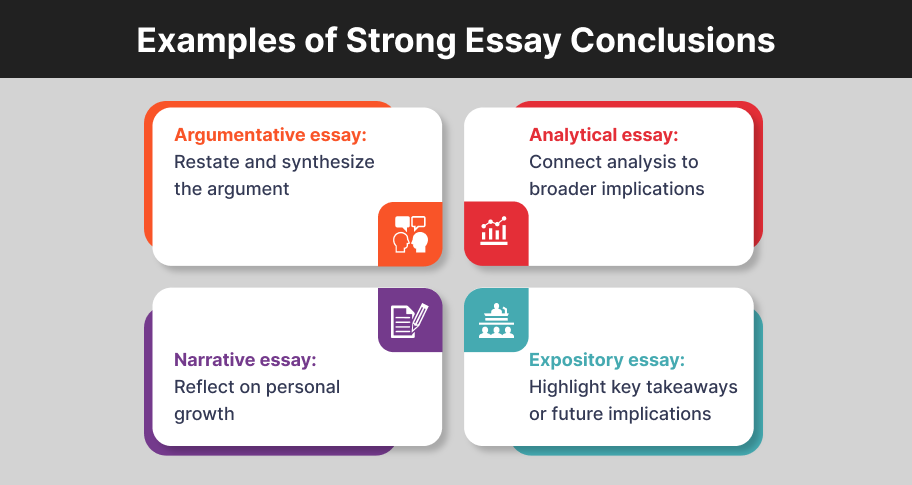
Examples of Strong Essay Conclusions
Argumentative Essay Conclusion
Topic – "The Impact of Social Media on Mental Health"
Social media's influence on mental health is undeniable. Platforms like Instagram and TikTok can help to build up connections and community, but they can also contribute to heightened anxiety and depression, especially among younger users. As of 2026, the U.S. Surgeon General's ongoing calls for social media warning labels and mounting legislative pressure around algorithmic transparency underscore just how seriously policymakers are beginning to take this issue. Through a restatement of the facts presented—social media's role in amplifying insecurities, fostering comparison culture, and leading to negative self-perception—it's clear that more responsible usage and policy intervention are necessary. Ultimately, society must decide if the conveniences of social media outweigh its detrimental effects on well-being. As our online interactions grow, so does our responsibility to safeguard mental health in this digital age.
Analytical Essay Conclusion
Topic – "Symbolism in 'The Great Gatsby'"
In The Great Gatsby, F. Scott Fitzgerald masterfully uses symbolism to represent the futility of the American Dream. The green light, Daisy's voice, and the valley of ashes each serve as reminders of the illusions that characters chase. Gatsby's ultimate downfall symbolizes the emptiness of pursuing material success and social status at the expense of personal fulfillment. By analyzing these symbols, readers understand that the novel is not just about one man's dream, but about the collective disillusionment of an entire society. Gatsby's failure forces us to question the very nature of ambition and success in America—a question that feels no less urgent today than it did when Fitzgerald first put it to us a century ago.
Narrative Essay Conclusion
Topic – "A Personal Experience with Failure"
My first major failure taught me more about resilience than any success ever could. When I didn't get into my dream college, I thought my future was over. But that rejection pushed me to reevaluate my goals, discover new passions, and find opportunities I hadn't previously considered. What I once saw as a dead-end became the foundation for a more rewarding path. Looking back, I realize that failure wasn't a step back but a redirection. It helped me build perseverance, adaptability, and most importantly, a clearer vision for my future.
Expository Essay Conclusion
Topic – "Climate Change and Its Effects on Global Agriculture"
Climate change has already begun to reshape global agriculture, with devastating consequences for food security. Rising temperatures, unpredictable weather patterns, and droughts are affecting crop yields across the world. According to the UN Food and Agriculture Organization's most recent assessments, climate-related disruptions now threaten the livelihoods of over 600 million smallholder farmers globally—a figure that continues to climb. While some regions may benefit from longer growing seasons, the overall impact on biodiversity, soil health, and farming communities is overwhelmingly negative. Immediate action to mitigate climate change and invest in sustainable farming practices is critical to ensuring that future generations can rely on a stable food supply. The effects are here, and we must act now to adapt and protect our agricultural future.
Persuasive Essay Conclusion
Topic – "Why College Should Be Free"
The debate surrounding free college education is not just about access to higher learning; it's about economic justice. As tuition costs continue to outpace inflation and student loan debt in the U.S. surpasses $1.7 trillion, more and more students are burdened with financial obligations that shape—and often constrain—their entire adult lives. By making college tuition-free, the government can empower young people to pursue their dreams without the shackles of debt. Moreover, the benefits of an educated workforce ripple throughout the economy, improving productivity and innovation. It's time for the U.S. to join other countries that have prioritized education as a public good, not a privilege for the wealthy.
Different Types of Essay Conclusions
- Narrative Essay Conclusions
- Expository Essay Conclusions
- Persuasive Essay Conclusions
Narrative Essay Conclusions
In a narrative essay, the conclusion often reflects on the personal story you've shared. To craft an effective narrative conclusion, focus on tying up the narrative arc while providing reflective insights. The goal is to show how the events discussed in the essay have impacted you or contributed to a broader understanding. You might highlight a lesson learned, a change in perspective, or an emotional takeaway.
For example, if your essay was about overcoming a personal challenge, your conclusion could explore how that experience shaped who you are today. The conclusion of a narrative essay should feel introspective, offering readers a deeper understanding of the writer's journey and encouraging them to reflect on their own experiences.
The best narrative conclusions don't just wrap up a story—they reframe it. They invite the reader to see the opening scene of the essay differently now that they know how it ends. If your essay opened with a moment of confusion or fear, your conclusion might return to that same moment and illuminate it from the vantage point of hard-won experience. That kind of circular structure, when done well, gives a narrative essay a satisfying sense of wholeness that lingers with the reader.
Expository Essay Conclusions
In expository essays, where the goal is to inform or explain a topic, the conclusion should restate the key facts while leaving the reader with something to ponder. Avoid merely summarizing the information provided; instead, synthesize the facts and highlight their significance.
For example, if your expository essay is about the benefits of renewable energy, your conclusion might revisit those benefits but also encourage readers to think about the future implications of transitioning to greener energy sources. Ending with a thought-provoking question or a forward-looking statement can leave a lasting impression on your audience, ensuring they continue to reflect on the topic even after finishing the essay.
A well-executed expository conclusion also performs a subtle but important function: it validates the reader's time. After pages of information, data, and explanation, the reader deserves a moment of clarity that tells them what it all adds up to. That moment of clarity—delivered through a confident, synthesizing final paragraph—is what transforms a well-researched report into a genuinely educational piece of writing.
Persuasive Essay Conclusions
In a persuasive essay, the conclusion is your final opportunity to compel readers to action or agreement. After restating your main argument, emphasize why it matters and what readers can do next.
For example, if you're writing about the importance of reducing e-waste, end with a call to action, urging readers to make small changes in their daily lives, how they think of electronics, and what they can do to eliminate e-waste. A strong, persuasive conclusion leaves readers motivated to act. It asks them to reconsider their beliefs. Or, it allows you to share your perspective, thereby elevating the persuasive power of your essay.
In persuasive writing, the emotional register of your conclusion matters just as much as the logical one. By the time a reader reaches your final paragraph, you've laid out your evidence and your reasoning—now is the moment to remind them that this argument isn't just intellectually sound, it's personally relevant to them. Connecting your call to action to something the reader actually cares about—their community, their finances, their children's future—transforms a general argument into a personal imperative. That's when persuasion stops being rhetoric and starts becoming real.
Conclusion
Mastering the art of writing strong essay conclusions takes practice, but it's a crucial skill for any student. A well-crafted conclusion ties the essay together and ensures that your main points resonate with the reader long after they finish reading. As you practice writing conclusions, remember to reflect on the purpose of your essay and tailor your closing remarks accordingly.
Additionally, tools like Grammarly or the Hemingway Editor remain incredibly useful for refining your writing, ensuring clarity, and checking for repetitive phrasing or grammatical errors—both have continued to expand their capabilities in 2026, with smarter style suggestions and more nuanced feedback than ever before. With practice and attention to detail, your essay conclusions will become more impactful and polished.
It's also worth developing a personal revision ritual specifically for conclusions. After finishing a full draft, return to your conclusion last. Read the introduction and the conclusion back to back, without reading anything in between. Ask yourself: does the conclusion feel like the earned destination of the journey that the introduction promised? If there's a disconnect—if the conclusion feels like it belongs to a different essay—revise until the two bookends of your essay feel like they were written in the same voice, toward the same destination, with full awareness of everything that came between them.
Get help with your essay
Browse 130,000+ paper examples, use our AI writing assistant, generate citations and outlines — all included.
Sign Up Now →