Complete Guide to Essay Format: MLA, APA, and Chicago Explained
MLA, APA, and Chicago each have distinct rules for margins, citations, and structure — master all three here so formatting never costs you points again.
📋 Table of Contents (12 sections) ▼
- Introduction
- What is Proper Essay Format?
- Importance of Following Proper Format
- Overview of Main Formats
- Standard College Essay Format
- How Do You Format an Essay in MLA?
- How Do You Format an Essay in APA?
- How Do You Format an Essay in Chicago Style?
- What's the Difference Between MLA, APA, and Chicago?
- Special Essay Formats
- Additional Formatting Tips
- Conclusion
🔑 Key Takeaways
- MLA, APA, and Chicago are the three major style guides; your discipline or instructor decides which you use.
- They differ most in citations: MLA = author–page + Works Cited; APA = author–date + References; Chicago = Notes–Bibliography or Author–Date.
- Page layout is nearly identical across all three: 1-inch margins, a readable 12-pt font, and double spacing.
- Titles: MLA and Chicago use Title Case; APA uses sentence case for the titles of works.
- Pick one style and apply it consistently — never mix formats in one paper.
MLA, APA, and Chicago are the three most common essay formats, and they differ mainly in citations, not page layout. MLA uses author–page citations with a Works Cited page, APA uses author–date with a References list, and Chicago offers a notes-and-bibliography or author–date system — while all three share 1-inch margins and double spacing.
Essay format is the set of layout rules that control how an essay looks on the page — margins, font, line spacing, headings, title page, and citations. A standard essay has three parts: an introduction that ends in a thesis, body paragraphs that support it with evidence, and a conclusion. Most schools require a specific style — MLA, APA, or Chicago — which sets the exact formatting details below.
Introduction
Content is king, but mastering the mechanics of academic writing is equally important. That's why formatting your essay matters. Proper formatting allows you to present your essays and term papers clearly, logically, and academically so that it is easy for readers to follow your argument and for instructors to assess your work. Poor formatting, on the other hand, can lead to point deductions, even if the content of your essay is strong. In 2026, with more courses being submitted digitally and increasingly reviewed through plagiarism-detection and AI-assisted grading platforms, consistent and correct formatting matters more than ever — instructors can spot deviations from style guidelines almost instantly.
What is Proper Essay Format?
The format of an essay refers to its basic structure, layout, and appearance on the page. It includes elements such as margins, font size, line spacing, and citation style, among others. Although it may seem daunting at first, mastering the different essay formats is not as difficult as it might appear. The more essays you write, the more familiar you will become with these formats. (Check out this article for more info on how to write an essay). Think of formatting as a shared language between you and your reader: when you follow the agreed-upon conventions, you signal that you understand the academic community you are writing for, and you make it easier for that reader to focus on what you are actually saying rather than how you have presented it.
Importance of Following Proper Format
Understanding and applying the correct essay format is essential for several reasons. First, it demonstrates your attention to detail and your ability to follow academic conventions. Proper formatting also improves the readability of your essay, allowing your ideas to be presented in a clear and organized manner. Proper formatting is what lets you meet the academic standards expected in your field of study. Beyond grades, these habits carry into professional life: grant applications, journal submissions, legal briefs, and policy reports all depend on consistent, recognizable formatting to be taken seriously by reviewers. Developing these habits now means you will not have to build them from scratch later. Additionally, many universities in 2026 use automated submission systems that flag formatting inconsistencies before a paper even reaches the instructor, making early mastery of these rules a genuine time-saver.
Overview of Main Formats
There are several widely recognized essay formats, each commonly used in different academic disciplines. The Modern Language Association (MLA) format is often used in the humanities, particularly in literature and language studies. The American Psychological Association (APA) format is typically used in the social sciences, such as psychology and education. The Chicago Manual of Style, or Chicago format, is frequently used in history and some social science fields. Each format has its own set of rules for citations, references, and overall layout. It is worth noting that each of these style guides is periodically updated by its governing organization: MLA is currently in its 9th edition, APA in its 7th edition, and the Chicago Manual of Style in its 18th edition (released in 2024). Always confirm which edition your institution or instructor requires, as rules can shift meaningfully between versions.
Standard College Essay Format
There is no universally "right" college essay format, but we do have some commonly accepted guidelines. Professors may have specific preferences, so understanding the standard structure and formatting rules will help you adapt to any requirements. As a practical starting point, most word processors — including Microsoft Word, Google Docs, and Apple Pages — offer built-in templates or style presets that approximate these standard guidelines. While those templates are a helpful baseline, always cross-check them against your instructor's assignment sheet, since default settings do not always match academic style requirements exactly.
Basic Components of Any Essay
- Title Page: This usually includes the title of your essay, your name, the course name, the instructor's name, and the date of submission. The title should be centered and written in a standard font, without italics or underlining. Some styles, like APA, have detailed title-page requirements; others, like MLA, dispense with a separate title page altogether and place identifying information at the top of the first page of text.
- Introduction: The introduction is the opening paragraph of your essay, where you present the topic and your thesis statement. It should contain a hook, a brief overview of the main points that will be discussed in the body of the essay, and your main point. A strong introduction draws the reader in immediately — whether through a surprising statistic, a thought-provoking question, or a vivid illustrative scenario — before narrowing toward the thesis.
- Body: The body of the essay is where you develop your arguments or analysis in detail. Each paragraph of the body should focus on a specific point or piece of evidence that supports your thesis. A well-constructed body paragraph typically opens with a topic sentence, presents evidence or analysis, explains how that evidence supports the thesis, and transitions smoothly to the next paragraph.
- Conclusion: The conclusion is the final paragraph of your essay, where you summarize the main points and restate your thesis in light of the evidence presented. It should contain no new info, but should leave a lasting impression on the reader so as to reinforce the significance of your essay. The most effective conclusions zoom outward — showing why your argument matters beyond the immediate scope of the paper.
- Bibliography: Also known as the Works Cited or References page, the bibliography lists all the sources you cited in your essay. The format of the bibliography varies depending on the citation style (MLA, APA, Chicago, etc.), but it typically includes the author's name, title of the work, publication information, and date. In 2026, a growing proportion of academic sources are digital-first or online-only, so be sure to include DOIs (Digital Object Identifiers) or stable URLs wherever required by your chosen style.
General Formatting Rules
- Fonts: Standard college essays typically use a uniform font for consistency and readability. Times New Roman is the most widely accepted font, though Arial is sometimes permitted. The font size is usually set to 12 points. Font should be consistent across the entire document. Some style guides, particularly the 7th edition of APA, now explicitly permit a wider range of accessible fonts — including Calibri 11pt, Arial 11pt, and Georgia 11pt — in addition to the traditional Times New Roman 12pt, so always verify what your specific style or instructor requires.
- Line Spacing: Most college essays require double spacing. Occasionally, you may be asked to use single spacing or 1.5 spacing, depending on the instructor's preference or the specific assignment guidelines. Double spacing is strongly preferred in most academic contexts because it gives instructors and peer reviewers room to write inline comments, and it improves readability on screen and in print alike.
- Margins: The standard margin size for college essays is one inch on all sides (top, bottom, left, and right). This margin size is typically the default setting in Word. Be cautious if you are working in Google Docs, where the default margin can sometimes be set to slightly different measurements — always manually verify your margin settings before submitting.
- Page Numbers: Including page numbers in your essay is generally expected, especially for longer assignments. Page numbers are usually placed in the upper right corner of each page, sometimes accompanied by your last name or the title of the essay. Page numbers are inserted through the "header and footer" function in most word processors; avoid manually typing them, as this can cause numbering errors if you later add or remove content.
- Title Page: Short essays often do not require a title page, but for longer essays or research papers, a title page will probably be mandatory. If required, the title page should follow the specific format outlined by your instructor (APA, MLA, etc.), typically including the title of the essay, your name, course details, and submission date.
How Do You Format an Essay in MLA?
MLA Structure and Layout
MLA format is known for its simplicity. Governed by the Modern Language Association and currently in its 9th edition, MLA is the go-to style for courses in English, comparative literature, foreign languages, cultural studies, and related humanities disciplines. The 9th edition, which is the current standard in 2026, introduced a more flexible, principle-based approach to citing sources — particularly useful given the proliferation of podcasts, social media posts, online databases, and other non-traditional source types that students now regularly cite. The following are the basic components of an essay written in MLA format:
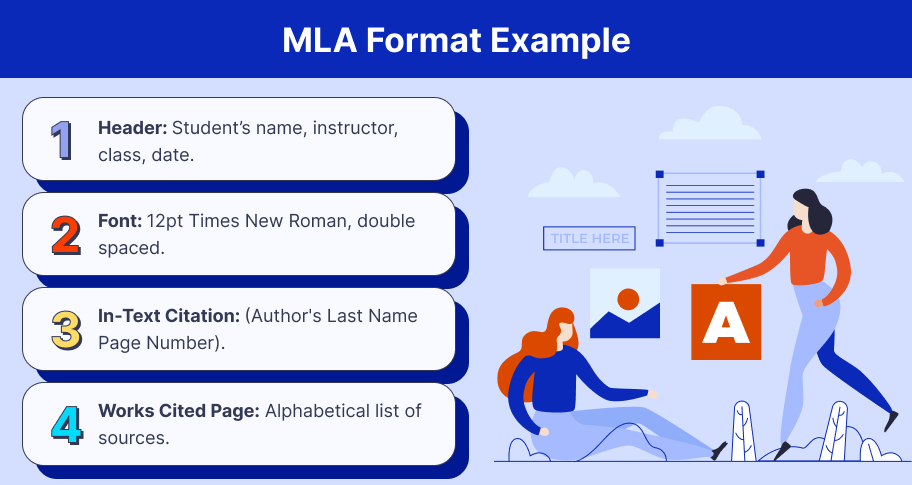
- 12-Point Font (Times New Roman): Times New Roman in 12-point font is the standard typeface used in MLA format. Some instructors now accept Calibri or Arial at 12-point as well, but when in doubt, default to Times New Roman to be safe.
- First Line Indent: Each paragraph in an MLA-formatted essay begins with an indentation of the first line, typically set at half an inch from the left margin. This indentation visually separates paragraphs, which makes the essay easy to read. Use the paragraph indent setting in your word processor rather than pressing the Tab key, which can produce inconsistent spacing across devices.
- Double-Spacing: The entire essay should be double-spaced, including the text, block quotes, and the Works Cited page. Double spacing should be consistent throughout. It is especially helpful as it allows space for instructors to make annotations. Note that block quotations — used for prose passages of more than four lines — are also double-spaced in MLA, but are indented half an inch from the left margin without additional quotation marks.
- 1-Inch Margins: MLA format requires uniform 1-inch margins on all sides of the page (top, bottom, left, and right), which keeps the page balanced in appearance.
- Header: Unlike APA format, MLA does not usually require a title page. Instead, your name, your professor's name, the course name, and the date should be listed in the upper left-hand corner of the first page. Below this information, the title of the essay should be centered and written in standard title case (capitalizing the first and main words of the title). A header with your last name and page number should appear in the upper right corner of each page, beginning with the first page. The date in an MLA header is written in day-month-year format (e.g., 15 March 2026), which differs from the month-day-year convention used in everyday American English writing.
MLA In-Text Citations and Works Cited
MLA format has specific guidelines for citing sources both within the text and in the Works Cited page. These citations are crucial for giving credit to the original authors and for allowing readers to trace the sources of your information. The 9th edition of MLA has streamlined citation construction by encouraging writers to think in terms of a consistent set of core elements — author, title of source, title of container, contributors, version, number, publisher, publication date, and location — rather than memorizing separate templates for each source type. This makes it considerably easier to handle newer source formats like YouTube videos, streaming series episodes, or database articles.
- In-Text Citations: In MLA format, in-text citations are brief and are usually placed at the end of the sentence before the period. They include the author's last name and the page number where the information was found, all within parentheses. For example: (Smith 123). If the author's name is mentioned in the sentence, only the page number is required in the citation: (123). Even when paraphrasing or summarizing, the page number must be included, which can be a challenge but is essential to meet MLA standards. For digital sources that lack page numbers, MLA allows the use of paragraph numbers, section headings, or simply the author's name alone, depending on what is available.
- Works Cited Page: The Works Cited page appears at the end of the essay and lists all the sources referenced in your paper. Each entry should be formatted with a hanging indent, where the first line of the citation is flush with the left margin, and subsequent lines are indented. Entries are listed alphabetically by the author's last name or by the title if no author is provided. The general format for a book citation in MLA is: Author's Last Name, First Name. Title of Book. Publisher, Year of Publication. For a webpage or online article, the format adds the URL or DOI and, where relevant, the date you accessed the source — particularly important for content that may change over time.
MLA Common Mistakes to Avoid
While MLA format is straightforward, there are common mistakes that students often make:
- Incorrect In-Text Citations: Failing to include the page number, using the wrong format for the author's name, or placing the period outside the parentheses are frequent errors. Always double-check your in-text citations for accuracy. A particularly common mistake is placing the period before the closing parenthesis — in MLA, the period follows the parenthetical citation, not the other way around.
- Improper Works Cited Formatting: Not following the correct order, incorrect use of italics or quotation marks, and missing publication details are common pitfalls. Ensure each entry adheres to MLA guidelines. Remember that in MLA, book and journal titles are italicized, while article titles and chapter titles are placed in quotation marks.
- Missing or Incorrect Header: Forgetting to include the header with your last name and page number on each page can lead to a lower grade. Also, ensure that the header is properly aligned with the right margin.
- Inconsistent Formatting Across Source Types: With the wide variety of sources students use in 2026 — including podcasts, TED Talks, Twitter/X threads, and online-only journals — it can be tempting to format digital sources differently from print ones. The 9th edition of MLA provides a unified framework for all source types; apply the core elements consistently regardless of the medium.
Example of MLA Format
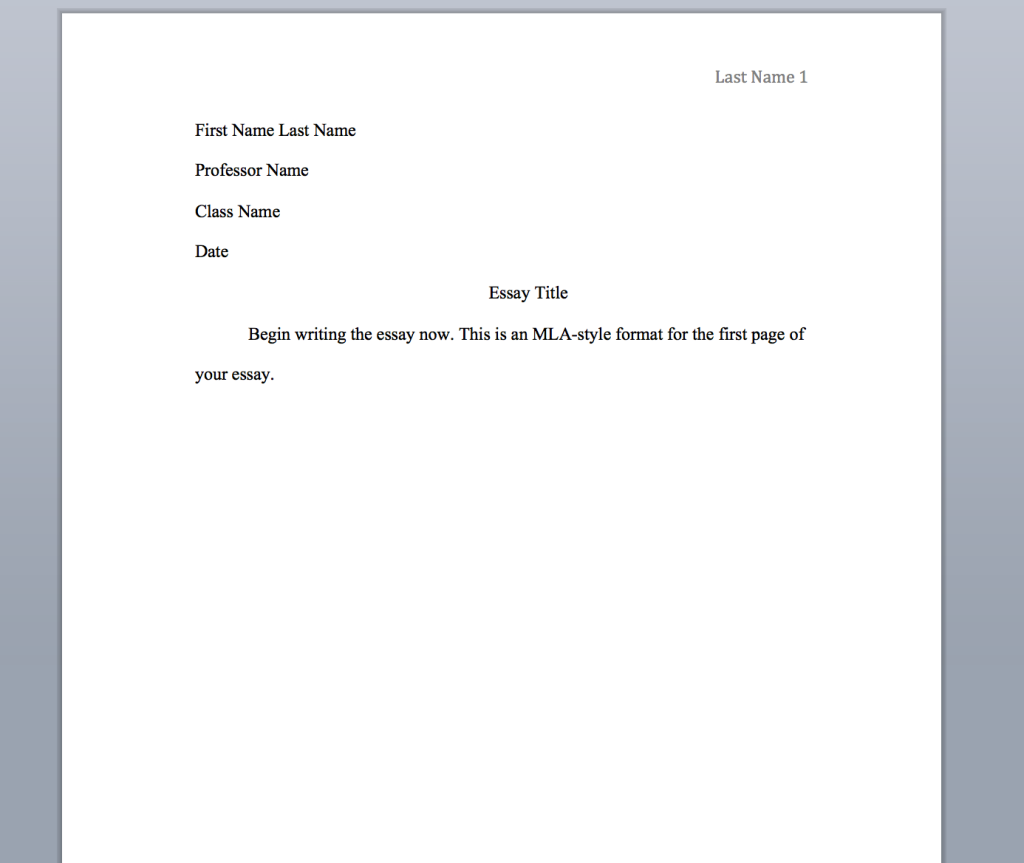
Here's a simplified example of how the first page of an MLA-formatted essay might look:
First Page of an MLA Paper:
MLA Format Example
Smith 1                          # header: last name + page number, top-right, every page

Jane Smith
Professor Alvarez
English 102
14 March 2026

                    The Cost of Convenience     # title: centered, not bold

    Modern consumers rarely pause to consider the true price of
    same-day delivery...

# readable 12-pt font (e.g. Times New Roman); double-spaced; 1-inch margins; no title page
How Do You Format an Essay in APA?
APA Structure and Layout
APA format follows a set structure that includes a title page, abstract, body, and references. Published by the American Psychological Association and currently in its 7th edition, APA is the dominant citation and formatting style across the social and behavioral sciences — including psychology, sociology, education, communication, nursing, and public health. The 7th edition, which remains the current standard in 2026, introduced several significant updates from the 6th edition: it expanded acceptable font options, changed the running head requirements for student papers (student papers no longer require a running head on every page), and updated the rules for citing online sources to reflect the ubiquity of DOIs. If you learned APA from an older guide or textbook, it is worth verifying that you are working from 7th-edition rules.
- Title Page: The title page in APA format is crucial as it sets the tone for your paper. It includes the title of your essay, your name, and your institutional affiliation, all centered on the page. The title should be concise and informative, reflecting the content of your paper. Below the title, your name appears, followed by your institution (e.g., university name). Some instructors may ask for additional information like the course title, instructor's name, and the date. Under the 7th edition, student papers and professional papers have slightly different title page requirements — student papers include the course number and name, instructor name, and assignment due date, while professional papers include an author note and running head. Always clarify with your instructor which version applies to your assignment.
- Abstract: The abstract is a brief summary of your paper, usually between 150-250 words. It gives a summary of your research, including the research question, methods, results, and conclusions. The abstract appears on its own page, right after the title page, and is typically a single paragraph without indentation. Abstracts are used in longer research papers and dissertations to give readers a quick snapshot of the study's content and findings. Note that the 7th edition also introduced an optional list of keywords below the abstract, which helps readers and database search engines locate your paper by topic. Keywords are written in lowercase, separated by commas, and preceded by the italicized label Keywords:.
- Body: The body of an APA paper is where you present your argument or findings. It starts on a new page after the abstract and is divided into sections such as the introduction, method, results, discussion, and conclusion, depending on the type of paper you are writing. Each section may include subheadings to improve organization and readability. In empirical research papers, this IMRD structure (Introduction, Methods, Results, Discussion) is standard; in literature reviews or theoretical papers, the sections are organized more thematically.
- References: The reference page, which comes at the end of your paper, lists all the sources cited in the text. This page follows specific APA formatting rules, including the use of a hanging indent and alphabetical order by the authors' last names. The reference entries must include detailed information about each source, such as the author's name, publication year, title of the work, and source. Under the 7th edition, up to 20 authors can be listed in a reference entry before an ellipsis is used to shorten the list — a change from the previous rule that required an ellipsis after the sixth author.
- Font & spacing: a readable 12-pt font (Times New Roman, Calibri, or Arial), double-spaced, with 1-inch margins.
- References page: hanging indent, entries listed alphabetically by author’s last name.
- Authors: up to 20 may be listed before an ellipsis (APA 7th edition).
APA In-Text Citations and References
APA style uses the author-date citation method, which includes the author's last name and the publication year in the text. This method allows readers to locate the full citation in the reference list easily. The author-date system is particularly well-suited to scientific and social-scientific writing because it immediately signals the recency of a source — a relevant consideration in fields where a study published even five years ago may have been superseded by newer research.
- In-Text Citations: In-text citations in APA format are concise. For example, if you're citing a book by John Doe published in 2024, the citation would appear as (Doe, 2024). If you directly quote a source, you must also include the page number: (Smith & Wesson, 2023, p. 15). These citations are usually placed at the end of a sentence before the period. When citing sources with three or more authors, the 7th edition simplifies the citation to include only the first author's last name followed by "et al." from the very first citation — a change from the 6th edition, which previously listed all authors up to five on the first mention.
- References: Every in-text citation must correspond to an entry in the reference list. The reference list provides full details about the source, formatted in a specific way. For a book, the format is: Author's Last Name, First Initial(s). (Year). Title of the book. Publisher. For a journal article, the format includes the article title (sentence case, no italics), the journal name (italicized, title case), the volume number (italicized), the issue number (in parentheses, not italicized), and the page range, followed by the DOI if available. Including the DOI is now strongly preferred by APA for any source that has one, since DOIs provide a stable, persistent link to digital content.
APA Headings and Subheadings
Headings and subheadings are essential in APA format as they help organize the content and guide readers through the paper. APA uses a specific hierarchy of headings:
- Level 1 Heading: Centered, Bold, Title Case (e.g., Introduction)
- Level 2 Heading: Flush Left, Bold, Title Case (e.g., Review of Literature)
- Level 3 Heading: Flush Left, Bold Italic, Title Case (e.g., Quantitative Studies)
- Level 4 Heading: Indented, Bold, Title Case, ending with a period. Used as a run-in heading at the start of a paragraph.
- Level 5 Heading: Indented, Bold Italic, Title Case, ending with a period. Also used as a run-in heading.
Subheadings break down sections into more detailed parts, making your essay easier to follow. You should only use as many heading levels as your paper actually requires — most undergraduate papers need no more than two or three levels. Avoid using a Level 2 heading unless there are at least two subsections under the corresponding Level 1 heading; a single lonely subheading is a sign that the content might be better integrated into the surrounding text.
Example of APA Format
APA Format Example (Student Paper)
Title page (page 1)                          # page number "1" in top-right

                    The Cost of Convenience    # title: bold, centered, upper third

                         Jane Smith
           Department of English, State University
                ENG 102: Composition II
                   Professor Alvarez
                     March 14, 2026

Body (new page):
                    The Cost of Convenience     # title repeated: bold, centered
    Modern consumers rarely pause to consider...

# one of several allowed fonts (e.g. 12-pt Times New Roman or 11-pt Calibri); double-spaced; 1-inch margins
How Do You Format an Essay in Chicago Style?
Overview of Chicago Style
Chicago style follows a standard set of formatting guidelines. The Chicago Manual of Style is published by the University of Chicago Press and is currently in its 18th edition, released in 2024. The 18th edition brought a number of updates relevant to students, including revised guidance on citing social media, AI-generated content, and other digital sources that have become increasingly common research materials. If you are working from an older Chicago style guide, it is worth checking whether your institution has adopted the 18th edition yet, as citation rules for online sources changed notably. Chicago style is widely used in history, art history, religious studies, and some areas of political science and economics. The formatting guidelines include:
- 12-Point Font (Times New Roman): Chicago style typically uses Times New Roman in 12-point font, which is considered a classic and highly readable typeface. As with other style guides, some instructors accept comparable serif fonts; when uncertain, default to Times New Roman.
- First Line Indent: Each paragraph should begin with a half-inch indent, creating a clear separation between sections of text. Block quotations of five or more lines are indented from the left margin as a whole, without quotation marks, and are single-spaced (note the difference from MLA, which double-spaces block quotes).
- Double-Spacing: The entire document, including block quotes, notes, and bibliography, should be double-spaced, providing ample room for comments or corrections. An exception applies to footnotes themselves: in many Chicago-style papers, footnotes are single-spaced internally but separated from one another by a blank line.
- 1-Inch Margins: Chicago style requires 1-inch margins on all sides of the page, which is standard for most academic papers.
Chicago style is known for its flexibility, especially in the way it handles citations. Unlike MLA or APA formats, which rely on in-text parenthetical citations, Chicago style allows for the use of either footnotes or endnotes, which are a less obtrusive way to cite sources. This flexibility also extends to the bibliography: Chicago's Notes and Bibliography system uses a full bibliography, while the less common Author-Date system uses a reference list formatted similarly to APA. Historians in particular favor the Notes and Bibliography system because footnotes allow them to include discursive commentary — brief explanatory notes that contextualize a source or flag a scholarly debate — without interrupting the flow of the main text.
Chicago Footnotes vs. Endnotes
- Footnotes: Footnotes appear at the bottom of the page on which the reference is made. They are numbered consecutively throughout the essay. Footnotes are preferred when you want the reader to have immediate access to the source or explanation while reading the text. For example, after quoting a source, a small superscript number is placed at the end of the sentence, corresponding to a footnote at the bottom of the page, where full citation details are provided. The first time you cite a source in a footnote, you provide the full citation; subsequent citations of the same source use a shortened form (author's last name, shortened title, and page number).
- Endnotes: Endnotes, like footnotes, are numbered consecutively but are placed at the end of the essay, just before the bibliography. Endnotes are often used in longer works where multiple citations might overwhelm the page layout. While they serve the same purpose as footnotes, they require the reader to flip to the end of the document to see the citation, which some writers prefer to keep the main text uncluttered. In digital submissions — increasingly common in 2026 — endnotes are often hyperlinked, making navigation between the main text and the notes seamless for the reader.
Both footnotes and endnotes in Chicago style include detailed citation information, such as the author's name, title of the work, publication details, and page numbers. The choice between footnotes and endnotes often depends on the nature of the paper and the instructor's preference. When in doubt, ask your instructor which they prefer — many history professors have a strong opinion one way or the other.
- Notes: numbered footnotes or endnotes, each matching a superscript marker in the text.
- Citation detail: author’s name, title of the work, publication details, and page numbers.
- Footnotes vs. endnotes: the choice depends on the paper and your instructor’s preference.
Chicago Bibliography Format
The bibliography in Chicago style lists all sources referenced in the paper. The bibliography page appears at the end of the essay and should follow these guidelines:
- Alphabetical Order: Entries in the bibliography are listed alphabetically by the author's last name. If no author is provided, the title of the work is used. For works with multiple authors, only the first author's name is inverted (Last, First); subsequent authors are listed in normal order (First Last).
- Hanging Indent: Each entry begins flush with the left margin, and subsequent lines are indented by half an inch. This format is known as a hanging indent. The hanging indent makes it visually easy for a reader to scan down the left margin to find a specific author's name.
- Detailed Citations: Each entry should include the author's name, the title of the work (italicized for books and journals; in quotation marks for articles and chapters), the place of publication, the publisher, and the year of publication. For example: Smith, John. The History of Modern Europe. New York: Random House, 2020. For online sources, include the URL or DOI and an access date if the content is likely to change. The 18th edition of the Chicago Manual of Style provides updated guidance on citing AI-generated content: if you use an AI tool in your research process, disclose it in a note or the bibliography according to your institution's policies and the 18th edition's recommendations.
Example of Chicago Format
Here's an example of how a Chicago-style essay might look:
Title Page Example:
What's the Difference Between MLA, APA, and Chicago?
Here is how MLA, APA, and Chicago compare on the essentials that actually differ. For the complete mechanics of each style, use the deep-dive guides: the full MLA citation guide, the full APA citation guide, and the full Chicago citation guide.
| Element | MLA (9th, 2021) | APA (7th, 2019) | Chicago (18th, 2024) |
|---|---|---|---|
| Citation system | Author–page | Author–date | Dual system: Notes–Bibliography (superscript note) and Author-Date |
| In-text form | (Smith 42) | (Smith, 2020, p. 42) | Superscript¹ → footnote/endnote, or (Smith 2020, 42) |
| Reference list title | Works Cited | References | Bibliography (Notes) / Reference List (Author-Date) |
| Author name | Last, First (full) | Last, F. M. (initials) | Last, First (full) |
| Title capitalization | Title Case | Sentence case | Title Case |
| Article/source title | “In quotation marks” | Plain (sentence case) | “In quotation marks” |
| Date placement | End of entry | In parentheses after author | End of note (Notes) / after author (Author-Date) |
| Publisher city | Not used | Not used | Dropped in the 18th edition — no publisher city (was required in the 17th) |
Conventions vary by edition and instructor — always confirm against your assignment or the official manual. For the deep mechanics of each style, follow the citation-guide links above.
| Element | MLA (9th ed.) | APA (7th ed.) | Chicago (17th ed. / Turabian) |
|---|---|---|---|
| Margins | 1 inch, all sides | 1 inch, all sides | At least 1 inch, all sides |
| Font | 12-pt, easily readable typeface (Times New Roman common); regular type must contrast clearly with italics | Several options — e.g., 12-pt Times New Roman, 11-pt Calibri, 11-pt Arial, or 11-pt Georgia | Recommends a readable typeface at 12-pt (Times New Roman common) — not mandated |
| Line spacing | Double-spaced throughout | Double-spaced throughout | Double-spaced body; single-spaced notes & bibliography (blank line between entries) |
| Title page | None by default — first-page header block (name, instructor, course, date), title centered | Required (student & professional versions) | Separate title page common (Turabian standard), left unnumbered |
| Citations | In-text parenthetical (Author page) + Works Cited | In-text (Author, year) + References | Notes–Bibliography (footnotes/endnotes + Bibliography) or Author-Date |
| Page header | Last name + page number, top-right of every page | Page number top-right on every page (student papers need no running head; professional papers do) | Page numbers top-right or bottom-center; title page counted but unnumbered |
Citation Styles
- MLA (Modern Language Association): MLA style is typically used in the humanities, particularly in literature, philosophy, and the arts. Citations are made using brief parenthetical references within the text, including the author's last name and page number (e.g., Mason 413). The full citation details are provided in a Works Cited page at the end of the document. MLA's 9th edition has made this system even more flexible by establishing a single core-elements framework that works across all source types, from printed books to TikTok videos.
- APA (American Psychological Association): APA format is prevalent in the social sciences, including psychology, sociology, and education. It uses the author-date method for in-text citations, where the author's last name and the year of publication are included (e.g., Como, 2020). A References page at the end lists all sources in full detail. The emphasis on the publication date in every in-text citation reflects the social sciences' strong priority on source recency — a 2010 study and a 2024 study may draw very different conclusions even on the same topic.
- Chicago Style: Chicago style, often used in history, political science, and the arts, offers two citation methods: the Notes and Bibliography system, which uses footnotes or endnotes along with a bibliography, and the Author-Date system, similar to APA but less commonly used. Footnotes or endnotes provide detailed source information at the bottom of the page or at the end of the paper, making this style flexible for detailed commentary. The 18th edition of the Chicago Manual of Style, released in 2024, is the current authoritative reference for this style.
Paper Structure
The structure of a paper also varies among these formats:
- MLA: MLA format is straightforward, typically consisting of a title page (optional), an introduction, body paragraphs, and a conclusion. It does not require a separate title page; instead, the student's name, instructor's name, course, and date are placed at the top of the first page. This minimalist approach reflects the humanities tradition of treating the essay as a continuous, flowing argument rather than a segmented research report.
- APA: APA format is more structured and includes a title page, abstract, main body, and references. The title page presents the title, author's name, and institutional affiliation, while the abstract provides a brief summary of the paper. APA also often uses headings and subheadings to organize content clearly. This structured, sectioned approach mirrors the format of journal articles in the social and behavioral sciences, helping to familiarize students with the conventions of professional research writing in those fields.
- Chicago: Chicago format is flexible and can vary based on the type of paper. A typical Chicago-style paper includes a title page, the main body of text, and a bibliography. When using the Notes and Bibliography system, Chicago style also incorporates footnotes or endnotes, which can make the structure appear more complex. This complexity, however, is also an asset: the footnote system allows a Chicago-style paper to carry on two conversations at once — the main argument in the body and a supplementary scholarly dialogue in the notes.
Where and When to Use Each Format
Each format is suited to specific academic disciplines:
- MLA: Best used in humanities subjects, especially in writing-intensive courses where the focus is on literary analysis, criticism, or cultural studies. If you are writing a close reading of a novel, analyzing a poem, or comparing two works of film criticism, MLA is almost certainly the right choice.
- APA: Ideal for the social sciences, where research often involves data analysis, experiments, and empirical studies. APA's structured format helps present research findings clearly. It is also the standard in many nursing and allied health programs, where citing up-to-date clinical research is essential.
- Chicago: Often required in history, art history, and some social sciences. It is particularly useful when extensive citation or commentary is needed, thanks to its footnote and endnote options. If your paper involves primary source analysis — archival documents, historical newspapers, legal records — Chicago's Notes and Bibliography system gives you the flexibility to cite these non-standard sources accurately.
A practical rule of thumb: if your instructor has not specified a format, look at the style used in the assigned readings for the course. Courses in English and the arts tend to assign MLA-formatted articles; courses in psychology and education assign APA-formatted journal articles; courses in history assign Chicago-formatted monographs. The readings are a strong signal about what style your instructor expects.
Special Essay Formats
When you're applying for a scholarship, submitting a college application, or crafting a research or persuasive essay, know that each format has unique elements that guide how you should present your work. Understanding these specialized formats is just as important as knowing the standard academic styles, particularly because mistakes in high-stakes submissions — scholarship applications, college admissions portals — can be difficult or impossible to correct after the deadline.
Scholarship Essay Format
Scholarship essays are critical for students aiming to secure financial aid for their education. Unlike standard academic essays, a scholarship essay is deeply personal and written in the first person. It focuses on your achievements, goals, and reasons for deserving the scholarship. Here are some key aspects of the scholarship essay format:
- 12-Point Font (Times New Roman or Arial): This is the standard for readability. If the scholarship organization specifies a different font, follow their instructions precisely.
- First Line Indent: Each paragraph should begin with an indentation, creating a clear structure.
- Double-Spacing: Double-spacing improves readability and allows room for comments.
- 1-Inch Margins: Standard margins provide a clean, professional look.
- Word Count Compliance: Most scholarship prompts specify a word or character count. Staying within the specified range is as important as any formatting requirement — exceeding it signals that you cannot follow directions, while falling significantly short may suggest a lack of engagement with the prompt.
Unlike academic essays that are typically written in the third person, scholarship essays are personal narratives. The essay should show your determination, goals, and the unique qualities that make you a worthy candidate. Discuss your academic achievements, community involvement, and future aspirations, while avoiding generic statements. Tailor each essay to the specific scholarship, addressing the organization's values and how they align with your goals. In 2026, many scholarship committees are sophisticated readers who review hundreds of applications; specificity and authenticity stand out far more than polished but generic prose.
College Application Essay Format
College application essays are crucial in the admissions process. They offer a glimpse into your personality, values, and potential contributions to the college community. These essays are also written in the first person and vary in length, from short responses to longer personal statements. Key formatting elements include:
- 12-Point Font (Times New Roman or Arial): Consistency in font choice helps maintain a formal tone.
- First Line Indent: Indenting paragraphs helps organize your thoughts.
- Double-Spacing: This spacing standard enhances readability and presentation.
- 1-Inch Margins: Uniform margins contribute to a polished appearance.
- Platform Formatting: Many college applications are submitted through platforms like the Common App or Coalition App, which have their own text-input fields. Formatting applied in a word processor may not transfer cleanly into these fields, so always preview your essay in the submission portal before finalizing it to ensure that indents, spacing, and special characters appear as intended.
A strong college application essay often begins with a thoughtful introduction, perhaps a personal anecdote or a significant experience that shaped your character. The body of the essay should go into your interests, goals, and why you are drawn to the specific college or program. Be authentic and reflective. This essay is your chance to stand out among many applicants, so it's important to convey your own unique story. Admissions readers in 2026 are well-attuned to essays that have been heavily edited by AI tools or college counselors; the most effective essays retain a distinctive individual voice throughout.
Research Essays (Extended Essays, IB Essays)
Research essays, such as those required for International Baccalaureate (IB) programs or extended essays, are more formal and structured than personal essays. These essays require rigorous research and a thorough analysis of the topic. The IB Extended Essay, for example, requires students to produce a 4,000-word independent research essay on a topic of their choosing within a recognized IB subject area — a serious academic exercise that prepares students for university-level research writing. The format for research essays generally includes:
- 12-Point Font (Times New Roman or Arial): A professional and readable font choice.
- First Line Indent: Each paragraph should be clearly indented.
- Double-Spacing: Allows for clear presentation and space for feedback.
- 1-Inch Margins: Standard for most academic papers.
- Title Page and Abstract: Depending on the requirements, these elements may be necessary, particularly in extended essays or formal research papers. The IB Extended Essay requires both a title page and a formal abstract of no more than 300 words.
- Table of Contents: For longer research essays, a table of contents helps readers navigate the document and signals a well-organized structure. Some research essay formats require this; others make it optional.
Research essays are structured around a thesis statement, with a clear introduction, body, and conclusion. The body should be divided into sections, each addressing different aspects of the research question, supported by evidence from credible sources. Use proper citation to avoid plagiarism charges and to give credit to original ideas. In 2026, with the widespread availability of AI writing tools, academic integrity policies around research essays have tightened considerably at many institutions; be sure you understand your school's policy on AI use before you begin drafting.
Reflective and Persuasive Essays
Reflective and persuasive essays require different approaches but share some formatting similarities with standard essays.
Reflective Essay: Reflective essays explore personal experiences and the insights gained from them. The format may include:
- 12-Point Font (Times New Roman or Arial).
- First Line Indent.
- Double-Spacing.
- 1-Inch Margins.
In a reflective essay, you may be asked to consider a personal experience or react to a text, event, or artwork. The essay should include a description of the experience or object of reflection, followed by an analysis of its impact on you. The tone can be informal, but the structure should remain coherent and well-organized. A useful framework for reflective essays is Gibbs' Reflective Cycle, which moves through description, feelings, evaluation, analysis, conclusion, and action plan — this structure ensures that your reflection moves beyond mere description into genuine critical insight.
Persuasive Essay: Persuasive essays aim to convince the reader of a particular point of view. They follow a more traditional academic structure:
- 12-Point Font (Times New Roman or Arial).
- First Line Indent.
- Double-Spacing.
- 1-Inch Margins.
Persuasive essays require a strong thesis statement, clear arguments supported by evidence, and a conclusion that reinforces your position. Use rhetorical strategies like ethos, pathos, and logos to strengthen your argument and persuade the reader effectively. Acknowledge opposing views and refute them to build a more compelling case. In 2026, when public discourse is saturated with opinion and commentary, a well-evidenced, carefully reasoned persuasive essay stands out precisely because it takes counterarguments seriously rather than dismissing them — so treat the opposing view with intellectual honesty and your own argument will be stronger for it.
Additional Formatting Tips
Creating an Outline
An outline helps you organize your thoughts and structure your essay logically. It serves as a roadmap, guiding you through each section of your paper and ensuring that your arguments flow coherently. An effective outline typically includes:
- Introduction: Start with your thesis statement, followed by a brief overview of the main points you will discuss. Even a one-sentence placeholder for your hook can be helpful at this stage, as it reminds you to think about how you will draw the reader in.
- Body Paragraphs: List the key points or arguments you plan to make, organized into sections. For each section, include supporting evidence or examples. Note the source for each piece of evidence in your outline so that you can insert citations efficiently during the drafting phase.
- Conclusion: Summarize your main points and restate your thesis in a new light, reflecting the arguments made in the body.
Using bullet points or numbering in your outline can help you maintain a clear hierarchy of ideas. While the outline itself is not part of the final essay, creating one can save time during the writing process and improve the overall structure of your paper. Many experienced writers return to and revise their outline mid-draft as new ideas emerge — think of it as a living document rather than a fixed plan you must follow rigidly from start to finish.
Formatting Headings and Subheadings
Headings and subheadings are essential for breaking up the text and guiding readers through your essay. They provide a clear structure, making it easier for readers to follow your argument. Different formatting styles have specific rules for headings and subheadings:
- MLA: Generally does not require headings, but when used, they should be formatted consistently without a boldface or italics. In the 9th edition, MLA acknowledges that some longer papers benefit from section headings, but recommends using them sparingly and uniformly.
- APA: APA uses a five-level heading system. Level 1 is centered and bold, Level 2 is flush left and bold, and so on, down to Level 5, which is indented, bold, and italicized. The 7th edition updated the Level 3, 4, and 5 heading formats slightly; if you learned APA headings from an older source, double-check against the current 7th-edition guidelines.
- Chicago: Offers flexibility, but generally, headings are bolded or italicized, and subheadings are formatted similarly but in a smaller font size or with less emphasis. Chicago does not prescribe a rigid heading hierarchy the way APA does, which gives authors more discretion — but also more responsibility to maintain consistency throughout the document.
Using clear and consistent formatting for your headings and subheadings helps organize the content and makes your essay more reader-friendly. A practical test: if you stripped out all the body text and read only the headings in sequence, would they tell a coherent story about the structure of your argument? If yes, your heading scheme is working well.
Formatting Tables, Charts, and Appendices
Including tables, charts, and appendices in your essay can be an effective way to present data, summarize information, or provide additional context without overcrowding the main text. Proper formatting of these elements is crucial to maintain the professionalism of your document. In 2026, students increasingly produce data visualizations — bar charts, scatter plots, heat maps — using tools like Excel, Google Sheets, Tableau, or Python's matplotlib library; regardless of the tool used to generate the visual, the formatting rules for embedding it in your essay remain the same.
- Tables and Charts:
- Labeling: Each table and chart should be labeled with a number (e.g., Table 1, Figure 2) and a descriptive title. In APA, table titles are italicized and placed above the table; figure captions are placed below the figure. In MLA, labels appear above the table or figure as well. Chicago is flexible but follows similar conventions.
- Placement: Tables and charts can be placed within the text close to where they are referenced or included at the end of the document in an appendix.
- Formatting: Ensure that tables are clear, with consistent font and spacing, and that charts are accurately labeled with legends if needed. Avoid using decorative colors or 3D effects in charts — clean, simple visuals communicate data more clearly and look more professional in academic submissions.
- Appendices:
- Purpose: Appendices are used to include supplementary material that is relevant but not essential to the main text, such as raw data, questionnaires, or detailed explanations. In 2026, appendices may also include transcripts of interviews, screenshots of digital sources, or documentation of research procedures.
- Labeling: Appendices should be labeled (e.g., Appendix A, Appendix B) and referenced in the main text. When you reference an appendix, do so explicitly — for example, "(see Appendix A for the full survey instrument)" — so readers know where to look for supplementary material.
- Content: Each appendix should start on a new page, with the title clearly labeled at the top.
Conclusion
Formatting is a big aspect of academic writing that goes beyond mere aesthetics. Proper formatting gives clarity, readability, and professionalism. Whether you're using MLA, APA, Chicago, or another style, adhering to the specific guidelines of each format will show your attention to detail and your commitment to academic standards. In 2026, when so much writing is produced and consumed digitally, consistent formatting also plays a practical role in accessibility — well-structured, properly formatted documents are easier for screen readers to interpret and easier for diverse audiences to navigate.
A well-formatted essay not only makes your work more accessible to readers but it also improves the credibility of your arguments. Be careful about organizing your content with appropriate headings, citations, and supplementary materials like tables or appendices, so that you can turn in a well-structured and persuasive piece of writing. Remember that format and content are not opposing concerns: a well-reasoned argument presented in a clear, properly formatted document is greater than the sum of its parts.
Final tips: always double-check the specific requirements of your assignment and seek clarification from your instructor if needed. Utilize tools like outlines to plan your essay structure, and pay attention to the nuances of each style, such as citation formats and the use of footnotes or endnotes. Keep your style guide edition current — MLA 9th, APA 7th, and Chicago 18th are the active standards in 2026 — and verify that any citation management tools you use (such as Zotero, Mendeley, or the citation features built into Google Docs and Microsoft Word) are configured to output the correct edition's format. Master these elements, and you'll be able to effectively communicate your ideas and enjoy academic success.
Get help with your essay
Browse 135,000+ paper examples, use our AI writing assistant, generate citations and outlines — all included.
Sign Up Now →