Letter Writing: Structure, Tips, and Examples for Formal and Informal Letters

Formal or informal, every letter has rules worth knowing — master structure, tone, and format so your next letter lands exactly the way you intend it to.
📋 Table of Contents (11 sections) ▼
- Introduction
- What is Letter Writing?
- Types of Letters
- Structure of a Letter
- Step-by-Step Guide to Writing a Formal Letter
- Step-by-Step Guide to Writing an Informal Letter
- Different Formats of Letters
- Tips for Effective Letter Writing
- Examples of Common Letters
- The Importance of Letter Writing in the Digital Age
- Conclusion
Introduction
Letter writing is a form of communication that is old as the hills. It goes back centuries and today is a well-practiced art that still remains relevant in many types of situations. Email may be faster, but letters have a high degree of value. Letter writing conveys a sense of gravity, appreciation, sincerity, generosity, and authenticity due to the fact that it actually takes time to compose and send a letter. Letter writing is applicable in business situations, gatherings, invitations, thanks, queries, and all sorts of correspondence. Whenever a little more formal touch is needed—even for informal communication—a letter can make all the difference.
Letter writing also serves as a wonderful bridge for sharing thoughts, heartfelt emotions, and essential information between friends, businesses, and institutions. Despite the dominance of electronic communication in today's age, the art of letter writing continues to hold a place of its own, especially in professional, legal, and formal contexts. In 2026, with AI-generated messages and automated email blasts flooding inboxes every day, a carefully composed letter stands out more than ever precisely because it signals that a human being took real time and real thought to communicate.
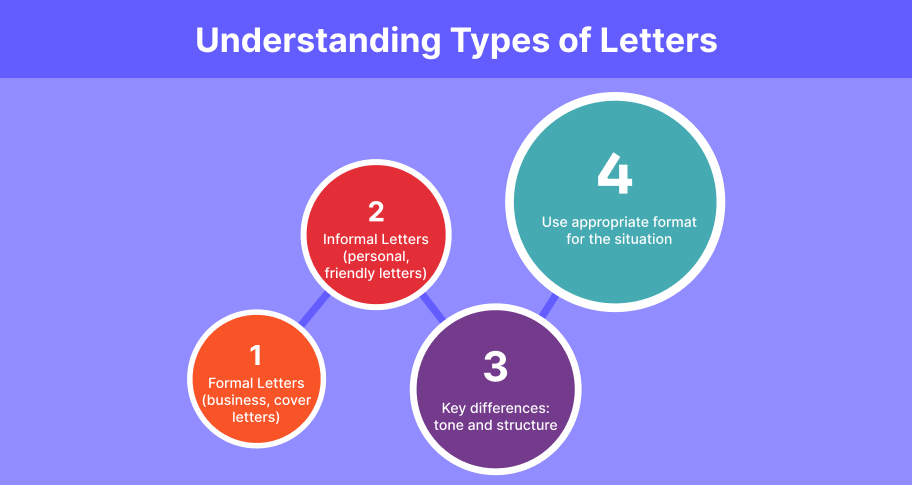
With all that said, there are primarily two types of letters: formal and informal. Formal letters are structured and adhere to specific conventions. Formal letters are most often used in professional, legal, business, or official communications.
Informal letters, on the other hand, are more personal. They tend to have a relaxed tone and structure, and are most often used among friends or family.
Knowing these differences and mastering the art of letter writing will greatly improve your ability to communicate effectively. Whether you're drafting a business proposal, writing an application letter, or sending a heartfelt personal note, this is one art you'll want to possess. The skills involved in developing a well-written letter can leave lasting impressions and will certainly help you in your personal and professional life.
What is Letter Writing?
Letter writing refers to the practice of composing written hard-text messages (on paper) with which you can communicate across short or great distances to others, personally or professionally. Historically, letters have been a method of correspondence useful in diplomacy, trade, business and personal dealing. Before the advent of the telegraph, telephone, the internet, or text messaging, letters were the best way to bridge geographical gaps.
The main difference between formal and informal letters is in their purpose, tone, and structure. Formal letters are typically used in professional purposes. They have a more official or respectful tone and standard structure. Formal letters are used in business, legal, academic, and organizational contexts. Examples include business correspondence, job applications, complaint letters, or letters of commendation. Informal letters, on the other hand, are casual, and have a conversational tone. They are typically written to friends or family.
In the modern world, letter writing is still important. In business, letters may be used as records of official communication, agreements, formal deals, or formal requests. Educational institutions rely on letters for applications and notifications. Additionally, handwritten personal letters have become a cherished way to express emotions, gratitude, or simply to maintain relationships in a more meaningful way. In an era where a quick text or a voice note takes seconds to send, the deliberate act of sitting down to write a letter communicates something that no push notification ever could: that the recipient is worth your undivided attention.
Types of Letters
Formal Letters
Formal letters are structured to follow specific formats. They maintain a formal tone, with a focus on clarity and professionalism. The importance of formal letters is in their ability to convey important information in a clear, concise, and respectful manner, often forming the basis for official records and legal communication. Because formal letters frequently serve as legally binding documents or as part of an official paper trail, even small errors in tone or structure can undermine their authority and credibility.
There are various types of formal letters, each serving a unique purpose:
- Business letters: Used for professional communication within or between companies, including inquiries or updates.
- Cover letters: Sent along with resumes, they introduce the applicant and highlight their qualifications for a specific job.
- Complaint letters: These are usually written to express dissatisfaction with products or services, with a goal being to achieve a resolution.
- Recommendation letters: Written by a supervisor, professor, or mentor to vouch for a candidate's abilities, character, or achievements in support of a job application, academic program, or award.
- Resignation letters: Used to formally notify an employer of your intention to leave a position, typically including a notice period and a gracious closing remark.
- Request letters: Sent to ask for information, permission, resources, or a specific action from an individual or organization.
- Other: Other types of formal letters include letters of intent, cease-and-desist letters, and official letters of commendation.
Informal Letters
Informal letters are personal messages between friends, family, or acquaintances, and are tend to have a relaxed, conversational tone. These letters do not adhere to a strict format, which means the writer may express himself more freely.
Types of informal letters include:
- Personal letters: Written to close family members or friends to share news, thanks, thoughts, or experiences.
- Friendly letters: Similar to personal letters, but slightly more structured, usually written to someone with whom the writer has a cordial relationship, such as an acquaintance or an old friend.
- Thank-you letters: Informal thank-you notes sent after a gift, a kind gesture, or a hospitality experience. While a quick text message says thanks, a handwritten thank-you letter is far more memorable and appreciated.
- Sympathy or condolence letters: Written to offer comfort and support to someone going through a difficult time such as a loss or illness. These letters are especially valued because of the warmth and care they convey.
The purpose of informal letters is typically to maintain personal contact with others, celebrate special moments, send thanks, or provide comfort and support.
Structure of a Letter
Basic Parts of a Letter
A well-organized letter, whether formal or informal, consists of the following core components:
- Salutation: The greeting or opening of the letter.
- Body: The main content where the message is conveyed.
- Conclusion: The closing statement, which may summarize the purpose of the letter and contain a parting thought.
- Signature: The final sign-off, indicating the writer's identity.
For formal letters specifically, these core components are supplemented by a few additional elements: the sender's address and date (placed at the top of the page), the recipient's full name, title, and address (below the date), and sometimes a subject or reference line placed between the recipient's address and the salutation. Each of these elements plays a role in making sure the letter is properly directed, dated, and easy to file or reference later.
Detailed Breakdown
Salutation
The salutation sets the tone of the letter and should correctly address the recipient. In formal letters, use respectful greetings like "Dear Mr. Smith" or "To Whom It May Concern." In informal letters, more relaxed greetings like "Hi Sarah" or "Dear John" are acceptable. It is worth noting that in 2026, gender-neutral salutations such as "Dear [Full Name]" or "Dear Mx. [Last Name]" have become increasingly common in professional correspondence, reflecting a growing awareness of inclusive language in the workplace. When you are unsure of a recipient's preferred title or gender, using their full name in the salutation is the safest and most respectful approach.
Body
The body is the most important part of the letter. Here, the writer conveys the essence of the message. In formal letters, it is important to stay focused and on point, using only as many words as are needed. One should begin a formal letter with an introduction that states the purpose, followed by a detailed explanation, and conclude with any required actions or follow-up steps.
In informal letters, the body can be more flexible. The writer may take time and space to share stories, ask questions, or simply catch up with the recipient. It is still important to maintain clarity so that the main point of the letter is evident. Even in the most casual of letters, a reader should never have to guess what you are trying to say or how you are feeling—clarity and warmth can absolutely coexist.
Conclusion
The conclusion is where the writer wraps up the message by summarizing the main point or expressing thanks. In formal letters, common closings include "Best" or "Kind regards," followed by a polite remark, such as "I look forward to hearing from you." Informal letters can end with phrases like "Take care" or "Hope to hear from you soon." Whichever type of letter you are writing, the conclusion is your last chance to reinforce the tone you have established throughout, so choose your closing words carefully—they tend to linger in the reader's mind longer than the opening.
Signature
The signature is an important part of the letter, especially in formal communications, as it provides identification and authenticity. For formal letters, sign off with your full name and title (if necessary). In informal letters, a first name or nickname is usually sufficient. In the case of printed formal letters sent physically, a handwritten signature placed above your typed name adds an important layer of authenticity. For digital formal letters sent as PDFs, a scanned signature or a certified digital signature serves the same purpose and is widely accepted in professional and legal contexts today.
Step-by-Step Guide to Writing a Formal Letter
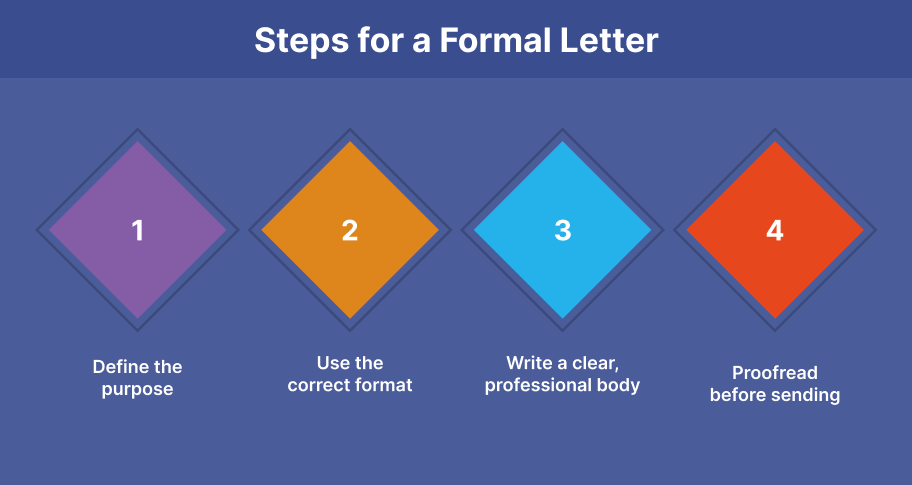
Step 1: Decide the Purpose of Your Letter
Before starting your formal letter, it's best to define its purpose. Know why you're writing. This will help you to keep your letter focused and concise. Regardless of whether you're requesting information, submitting a complaint, submitting an agreement, or applying for a job, understanding the goal of the letter is what will guide the content and tone of the letter. If you know the purpose, you know what information to include and how to structure it. For example, a business inquiry will differ greatly from a resignation letter.
A useful habit before drafting is to write a single sentence that captures the core purpose of the letter—something like, "I am writing to formally request a refund for a defective product received on [date]." If you cannot summarize the purpose of your letter in one clear sentence, your letter is not yet ready to be written. That single sentence will also often serve as the basis for your opening paragraph, keeping the letter direct and purposeful from the very first line.
Step 2: Format Your Letter
Choosing the correct format for your formal letter will show your professionalism. There are three common letter formats:
- Block format: The entire letter, including paragraphs, is left-aligned with no indentations. This is the most widely used and accepted format for business letters.
- Modified block format: Similar to the block format, but the date and closing are aligned to the right.
- AMS (Administrative Management Style): This format eliminates the salutation and closing, using subject lines instead.
Regardless of the format, all formal letters should include basic elements such as the sender's address, the date, the recipient's address (and all but the AMS format should have a formal greeting and a closing). When preparing a formal letter in 2026, it is also worth considering whether the letter will be delivered as a physical document or as a PDF attachment via email. Either way, keeping consistent margins (typically one inch on all sides), a professional font such as Times New Roman or Calibri at 11–12pt, and adequate white space between sections will ensure the letter looks polished and is easy to read.
Step 3: Write the Body
The body of your formal letter is the most important part of your message, and it should be to the point and professional. Begin by briefly introducing yourself and stating the purpose of the letter in the first paragraph. Avoid unnecessary details or digressions. The point is be as direct as possible.
The second paragraph should elaborate on the purpose. Give the most relevant details, explanations, or examples. Be specific and well-organized. Let each main point have its own paragraph. Use polite language and keep a professional tone throughout, even if you are making or addressing a complaint.
In the final paragraph, refer to any necessary actions or responses you expect from the recipient, such as a reply or meeting. Conclude by thanking the recipient for their time and consideration, and offering any additional contact information if needed. If your letter requires the recipient to take a specific action by a specific deadline, state that deadline clearly and politely in this final paragraph—vague calls to action are one of the most common reasons formal letters fail to generate a timely response.
Step 4: Proofread and Edit
Once the letter is written, proofread and edit. Errors in grammar, spelling, syntax, or punctuation can damage your credibility and professionalism. Read the letter carefully to catch any mistakes.
In addition to grammar and spelling, pay attention to the overall clarity of the letter. Does each paragraph communicate its intended point? Are there any sentences that seem too wordy? A well-edited letter will be free of errors and will flow smoothly. Make sure yours does both.
Taking the time to carefully proofread your letter will allow you to make the best possible impression. One practical tip: read the letter aloud before sending it. Awkward phrasing and run-on sentences that slip past a visual read often become obvious when you hear them spoken. You can also use tools like Grammarly or the built-in editor in Microsoft Word or Google Docs as a first pass, but never rely on these tools alone—automated grammar checkers can miss tonal inconsistencies, contextual errors, and stylistic problems that a careful human reader will catch.
Step-by-Step Guide to Writing an Informal Letter
Step 1: Choose Your Style
When writing an informal letter, your writing style should reflect your relationship with the recipient. Style and tone will vary depending on your relationship—whether you are fiends, romantic partners, associates, siblings, and so on. You can use personal touches like friendly greetings and colloquial terms to make the tone feel warm and approachable. Also, you should feel free to use contractions (like "I'll" or "you're") and casual expressions, which are frowned upon in formal writing. The best informal letters feel like an extension of a conversation you were already having—natural, warm, and unmistakably you.
Step 2: Structure the Letter
Informal letters are less rigid than formal ones, but it's still important to have a basic structure to your message. Start with a greeting such as "Dear [Name]" or a more casual salutation like "Hi" or "Hello." The body of the letter can flow freely, as there no strict rules on paragraph length. Feel free to share stories, ask questions, go off on tangents, or discuss anything of interest. However, try to keep the letter somewhat organized so the recipient can follow your thoughts. End with a friendly closing, such as "Take care," or "Love."
Even though the informal letter does not demand the rigid paragraph structure of a formal one, a loose three-part arc—opening remarks, the main substance of what you want to share or ask, and a warm send-off—helps the reader feel guided rather than lost. Think of it the same way you would think about a good phone call: you don't just hang up without a goodbye, and you don't launch straight into the heavy stuff without a moment of "how are you?"
Step 3: Add a Personal Touch
One thing that makes a good informal letter is the personal touch. Try using a tone that is conversational and sincere. Show your personality in your writing so that the recipient sees the real you. You can share anecdotes, memories, inside jokes—anything to make the letter feel more intimate. Express genuine emotions—whether it's joy, nostalgia, or support—to give the letter that personal touch.
Also, consider mentioning specific details about the recipient, such as recent events in their life, or something you admire about them. This shows thoughtfulness and can make the recipient feel valued. End with a handwritten signature or a short, personal postscript (P.S.) to add an extra layer of warmth to your letter and leave a lasting impression. In an age when most people's inboxes are full of mass-generated content, a letter that speaks directly and specifically to the reader as an individual is genuinely rare—and genuinely treasured.
Different Formats of Letters
Block Format
The block format is the most widely used style for formal letters because it is simple and easy to read. All text is left-aligned, and there are no indentations at the beginning of paragraphs. Each section of the letter, including the address, date, salutation, body, closing, and signature, is separated by a single space, with double spacing between paragraphs.
This format is commonly used for business correspondence. The uniform alignment and straightforward layout make it easy for the recipient to read and follow the content, which is why it remains the go-to choice in professional settings. The block format is ideal when you want to convey a professional and organized impression. It is also the format most commonly requested by human resources departments when asking for written correspondence alongside a job application, so learning it well will serve you in practical and immediate ways.
AMS Format
The AMS (Administrative Management Style) format is a more modern, simplified approach to formal letter writing. Unlike traditional formats, AMS eliminates the salutation ("Dear [Name]") and closing ("Sincerely," "Regards"). Instead, the letter begins with a subject line in all caps that summarizes the content, and the body follows in a clear, concise manner.
AMS format is commonly used in administrative and official settings, particularly when writing memos, internal communications, reminders, or formal notices. It is best suited for situations where brevity and directness are required, as it lets the writer get straight to the point without the formalities of greetings and closings. This format is ideal for internal business correspondence and communication between colleagues or departments. Because AMS strips away the social niceties of traditional letter formats, it should only be used in contexts where such directness is expected and appropriate—using AMS to write to an external client or a government official, for instance, could come across as curt or disrespectful.
Modified Block Format
The modified block format sits comfortably between the full block format and older, more traditional letter styles. Like the block format, most of the content is left-aligned. However, the date, complimentary closing, and signature are indented to the center or right side of the page. Paragraphs in the body may also be indented at the first line, though this is optional. The modified block format is a popular choice for professionals who want a letter to feel slightly more traditional or visually balanced than the strict left-alignment of the full block format, while still maintaining a clean, modern look. It is particularly common in law firms, financial institutions, and older corporate environments where convention carries weight.
Tips for Effective Letter Writing
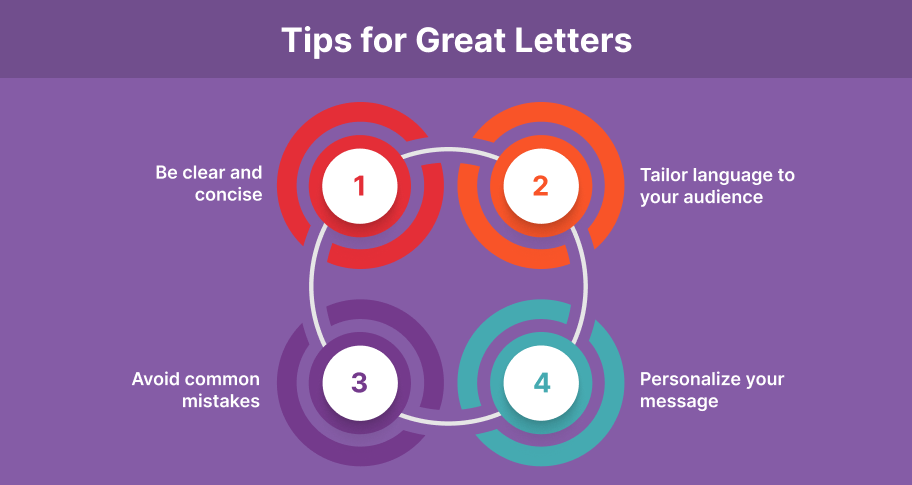
Be Clear and Concise
For the most effective letter writing always pursue clarity. Avoid long-winded or wordy sentences. No need for excessive detail that may confuse or overwhelm the recipient. Each paragraph should focus on a single point, with concise sentences that communicate your message clearly. Stay on point so that the recipient can quickly grasp the purpose of your letter.
It's also helpful to review your letter and remove any unnecessary words or sentences that do not contribute directly to your message. Being brief yet thorough will make your letter more impactful and ultimately easier to read. A good rule of thumb: if a sentence does not either advance your purpose or support a sentence that does, cut it. This discipline is harder than it sounds, but it is what separates a sharp, readable letter from a rambling one that leaves the recipient unsure of what you are actually asking.
Tailor Your Language to Your Audience
The tone and language of your letter should be tailored to suit your audience. For formal letters, use professional language; avoid slang and maintain a respectful tone throughout. In contrast, for informal letters, a conversational tone is appropriate, for a relaxed and personal style.
Consider the relationship you have with the recipient and the purpose of your letter. Adjust your tone so that your message resonates with the reader and sets the right mood, whether it's a professional request or a personal note to a friend. It is also worth considering the industry or context when writing a formal letter. A letter to a creative agency can afford a slightly warmer and more expressive tone than a letter addressed to a law firm or a government department. Reading the room—even in written form—is a skill that separates competent letter writers from truly effective ones.
Avoid Common Mistakes
There are several common mistakes to avoid in letter writing:
- Misspellings and grammar errors: These detract from your professionalism, so always proofread before sending.
- Incorrect tone: A formal letter written with a casual tone can be seen as disrespectful, just like overly formal language in an informal letter may seem distant.
- Ambiguity: Be clear in your message. Explicitly state your purpose.
- Lack of structure: Organize your letter with a clear introduction, body, and conclusion.
- Addressing the wrong person or using the wrong title: Always double-check the recipient's name, job title, and preferred salutation before sending. Getting this wrong signals carelessness and can immediately undermine your credibility.
- Burying the main point: In a formal letter especially, the reader should not have to get to the third paragraph before understanding why you are writing. Lead with your purpose.
Examples of Common Letters
Example of a Formal Business Letter
[Your Name]
[Your Address]
[City, State, ZIP Code]
[Date]
[Recipient's Name]
[Recipient's Job Title]
[Company Name]
[Company Address]
[City, State, ZIP Code]
Dear [Recipient's Name],
I am writing to inquire about your company's product line and pricing regarding your latest product line of electronic equipment. As we are expanding our operations, we are looking to establish a partnership with reliable suppliers, and I believe your offerings align well with what we want to make available to our clients.
Please provide a detailed quote, including discounts for bulk orders, and let us know the estimated delivery timelines.
Thank you for your time. I look forward to your prompt response.
Sincerely,
[Your Name]
[Your Job Title]
Example of an Informal Letter
Hi [Friend's Name],
I hope this letter finds you well! It's been such a long time since we last caught up, and I've been meaning to share some exciting news with you. You'll never believe it! I recently started my new job at [Company]! Yeah, that's right—Uncle Bud's old place—and it's been an amazing experience so far. I can't wait to talk to fill you in on everything I've seen so far!
I hope things have been good on your end. I miss our weekend hangouts and long chats. Let's plan something soon—maybe a little trip, or—if nothing else at least a call! Can't wait to hear what you've been up to.
Take care and write back when you can! I miss your letters most of all.
Best,
[Your Name]
Example of a Cover Letter
[Your Name]
[Your Address]
[City, State, ZIP Code]
[Date]
[Hiring Manager's Name]
[Their Job Title]
[Company Name]
[Company Address]
[City, State, ZIP Code]
Dear [Hiring Manager's Name],
I am writing to express my interest in the [Job Title] position recently posted on [Company Name]'s careers page. With [X] years of experience in [relevant field] and a demonstrated record of [key achievement or skill], I am confident that I would be a strong addition to your team.
In my current role at [Current or Most Recent Employer], I have been responsible for [brief description of key responsibilities]. During that time, I [specific achievement that aligns with the role you are applying for]. I am drawn to [Company Name] because of [specific reason—company mission, product, culture, reputation], and I am eager to bring my skills in [relevant skill set] to contribute to your continued growth.
I have attached my resume for your consideration and would welcome the opportunity to discuss how my background aligns with your needs. Thank you for your time and I look forward to hearing from you.
Sincerely,
[Your Name]
[Phone Number]
[Email Address]
The Importance of Letter Writing in the Digital Age
In the digital age, communication has shifted to electronic forms such as emails, text messages, and social media. However, letter writing remains a powerful and enduring form of communication. Technology has certainly made it easier to send messages instantly, but the thoughtful and deliberate nature of writing a letter still has great value in society.
Letter writing has changed with advances in technology. Certainly, emails and digital messaging offer convenience—but they lack the personal touch and/or the seriousness that a handwritten letter conveys. A handwritten letter can evoke emotions, thoughts, consideration, care, effort, and personality in ways that an email often cannot. In professional settings, formal letters, whether typed or written, are still used for legal and official purposes, where record-keeping is needed.
The difference between handwritten and electronic letters today is in their purpose. Handwritten letters are typically used for personal communication, such as expressing gratitude, sympathy, or love, because of their intimate and tangible nature. Electronic letters, on the other hand, are more common in business and formal messaging due to their speed and ease of delivery. It is also worth noting that in legal and official contexts, a printed and signed letter still carries more weight than a standard email, even in 2026—courts, regulatory bodies, and many HR departments continue to treat signed written correspondence as the authoritative form of record.
In both personal and professional spaces, the art of letter writing continues to be important. Letter writing should be seen as a meaningful alternative to the impersonal speed of digital communication. Letter writing takes time and therefore carries more weight. It also bridges the gap between tradition and modernity in a way that helps us keep connections alive.
There is also a growing cultural reassessment of what we lose when we communicate exclusively through digital channels. Researchers and communication scholars have noted that the rise of short-form digital messaging—from texts to social media posts—has contributed to a broader decline in the ability to sustain extended, nuanced, written thought. Letter writing, by contrast, demands that we slow down, organize our ideas, and commit to a complete expression of what we mean. In that sense, practicing letter writing is not just a professional skill—it is an exercise in clear thinking and deliberate communication that benefits every area of life.
Conclusion
Letter writing is an essential skill we should strive to cultivate. Both formal or informal letters have a unique ability to communicate information and feelings. From business correspondence to personal notes, mastering the art of letter writing lets us share our thoughts with purpose, meaning, respect, and friendship.
Formal letters are good for when you need a structured format and professional tone. They are truly indispensable in business, legal, official and inter-office communication. They help one to maintain professionalism and create records of important exchanges. Informal letters are perfect for a more personal and heartfelt means of staying in touch with a friend or loved one, and letting out expressions of feelings, sympathy, thanks, or shared experiences.
Even in the digital age, letter writing has its place. Technology has made communication faster and more convenient, but the value of a carefully written letter continues to hold its own. In 2026, as AI tools increasingly handle routine messaging for us, the letters that we choose to write ourselves carry even more meaning—they signal intention, care, and a willingness to invest real time in another person.
Ultimately, knowing when to use a formal or informal letter depends on the context and relationship with the recipient. Letter writing, in any form, will always be a powerful way to connect and correspond with others.
Get help with your essay
Browse 130,000+ paper examples, use our AI writing assistant, generate citations and outlines — all included.
Sign Up Now →