The Ultimate Guide to Literary Devices
Master the tools great writers actually use — metaphors, irony, symbolism, and more — with definitions, vivid examples, and tips for using each one well.
📋 Table of Contents (6 sections) ▼
Introduction
One of the tricks to great writing is to make good use of literary devices. Literary devices are the techniques writers use to help them communicate their ideas more colorfully, more meaningfully, and most effectively. They often involve the use of figurative language and things like metaphors, similes, symbols, exaggeration, irony, assonance, and alliteration. All great writers use literary devices, whether in poetry, prose, essays, or commentaries. Just like a musician uses all the tricks of the trade to win the ear of the listener, writers must use all the tricks of their craft to win their reader. In this article, we'll talk about literary devices and what they are, and we'll give some examples, too, to help you learn how to use them.
As of 2026, literary devices remain just as essential as they ever were — perhaps even more so, given how much written content competes for attention online and in print. Students, bloggers, novelists, speechwriters, and content creators alike benefit from understanding and deliberately employing these techniques. The ability to recognize a device in something you are reading and then reach for it intentionally in your own writing is one of the clearest markers of a maturing writer. That is precisely what this guide is designed to help you do.
What are Literary Devices / Definition
Literary devices are tools or literary techniques that help a writer unlock the potential of his words. Ever tapped a tree to get the maple syrup out? That's what using literary devices is like (in fact, I've just used one here with this simile). It's a way to get the meaning across without being bland, boring, dry, and dull. It adds sugar and spice, makes it tasty for the reader, keeps it interesting and zesty, and deepens the experience. You're not likely to see many literary devices in purely technical writing; but in all other types—from speeches to essays to fiction—you will start to notice literary devices galore, once you know what to look for.
In short, a literary device is a way of adding color and depth to one's writing. Techniques can range from figurative writing to putting two dissimilar things together (i.e., juxtapose ideas to bring out the sharp contrast). It is a type of language used to create more interesting and effective descriptions, to express ideas more fully without being complicated about it (i.e., expressing more completely but also more simply), and to make the language stand out, pop, seem more vivid and alive.
It is worth noting that literary devices operate on multiple levels simultaneously. A single well-chosen metaphor can do the work of an entire paragraph of plain explanation, while also creating an emotional impression that plain explanation simply cannot achieve. This is why studying literary devices is not merely an academic exercise — it is a practical investment in the quality and power of one's own writing. The more familiar you become with these tools, the more instinctively you will reach for them when a passage needs energy, clarity, or resonance.
For example, one literary device that often goes unnoticed but is very helpful in creating sensory experiences for the reader is the use of gustatory imagery. This technique involves describing tastes so vividly that the reader can almost savor them. J.K. Rowling's Harry Potter series is full of descriptions of magical feasts and treats, where the gustatory imagery makes you almost taste the pumpkin pasties and butterbeer. Indeed, pumpkin pasties are a particularly nice touch because it represents two devices: imagery and allusion. The allusion is found in the fact that pumpkins are associated with Halloween, and Halloween is a dress-up time for kids; Harry and his friends enjoy pumpkin pasties on the train to Hogwarts, and the association of going to Hogwarts with pumpkins makes it easier for young readers to enter into the world of make-believe, as their train-of-thought is already thinking "dress-up" due to the association of pumpkins with Halloween and costumes. It is a brilliant bit of writing on the part of Rowling.
Another example is in Edgar Allan Poe's poem "The Raven," where the poet uses all kinds of literary devices to bring the scene alive for the reader. Alliteration is rampant in the poem: one can see the repetition of sounds in lines like "And the silken, sad, uncertain rustling of each purple curtain / Thrilled me—filled me with fantastic terrors never felt before" and 'Doubting, dreaming dreams no mortal ever dared to dream before." These are just two examples of how sounds sweep the reader along. But there is also the image of the ominous bird itself, which is meant to evoke death and gloom—and the fact that it perches itself "upon a bust of Pallas," itself a symbol of wisdom, is a great use of irony as the bird symbolizes irrational fear sitting in a position of dominance over a symbol of reason.
The great thing about literary devices is that they are used to communicate all of these ideas subtly so that the reader hardly even realizes what is happening, although everything is felt and experienced below the surface.
To get a sense of how important literary devices are, let's compare an excerpt from Poe's "The Raven" to an excerpt in which the same passage is rewritten but without literary devices.
| Original Excerpt from "The Raven" by Edgar Allan Poe (with Literary Devices): "Once upon a midnight dreary, while I pondered, weak and weary, Over many a quaint and curious volume of forgotten lore— While I nodded, nearly napping, suddenly there came a tapping, As of some one gently rapping, rapping at my chamber door. 'Tis some visitor,' I muttered, 'tapping at my chamber door— Only this and nothing more.'" | Rewritten Excerpt without Literary Devices: "It was a late night, and I was sitting, feeling tired and weak. I was looking at some old and unusual books. While I was almost asleep, I heard a sound, like someone knocking at the door of my room. I thought it must be a visitor knocking at my door, and that's all it was." |
The original verses with literary devices set a definite mood, a rhythm, a tone, an atmosphere, and a feeling of unease that simply cannot be matched in the excerpt where no literary devices are used.
In the rewritten lines, the richness and rhythm of Poe's original text are all but absent. The original's use of alliteration in "weak and weary," the internal rhyme in "napping, tapping," and the repetition in "rapping, rapping at my chamber door" contribute to the poem's haunting undertones. The phrase "Once upon a midnight dreary" sets a dark, mysterious, ominous note, which is lost in the plain description of "It was a late night." Plus, the original's use of a first-person narrative creates a sense of immediacy and personal involvement, which is diminished in the more straightforward and detached rewrite.
Let's look at another example, this time using an excerpt from William Wordsworth's "I Wandered Lonely as a Cloud" (which uses literary devices) and then rewrite it without them:
| Original Excerpt (with Literary Devices): "I wandered lonely as a cloud That floats on high o'er vales and hills, When all at once I saw a crowd, A host, of golden daffodils; Beside the lake, beneath the trees, Fluttering and dancing in the breeze." | Rewritten (without Literary Devices): "I walked alone, Above valleys and hills, And then I saw many yellow flowers; They were next to the lake and under the trees, Moving in the wind." |
In the original verses, Wordsworth uses several literary devices that enlarge the text. The simile "lonely as a cloud" establishes a big scene and or canvass, and conveys the speaker's sense of solitude as well as the wide open space in which he travels. The personification of daffodils as "fluttering and dancing in the breeze" gives them to life and brings the overall setting a sense of joyfulness and serenity. The use of words like "crowd" and "host" for the daffodils is further use of personification, making it seem as though the narrator could commune with nature quite literally.
In the rewritten version, the absence of these devices results in a more straightforward and less evocative text. There is no nuance or subtlety to it, and much of the meaning has been removed as a result. The sense of wonder and the emotional resonance of the scene are diminished. The imagery is less vivid, and the overall poetic quality and rhythm of the original are gone. Thus, one can see that literary devices are integral to creating the beauty and depth of poetic expression.
G.K. Chesterton was another master of literary devices. His essays are brimming with them and, therefore, make a great example for how their usage can elevate one's language and train-of-thought.
| Original Excerpt from "On Running After One's Hat" (with Literary Devices): "An adventure is only an inconvenience rightly considered. An inconvenience is only an adventure wrongly considered. The hour of peril is the hour of splendour. The inconvenience of the rain is an adventure for the child who seeks the rainbow, but an ordeal for the adult who has forgotten the colours." | Rewritten Excerpt (without Literary Devices): "An adventure is just a situation that you think about in a positive way. If you think about it negatively, it's just a problem. Dangerous times can be exciting. Rain is fun for a child who is looking for something beautiful, but it's a problem for an adult who doesn't see it that way." |
In Chesterton's original text, his use of paradox ("An adventure is only an inconvenience rightly considered. An inconvenience is only an adventure wrongly considered.") immediately captures the reader's attention and encourages them to see common experiences from a new perspective. There is also a sharp use of contrast used by Chesterton, as between the child and the adult in their reactions to rain; this contrast provides unspoken commentary on the loss of wonder and imagination that often accompanies adulthood. The phrase "the hour of splendour" is a grand way of expressing how moments of challenge can be wonderful when approached like with childlike innocence.
The rewritten text is stripped of these literary devices, and in becoming more straightforward it loses much of its charm and depth. The paradox is replaced with a simplistic explanation, and the contrasting frame of mind between the child's and the adult's perspectives is reduced to a basic comparison of experience. The nuanced encouragement to reframe one's perspective on life's inconveniences is lost as the literary devices are shelved, and the text acts as more of a direct, dull statement than a thought-provoking reflection.
Let's do one final example, using George Washington's Farewell Address.
| Original Excerpt from George Washington's Farewell Address (with Literary Devices): "The unity of government which constitutes you one people is also now dear to you. It is justly so, for it is a main pillar in the edifice of your real independence, the support of your tranquility at home, your peace abroad; of your safety; of your prosperity; of that very liberty which you so highly prize. But as it is easy to foresee that, from different causes and from different quarters, much pains will be taken, many artifices employed to weaken in your minds the conviction of this truth; as this is the point in your political fortress against which the batteries of internal and external enemies will be most constantly and actively (though often covertly and insidiously) directed, it is of infinite moment that you should properly estimate the immense value of your national union to your collective and individual happiness." | Rewritten Excerpt (without Literary Devices): "Your government's unity, which makes you a single people, is important to you. This is good because it is a key part of your true independence. It helps maintain calm at home, peace with other countries, your safety, your success, and the freedom you value so much. However, it's clear that for various reasons and from different places, efforts will be made to make you doubt this. Both internal and external opponents will consistently target this aspect of your politics, often in hidden and tricky ways. Therefore, it is very important for you to understand how much your national unity contributes to your happiness, both as a group and individually." |
George Washington's original is filled with literary devices that support its rhetorical power. The metaphor of the government as a "main pillar in the edifice of your real independence" and other aspects of national well-being is particularly effective. It conveys the importance of unity and frames it as a foundational structure that is needed to maintain a prosperous nation. The use of parallelism in listing the benefits of unity ("your tranquility at home, your peace abroad; of your safety; of your prosperity; of that very liberty which you so highly prize") adds cadence and rhythm to his argument and helps him to emphasize these benefits.
The rewritten text maintains the core message, but it lacks vigor, imagination, metaphorical depth, and the rhetorical strength of the original. The metaphor of the government as a pillar and the parallel structure are replaced with duller but more direct statements, which result in a loss of the persuasive quality that Washington's words carry. The original's eloquent and structured presentation of ideas gives a grand sense of gravity and urgency that is simply missing in the plain rewriting.
What is especially instructive about the Washington example is that it comes not from fiction or poetry, but from a political speech — a reminder that literary devices are not the exclusive property of creative writers. Speechwriters, lawyers, journalists, essayists, and public intellectuals have always relied on these same techniques to give their arguments staying power. A well-placed metaphor in an op-ed or a carefully constructed parallelism in a persuasive essay can be just as decisive as any statistic or citation. Knowing how to deploy these tools is, in this sense, a form of rhetorical literacy — and rhetorical literacy is increasingly prized in academic, professional, and public life alike.
How to Identify and Use Literary Devices in Writing
To identify literary devices, one must first become familiar with the different types of devices. Read widely across genres and look for patterns and usages of devices like metaphors, similes, personifications, and others. Pay close attention to how authors use language to convey emotions, create imagery, generate interest, make a point, embellish an argument, or emphasize ideas. Understand the context in which these devices are used – the setting, character emotions, the overarching themes – context is very important in understanding how and why literary devices are being used.
One practical technique for sharpening your ability to identify literary devices is annotation. As you read — whether a novel, a poem, an essay, or even a well-crafted news feature — keep a pencil or a digital highlighter handy and mark moments where the language feels unusually vivid, surprising, or musical. Then ask yourself why. Is a comparison being made? Is a sound being repeated? Is something being described as though it were alive? Naming the device is less important at first than noticing that something deliberate is happening. Over time, the names will attach themselves naturally to the patterns you have already learned to feel.
Using literary devices in writing requires a careful approach. The choice of device should align with the message or the idea or the emotion the writer intends to convey. For example, metaphors and similes are excellent for creating powerful descriptions that convey deeper meanings (implied by the image used). Irony can be used to convey subtle points or to present complex emotions in a simple way. Irony can also be used with satire to critique social norms or deviations.
Overall, it is important to use these devices sparingly and purposefully. Overusing literary devices or using them when it is not reasonable to do so can overwhelm the reader and make the writing superfluous.
Experimenting with different devices in various types of writing can help in understanding their effect. For example, in creative writing, you can try using symbolism to add depth, while in persuasive writing, you can try using analogies to make your arguments more convincing.
The key when using literary devices is to enhance your writing, not distract from it.
A useful exercise for writers at any level is to take a passage you have already written — a paragraph from an essay, a scene from a story, or even a journal entry — and deliberately revise it to include at least two or three literary devices. Notice how the tone shifts, how the sentences gain momentum, and how abstract ideas suddenly become concrete. Then, just as deliberately, ask whether each device earns its place. Does the metaphor clarify, or does it muddle? Does the alliteration feel natural, or forced? This back-and-forth habit of adding and then auditing is one of the fastest ways to develop genuine command over the full toolkit of literary expression. In 2026, many writing instructors recommend pairing this kind of manual revision practice with the close reading of strong mentor texts — published works in the same genre you are working in — so that your instincts are being trained by the best available models, not just by abstract rules.
Literary Devices List
Main Literary Devices
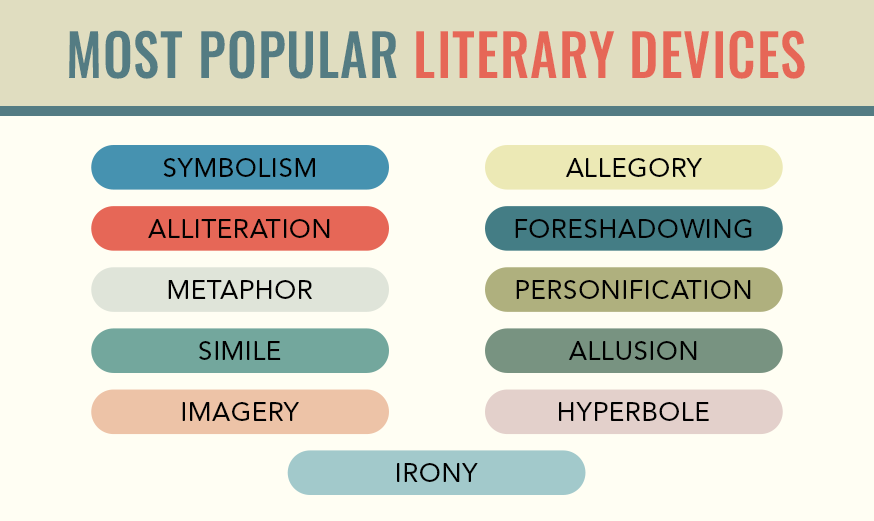
Some literary devices are used so frequently that you can find them readily across various genres. Here are some of the most popular literary devices in use today:
- Symbolism: This is the technique of using symbols to ascribe ideas and qualities to one thing by calling to mind the characteristics of another; i.e., giving an object representative meaning that is different from its literal sense. For example, a black cat may symbolize something ominous in a Poe story; a storm may symbolize moral disorder in a Shakespeare play.
- Alliteration: This technique involves the use of repetition by repeating the same consonant sounds at the beginning of words in close sequence. For example, "Fuzzy Wuzzy was a bear. Fuzzy Wuzzy had no hair. Fuzzy Wuzzy wasn't very fuzzy, was he?"
- Assonance: This technique involves the use of repetition of vowel sounds. For example, "The early bird catches the worm," where the 'ea' and 'ir' sounds are repeated.
- Metaphor: This is a figure of speech in which one thing is said to be another. For example, "The note was a killer."
- Simile: This is a figure of speech in which one thing is said to be "like" another thing. For example, "Her smile was as bright as the 4000 watt light bulb."
- Imagery: This consists of descriptive or figurative language used to create strong pictures that appeal to any or all of the five senses—such as visual imagery (sight), auditory imagery (sound), olfactory imagery (smell), gustatory imagery (taste), and tactile imagery (touch).
- Allegory: This is a simple story that contains a deeper, symbolic, or a hidden meaning, usually one with a moral purpose.
- Onomatopoeia: This is a word whose speech imitates the natural sounds of the thing it describes—like a phonetic sound effect that amplifies the description so as to make it more expressive and interesting. For example, "The bees buzzed and blitzed the intruder."
- Irony: This technique draws contrast between what is stated and what is left unsaid, or between expectations and reality. This includes verbal irony (saying the opposite of what one means), situational irony (when the opposite of what is expected occurs), and dramatic irony (when the audience knows something the characters do not).
- Foreshadowing: This is a literary device used to suggest or hint at what will come later in the text.
- Personification: This is the practice of giving human characteristics to non-human things. For example: The wind howled; the moon sang.
- Allusion: This is a brief and usually indirect reference to a person, place, thing, or idea of some significance. It does not describe in detail the person or thing to which it refers, but the object is typically well-known.
- Hyperbole: These are exaggerated statements or claims used to make a point but not meant to be taken literally. For example, "I've told you a million times to cut that out!"
- Tone: Though sometimes overlooked as a literary device in its own right, tone refers to the attitude a writer takes toward the subject or the audience — whether sardonic, reverent, melancholy, celebratory, or anything in between. Tone is created by the cumulative effect of word choice, imagery, syntax, and the other devices on this list, and it shapes how a reader emotionally receives everything else in the text.
- Juxtaposition: The deliberate placement of two contrasting ideas, images, characters, or settings side by side in order to highlight their differences and sharpen the impact of each. Juxtaposition is closely related to contrast but operates at the structural level — it is not just about pointing out a difference but about letting the collision of two unlike things generate meaning on its own.
Secondary Literary Devices
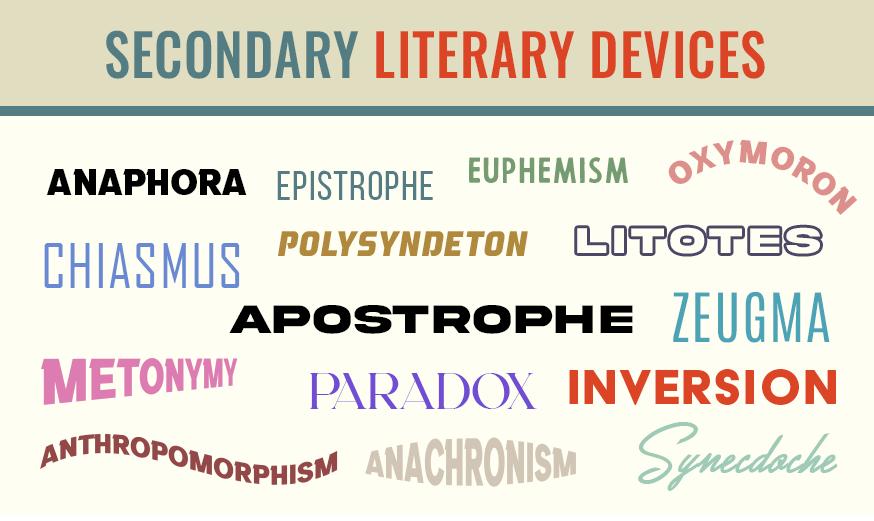
Beyond the most commonly known literary devices, there are many others that writers use to improve their storytelling, strengthen their rhetoric, deepen the meaning of their ideas, or get their audiences more engaged. Here's a list of additional literary devices, how they work and what they look like:
- Anaphora: The repetition of a word or phrase at the beginning of successive clauses or sentences. For example, Martin Luther King Jr.'s famous repetition of "I have a dream" in his speech. Or: "Every day, every night, in every way, I was falling further behind."
- Epistrophe: The opposite of anaphora, this is the repetition of a word or phrase at the end of successive clauses. For example, "of the people, by the people, for the people" from Abraham Lincoln's Gettysburg Address.
- Euphemism: Using a mild or indirect word or expression to replace one considered too harsh or blunt when referring to something unpleasant or embarrassing. For example, saying "passed away" instead of "died." Or: Referring to someone being "let go" from their job instead of "fired."
- Oxymoron: A figure of speech in which contradictory terms appear in conjunction. Examples include "jumbo shrimp" and "deafening silence."
- Asyndeton: The omission of conjunctions between parts of a sentence, used to shorten a sentence and focus on its meaning. For example, there is Julius Caesar's famous quip: "I came, I saw, I conquered."
- Polysyndeton: The deliberate use of many conjunctions for special emphasis to highlight quantity or mass of detail or to create a flowing, continuous sentence pattern. For example, "We have ships and men and money and stores."
- Chiasmus: A rhetorical or literary figure in which words, grammatical constructions, or concepts are repeated in reverse order. For example, "Never let a Fool Kiss You or a Kiss Fool You."
- Litotes: A form of understatement that involves making an affirmative point by denying its opposite—i.e., an understatement that uses double negatives. For example, "Not too bad" for "very good." Or: "He's not the brightest" instead of saying "He's dumb."
- Synecdoche: A figure of speech in which a part is made to represent the whole or vice versa. For example, "All hands on deck," where "hands" refers to people. Or: Referring to a car as "wheels."
- Metonymy: A figure of speech in which a thing or concept is referred to by the name of something closely associated with that thing or concept. For example, "The pen is mightier than the sword," where "pen" represents peaceful writing and "sword" represents military action. Or: Using "the crown" to refer to royal authority or monarchy.
- Apostrophe: A figure of speech in which the poet addresses an absent person, an abstract idea, or a thing. For instance, "O Death, where is thy sting?"
- Paradox: A statement that appears to be self-contradictory or silly but may include a latent truth. For example, "Fair is foul, and foul is fair."
- Zeugma: A figure of speech in which a word applies to multiple parts of the sentence. For example, "He opened his mind and his wallet at the movies."
- Anachronism: Placing a person, thing, event, or phrase in the wrong historical or chronological time. For example, depicting a Roman soldier using a smartphone.
- Anthropomorphism: Attributing human characteristics to a god, animal, or object. Unlike personification, which is metaphorical, anthropomorphism is more literal.
- Inversion: Changing the natural flow of language or inverting the word order to make an emphatic point. Yoda does this a lot in Star Wars: "Consume you, it will."
- Motif: A recurring element — whether an image, symbol, phrase, action, or idea — that appears multiple times throughout a work and contributes to the development of its central themes. Unlike a symbol, which carries meaning in a single instance, a motif accumulates meaning through repetition. In F. Scott Fitzgerald's The Great Gatsby, for example, the recurring image of the green light at the end of Daisy's dock functions both as a symbol and as a broader motif of longing and the elusiveness of the American Dream.
- Deus ex Machina: A plot device in which an unexpected power, character, or event is introduced suddenly to resolve a seemingly unsolvable problem. The term, Latin for "god from the machine," originates in ancient Greek theatre, where a mechanical crane would lower an actor playing a god onto the stage to untangle a complicated plot. In modern storytelling, this device is generally considered a weakness when overused, as it can feel contrived and undermine the internal logic of a narrative — but when employed knowingly and with irony, it can be a powerful satirical tool.
Literary Devices Examples
Here are more examples of some literary devices to show how they can be used:
- Metaphor:
- "All the world's a stage, and all the men and women merely players." (William Shakespeare, "As You Like It")
- This metaphor compares the world to a stage and people to actors, suggesting that life is like a play with various roles and acts.
- "He is a lion among men."
- Simile:
- "Life is like a box of chocolates; you never know what you're gonna get." (Forrest Gump, 1994)
- This simile compares life to a box of chocolates to suggest its unpredictability.
- "Her smile was as warm as the sun on a midsummer day."
- Personification:
- "The kites danced in the wind."
- This gives the kites human qualities, suggesting they are dancing.
- "The ship ascended the giant wave with monarchical presence, smiling gently and wholly composed even in the face of the enormous tempest before it.
- Hyperbole:
- "I'm so hungry I could eat a horse." Or: "I could eat a million burgers tonight."
- This is an exaggerated statement to emphasize extreme hunger.
- Alliteration:
- "Billy bounced the basketball against the barn door."
- The repetition of the 'b' sound creates a sound effect like that which is depicted.
- "She sells sea shells down by the sea shore. "
- Onomatopoeia:
- "The clock tick-tocked in the background."
- The 'ck' imitates the sound a clock makes.
- Irony:
- Verbal irony: Saying "Great weather!" during a storm.
- Situational irony: A fire station burns down. A pilot has a fear of heights.
- Dramatic irony: In "Romeo and Juliet," the audience knows Juliet is alive when Romeo believes she is dead. In Oedipus Rex, the audience knows the identity of Oedipus before he does.
- Symbolism:
- In "The Great Gatsby," the green light at the end of Daisy's dock symbolizes Gatsby's hopes and dreams for the future.
- Foreshadowing:
- In "The Lord of the Flies," the boys' descent into savagery is foreshadowed by the gradual destruction of their clothes.
- "The buzzsaw bzzz-ed its way through the lumber."
- In "Macbeth," the witches' prophecies foreshadow the rise and fall of Macbeth.
- Imagery:
- "The golden sun poured its warmth onto the fields, covered in a blanket of wildflowers."
- This sentence creates a vivid picture of the scene, appealing to our senses of sight and touch.
- Allusion:
- "He was a real Romeo with the ladies."
- This alludes to Shakespeare's Romeo, a well-known romantic figure.
- "She had a Cinderella moment when the entire room turned to look at her."
- This alludes to the fairy tale character, suggesting a transformation into grace and beauty.
- Allegory:
- George Orwell's "Animal Farm" is an allegory for the Russian Revolution and the subsequent Soviet Union, with farm animals representing different groups in Soviet society.
- In "The Chronicles of Narnia" by C.S. Lewis, the story serves as an allegory for Christian themes, with Aslan representing Christ.
- Anaphora:
- Winston Churchill's wartime speeches made frequent and electrifying use of anaphora. In his June 1940 address to the House of Commons, the hammering repetition of "we shall fight" — on the beaches, on the landing grounds, in the fields and in the streets — built an almost incantatory momentum that transformed a statement of military resolve into something closer to a shared oath. The anaphora does not merely repeat; it accumulates, each new location adding weight to the promise, until the listener feels the full magnitude of the commitment being made.
- "Every morning I wake up hopeful. Every morning I make my coffee. Every morning I remind myself that today is a new beginning." — The repetition of the opening phrase creates rhythm and emotional emphasis, suggesting a determined, almost ritualistic daily resolve.
- Motif:
- Blood in Shakespeare's "Macbeth" is one of the most famous examples of a sustained motif in all of English literature. It appears first as a marker of battlefield honor ("brave" Macbeth "unseamed" his enemy "from the nave to the chaps"), then transforms into a symbol of guilt, moral corruption, and the impossibility of washing away a crime. Lady Macbeth's famous sleep-walking scene — "Out, damned spot!" — is perhaps the most vivid expression of this motif, and it works precisely because blood has been accumulating symbolic weight since the play's opening lines.
- Juxtaposition:
- Charles Dickens opens A Tale of Two Cities with one of the most celebrated juxtapositions in the English language: "It was the best of times, it was the worst of times." The collision of extremes in a single sentence captures the paradoxical nature of the French Revolutionary period, where extraordinary hope and extraordinary terror existed simultaneously. The device forces the reader to hold two contradictory truths at once, which is precisely the disorienting experience Dickens wants to convey.
Conclusion
In conclusion, literary devices act as the muscles and sinews that help bring communication to life. They can be found in almost all forms of writing save technical: thus, from the poetic works of Wordsworth to the philosophical insights of Emerson and the whimsical reflections of Chesterton, literary devices can be formed. They transform ordinary language into extraordinary expression. They lift up prose to the skies and give it depth like the seas.
Literary devices also help to establish a deeper connection between the text and the reader. They engage the reader's imagination and emotions, and invite them into a fuller contemplation of the themes and ideas presented. One can find in them the rhythms of alliteration and the beauty of allegory, the fascinating symbols and meaningful similes; with them, one experiences the text rather than just reads it.
For this reason, literary devices are the tools through which writers bring their thoughts and stories and essays and speeches into forms that captivate. They are the chisels and paint brushes and colors that artists use to make their writing superb. Learning to use literary devices wisely is one of the greatest achievements a writer can do.
As writers and readers in 2026, we are surrounded by more text than at any point in human history — on screens, in feeds, across platforms both old and new. In this environment, the writers who stand out are not necessarily the ones with the most information or the loudest voices, but the ones with the most craft. Literary devices are that craft. They are the difference between a sentence that is merely read and a sentence that is felt, remembered, and returned to. Whether you are writing a college essay, a short story, a cover letter, or a speech, the deliberate use of these tools will set your writing apart in ways that no spell-checker or grammar corrector ever could. Study them, practice them, and let them become second nature — because the writers history remembers are, almost without exception, the writers who used language with intention.
Key Points to Remember
- Literary devices enhance expressiveness in writing.
- Literary devices help convey complex ideas in an understandable way.
- They add creativity and artistic flourishes to the text.
- Literary devices encourage readers to engage more deeply with the text.
- Literary devices should be used sparingly, appropriately and purposefully—otherwise you risk making your writing seem superfluous.
- Literary devices include metaphors, similes, personification, and hyperbole, which enhance descriptive language.
- Metaphors create direct comparisons without using "like" or "as."
- Similes make comparisons using "like" or "as."
- Personification attributes human qualities to non-human entities and can make abstract concepts relatable.
- Hyperbole involves exaggeration for emphasis.
- Irony presents contradictions between expectations and reality. Irony and satire are effective in critiquing social issues from a moral point of view assumed by the reader and writer alike.
- Symbolism uses symbols to represent ideas or qualities and allows for deeper layers of meaning in narratives.
- Imagery creates vivid sensory experiences and aids in creating great mental pictures.
- Alliteration and assonance enhance the musicality of prose and poetry.
- Anaphora and epistrophe use strategic repetition to build rhythm, emotional momentum, and rhetorical force — tools just as relevant in a student essay as in a political speech.
- Juxtaposition and motif operate at a structural level, shaping how meaning accumulates across a text rather than within a single sentence — making them especially powerful in longer works.
Get help with your essay
Browse 135,000+ paper examples, use our AI writing assistant, generate citations and outlines — all included.
Sign Up Now →