The Great Gatsby Chapter 7 Summary
Updated · The Great Gatsby by F. Scott Fitzgerald
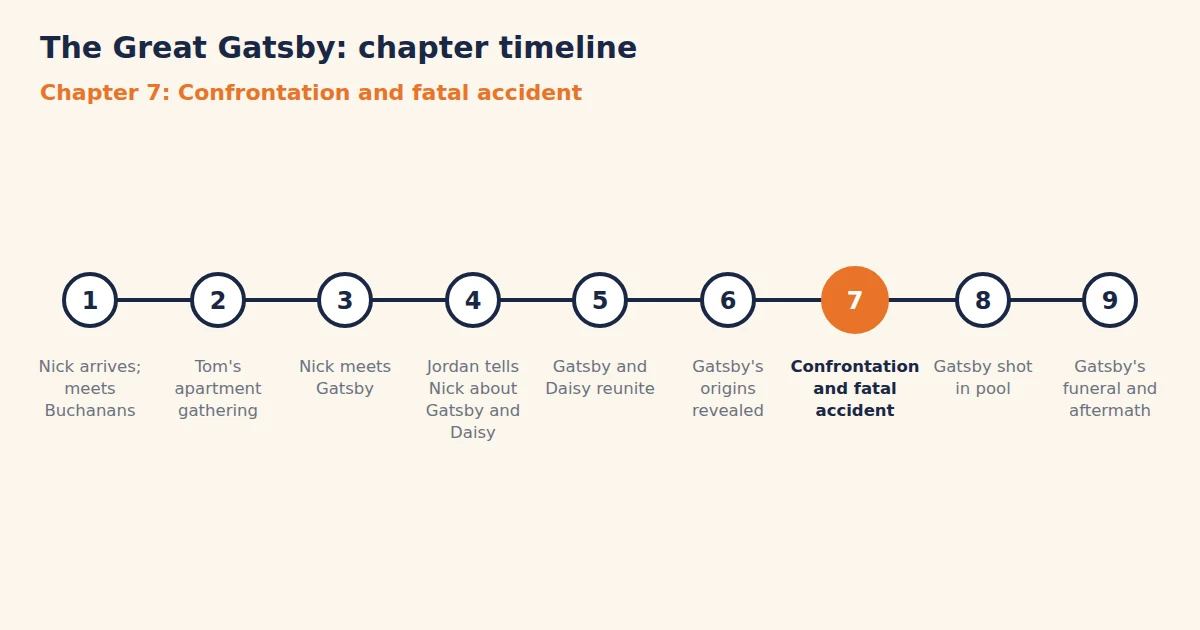
Chapter 7 summary
The chapter opens with Gatsby having shut down his parties and replaced his servants to protect his secret meetings with Daisy. The group gathers for lunch at the Buchanans' on the summer's most brutal day. Tom notices Daisy's open affection for Gatsby and insists they all drive to New York. On the way, Tom stops at Wilson's garage, where a sick and suspicious George Wilson reveals he plans to take Myrtle away. Myrtle herself watches from an upstairs window, mistaking Jordan Baker for Tom's wife.
In a suite at the Plaza Hotel, Tom directly confronts Gatsby, accusing him of lying about Oxford and exposing his bootlegging. Gatsby declares that Daisy never loved Tom and demands she say so. Daisy initially complies but then breaks down, admitting she loved Tom once. The confrontation ends with Tom sending Daisy home in Gatsby's car, confident his hold over her is restored.
Driving back, Gatsby's yellow car strikes Myrtle Wilson as she runs into the road; she is killed instantly. Nick later learns that Daisy was driving. Gatsby tells Nick he will take the blame. The chapter closes with Nick glimpsing Tom and Daisy sitting together at their kitchen table in quiet intimacy, and Gatsby standing alone in the moonlight outside, keeping a vigil over nothing.
Key events
- Gatsby has replaced his servants with people who will not gossip about Daisy's afternoon visits.
- At the Buchanan lunch, Tom sees Daisy tell Gatsby she loves him and forces a trip to New York.
- At Wilson's garage, a sick George Wilson reveals he suspects his wife and plans to move her away.
- In the Plaza Hotel suite, Tom exposes Gatsby's bootlegging and challenges his claim to have attended Oxford.
- Gatsby demands Daisy say she never loved Tom; she falters and admits she loved Tom once.
- Driving home in Gatsby's yellow car, Daisy strikes and kills Myrtle Wilson near the valley of ashes.
- Gatsby tells Nick that Daisy was driving but that he will say he was, and stands watch outside the Buchanan house all night.
Characters in chapter 7
- Jay Gatsby: Confronts Tom over Daisy at the Plaza and agrees to cover for Daisy after the accident.
- Tom Buchanan: Exposes Gatsby's criminal dealings, reasserts his hold over Daisy, and misleads Wilson at the accident scene.
- Daisy Buchanan: Declares love for Gatsby but cannot fully renounce Tom; she is driving when Myrtle is struck.
- Jordan Baker: Witnesses the Plaza confrontation; Myrtle mistakes her for Tom's wife at the garage.
- Nick Carraway: Narrates events, learns Daisy was driving, and observes Tom and Daisy's quiet intimacy afterward.
- Myrtle Wilson: Runs into the road and is killed by Gatsby's car, driven by Daisy.
- George Wilson: Reveals his suspicions about Myrtle and his plan to leave; is devastated at the accident scene.
Quotes from chapter 7
“Her voice is full of money”
Many readers see this as Gatsby recognizing that Daisy represents wealth itself, not merely a person he loves.
“I never loved him,” she said, with perceptible reluctance.”
The word 'reluctance' suggests to many readers that Daisy's declaration is forced rather than freely given, undermining Gatsby's victory.
“So we drove on toward death through the cooling twilight.”
This line can be read as foreshadowing the fatal accident moments later, casting the whole chapter in a fatalistic light.
Frequently asked questions
What happens in Chapter 7 of The Great Gatsby?
On the hottest day of the summer, Gatsby and Tom clash openly at the Plaza Hotel over Daisy. Tom exposes Gatsby's bootlegging, and Daisy tells Tom she never loved him, but cannot hold to it, admitting she loved him once too. Driving home, Daisy hits and kills Myrtle Wilson with Gatsby's car. Gatsby tells Nick he will take the blame, then spends the night watching the Buchanan house.
Who is driving the car that kills Myrtle Wilson?
Daisy is driving Gatsby's yellow car when it strikes Myrtle. Gatsby tells Nick: 'Yes,' she was driving, 'but of course I'll say I was.' He explains that Daisy was nervous after leaving New York and thought driving would steady her when Myrtle ran into the road.
What does Gatsby mean when he says Daisy's voice is full of money?
When Nick struggles to describe what is so compelling about Daisy's voice, Gatsby says suddenly, 'Her voice is full of money.' Nick finds this captures something he had never understood before. Many readers interpret the remark as linking Daisy's appeal directly to wealth and the promise of a privileged world.
Essays on The Great Gatsby
- The Mystery of Jay Gatsby and the Limits of Social Mobility
- Jay Gatsby: Ambition, Illusion, and the American Dream
- Nick Carraway as Unreliable Narrator in The Great Gatsby
- Illusion as Architecture: Gatsby's Dream and Its Ruins
- The Great Gatsby: Marxist, Feminist, and Freudian Analysis
- Materialism and the American Dream in The Great Gatsby
- The Great Gatsby: Symbols, Themes, and the American Dream
- Color Symbolism in The Great Gatsby by Fitzgerald