How to Start an Essay: Tips for Writing a Strong Introduction

Your hook either earns the read or loses it — master the essay introduction with proven steps, real examples, and the mistakes most writers never catch.
📋 Table of Contents (9 sections) ▼
Introduction
The first place you lose a reader is right at the very start. Not the middle. Not the second paragraph. The very first line.
It's the first impression that matters—which is why the essay hook is so big a deal. It's the initial greeting, the smile, the posture, the body language. It tells all, reveals all. If your hook has meat on it, you'll get the bite you desire. If it doesn't, your essay is going to sink like a log.
Writing an essay introduction doesn't have to be hard. In this comprehensive guide, we'll go over all the ins and outs of how to start an essay. We'll cover all the essay introduction sins you might be tempted to commit.
We'll show you how to launch right into it with a compelling fact, quote or question.
Stick with us and you'll be a paragon of essay-writing virtue.
The goal of this article is to help readers craft effective essay introductions.
Understanding the Essay Introduction
Definition of an Essay Introduction
An essay introduction is like a welcome center when you enter a new state on the expressway. You can see your location on the map, get an idea of all the neat things to do and see, get some refreshment, and head out. In an essay, the introduction sets the course, establishes the tone, pulls the reader in, and conveys the main idea or point.
Think of it this way: your reader is a stranger walking through a door. The introduction is the room they step into first. If it's warm, well-lit, and interesting, they'll keep walking. If it's cluttered, cold, or confusing, they'll turn right around. Every word in your introduction is working either for you or against you—there is no neutral ground.
Importance of a Good Introduction
Obviously, introductions matter. If you show up at a party and no one is there to receive you or introduce you to others, you might spend an uncomfortable evening sitting alone. A good essay introduction brings two minds together—yours (the writer) and theirs (the reader). It shows the reader that you have thoughtfully considered him as a guest in the house of your mind, and are prepared to deliver a reasonable greeting, show him around, get him seated, and make him comfortable. It shows you know how to make what you have to say appear relevant to your audience.
In 2026, with readers more distracted than ever—scrolling feeds, fielding notifications, and toggling between a dozen browser tabs—the stakes are even higher. You are competing for attention in a noisy world. A strong introduction is your best argument that this essay is worth the time. Lose that argument in the first sentence, and you may never get a second chance to make it.
Overview of What a Strong Introduction Should Achieve
A strong introduction should create in the reader a desire to read on. The intro is like the "hors d'oeuvres"—which is French for "outside the main work"—which is to say: the intro is not the meat but rather the morsel before the main dish. It should give a sense of what's to come and whet the appetite for more. When writing an essay introduction, the goal is to conclude with a thesis statement, which conveys the precise purpose of the essay. The whole idea of how to start an essay is found in this simple analogy of the appetizer as prelude to the main course.
A strong introduction also does something subtler: it earns trust. When a reader can tell from the very first paragraph that the writer knows the subject, has a clear point to make, and won't waste their time, they relax into the essay. That trust is hard to win back once lost, which is why the introduction deserves as much care and revision as any other part of your writing.
Key Elements of an Essay Introduction
The Hook: Different Types of Hooks
The hook is the first sentence of your essay. It is usually something as simple as a quote, statistic, or question designed to pique the reader's interest. With longer essays it could be all right to tell an anecdote as a hook.
The point is that a well-chosen hook will stir your reader's imagination. It should feel inevitable in retrospect—like the only possible way this particular essay could have started. That sense of rightness comes from choosing a hook that is genuinely connected to your topic, not just bolted onto the front of it as an afterthought.
- Quotes: Starting with a relevant quote can add authority and context to your essay. For example, "Injustice anywhere is a threat to justice everywhere," is a quote from Martin Luther King Jr. that can be used to establish a powerful moral tone for an essay on social justice.
- Anecdotes: A brief, interesting story or personal experience can draw readers in by making the topic relatable, human, humorous or dramatic. The best anecdotes are specific and sensory—they put the reader in a moment rather than summarizing one from a distance.
- Statistics: Presenting a surprising or shocking statistic can instantly capture attention. For example, "Nearly 70% of adults experience imposter syndrome at some point in their careers." When using statistics as a hook, always aim for the most current data available—a figure from five years ago can undermine your credibility before you've even made your first argument.
- Questions: Asking a thought-provoking question encourages readers to think critically and engage with the topic. For example, "What would you do if you knew this was your last day on earth?" The key is to ask a question the reader genuinely cannot answer immediately—one that creates productive uncertainty and pulls them forward into your argument.
- Bold Declarations: Sometimes the most arresting hook is a confident, even provocative statement that plants a flag and dares the reader to disagree. This works especially well in argumentative essays where your job is to defend a position. Lead with the claim, and let the body of the essay do the proving.
- Vivid Scene-Setting: Drop the reader directly into a place, moment, or scenario that illustrates your topic in miniature. This cinematic approach works well for personal essays and narrative-driven academic writing, and it signals right away that you can write—not just report.
- Quote — borrow authority and context from a well-known line.
- Statistic — open with a striking, current figure.
- Question — pose something the reader genuinely can’t answer right away.
- Bold Declaration — plant a flag with a confident, provocative claim.
- Vivid Scene-Setting — drop the reader into a moment that illustrates your topic.
- Anecdote — a short story that draws the reader in (works well in longer essays).
Background Information: How to Provide Context and Relevance
After the hook, your reader will need some background information that puts your subject into its proper context. You might share historical background, definitions, or an overview of the current state of the topic. Basically, this section of the introduction should bridge the gap between the hook and the thesis statement which is to come.
When sharing background information, be mindful not to overwhelm your reader with too much detail. Remember: the body paragraphs are the meat—the intro is just the appetizer. You can use the body to give more background and context if needed. The introduction should be brief and focused—a few short steps from the hook to the thesis. Done!
A useful test: after writing your background section, ask yourself whether a smart reader who knew nothing about your topic could now follow your thesis statement without confusion. If the answer is yes, you've done enough. If the answer is no, add one more clarifying sentence—not a paragraph, not a digression, just one clean sentence that closes the gap. Economy is the whole game here.
Thesis Statement: Crafting a Clear and Concise Thesis
The thesis statement is really the distillation of the point of the essay—and therefore it has great importance in your introduction. It presents the main argument or claim of your essay, so that the reader has an idea what to expect. A strong thesis statement is clear, precise, confident, and direct. It may even preview the points that will be discussed in the essay.
For example, in an argumentative essay on healthcare, a strong thesis might be: "Healthcare today is controlled by a cartel of corporations that put profits before people because they know that if they actually healed people and prevented disease their entire industry would go out of business."
Notice what makes that thesis work: it takes a position, it implies a "because," and it practically demands that the reader either agree or push back. A thesis that nobody could disagree with is not really a thesis at all—it's a statement of fact, and facts don't need essays to defend them. Aim for a thesis that is arguable, specific, and yours. If it sounds like it could be the thesis of anyone's essay on this topic, sharpen it until it couldn't be.
Step-by-Step Guide to Writing an Essay Introduction
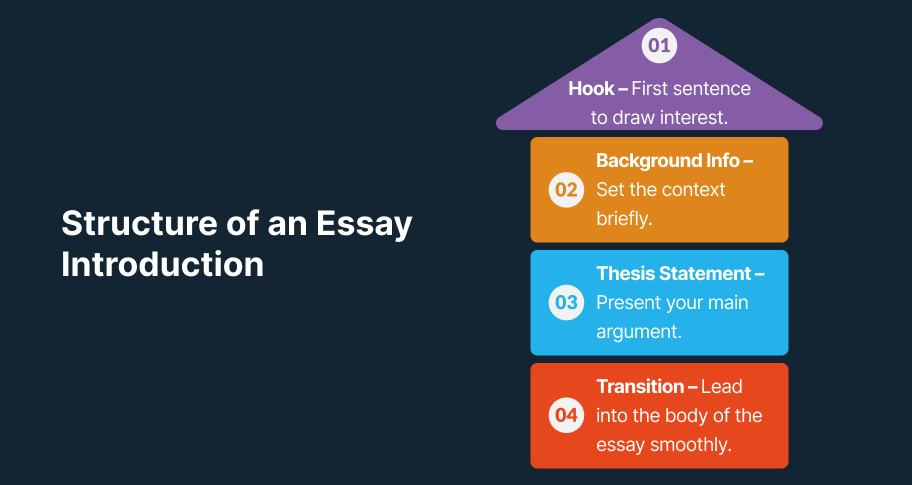
Step 1: Start with a Hook
Start with a hook that makes your reader want to read on. The hook should be relevant and allow you to get from point A ("Hey, look at this!") to point B ("Here's what I have to say now!"). A good hook also sets the tone for the rest of the essay—so a humorous anecdote about barracks life is probably not appropriate for a serious essay on trench warfare.
If you are struggling to find the right hook, try writing three or four completely different opening sentences and then stepping back to read them cold. Which one makes you want to keep reading? That's your hook. Often the best opening isn't the first one you write—it's the one you discover by trying and discarding the obvious choices first.
Step 2: Provide Background Information
After the hook, you'll need to give some background information. Help the reader understand the context of your essay. By letting your reader know where you are coming from, the reader can orient himself and make quicker sense of what you have to say.
Keep this section lean and purposeful. Every sentence of background information should be earning its place by moving the reader one step closer to understanding your thesis. If a sentence is interesting but doesn't do that work, save it for the body of the essay where it will have more room to breathe.
Step 3: State Your Thesis Statement
Say what your point is and how you intend to show it. Simple as that.
Don't bury your thesis in hedging language or qualifications. Own your argument. Writers sometimes soften their thesis out of fear—fear of being wrong, fear of sounding too assertive. Resist that impulse. Readers, and especially instructors, want to see a writer who is confident enough to stake a claim and willing to defend it. State the thesis plainly, at or near the end of your introduction, and let the body of the essay do the defending.
Step 4: Preview the Main Points
Don't go into too much detail here: just quickly—in a few words—list your reasons that support your thesis. For example, "Hamlet is a tragic hero according to Aristotle's definition, because he is good (virtuous), realistic (flawed), and experiences a fall."
This preview gives your reader a mental map of the essay before they enter it. It tells them where you're going, how many stops there are, and in what order. That kind of transparency is not a spoiler—it's a courtesy. Readers who know the shape of an argument in advance are better equipped to follow it, evaluate it, and remember it. Don't skip the roadmap just because you think it sounds formulaic. Used well, it's one of the most effective structural moves in academic writing.
Step 5: Revise and Refine
Once you have written your introduction, take the time to revise and refine it. This is actually the most important step. Great intros don't happen by themselves—they take skill, effort, and practice. Look to see that it all flows smoothly and that each element (hook, background information, thesis statement, and preview) is effectively linked. Take out any extraneous information or unnecessary clichés. Keep it sweet and to point.
One professional trick: write your introduction last. It sounds counterintuitive, but many experienced writers draft the body of their essay first and then circle back to write the introduction once they know exactly what they've argued. By the time you've finished the essay, you know your thesis, your best supporting points, and your overall tone—which means you can write an introduction that fits the essay like a glove rather than one that only vaguely predicts it. Try it at least once and see if it doesn't change how you approach the whole process.
Examples of Essay Introductions
To help illustrate these concepts discussed, here are examples of introductions for different types of essays and topics.
Essay Types
- Argumentative Essay Example: "Universal Basic Income (UBI) is a progressive policy that proposes providing all citizens with a guaranteed income regardless of their employment status. Advocates argue that UBI can reduce poverty, boost economic security, and provide a safety net in an increasingly automated world. However, two major problems with UBI are how to fund it and how it might hinder stimulating productivity. This essay contends that implementing UBI is a misstep to addressing income inequality and adapting to the future of work, and that instead free education, training, and child care should be offered to people who need it so that they can work."
- Expository Essay Example: "Renewable energy sources, such as solar, wind, and hydroelectric power, are becoming increasingly popular as the world seeks to reduce its dependence on fossil fuels. This essay explores the various types of renewable energy, their benefits for the environment and economy, and the challenges posed in transitioning to a sustainable energy future."
- Literary Analysis Essay Example: "In George Orwell's '1984,' the concept of totalitarianism is explored through the dystopian society of Oceania, where the government holds absolute control over every aspect of its citizens' lives. This essay shows how Orwell uses the symbol of the omnipresent and omnipotent figure of Big Brother, and the concept of 'Newspeak,' to describe a regime that operates totally on lies."
Each of these examples follows the same basic architecture—hook or opening context, brief framing of the topic, and a thesis that tells the reader exactly what the essay will argue or explore. Notice that none of them tries to do too much. They are compact, directed, and leave the real work to the body paragraphs where it belongs.
Essay Topics
Air Pollution Example: "Air pollution is cited by the World Health Organization as the main cause of death for 6.7 million people worldwide. Clearly, the consequences of air pollution are far-reaching, with smog, smoke, and toxins filling the air. This essay looks at the causes, effects, and potential solutions to the problem of air pollution."
Drug Abuse Example: "Drug abuse is on the rise all over the world, thanks in no small part to the Sackler family and its development of opioids like Oxycontin and Fentanyl. While the courts are having their say regarding the extent to which the Sackler's Purdue Pharma must pay for this crisis, victims of drug abuse still have to struggle to put their lives back together again. This essay explores the social factors contributing to drug abuse, its impact on families, and the strategies for prevention and treatment."
Save Water Example: "Have you ever thought about how water is a precious resource that is essential for life, yet is often taken for granted? It may seem odd to think of it, considering that the earth is literally covered with water, but the fact is that water conservation is a serious problem in the world. This essay discusses the reasons why saving water is important, the challenges we face, and the steps that can be taken."
Social Media Example: "Social media has democratized information and stood legacy media on its head. In that respect, it is a win for the people. On the other hand, it has totally seduced young people and become the whole center of their existence, causing depression and isolation. This essay describes the pros and cons of social media, and discusses how to balance it through moderation and self-control."
Technology Example: "Technology has literally transformed the planet: even the Amish are using modern tools! As for the rest of us, we engage with smartphones and artificial intelligence on a daily basis, and it is changing our lives, our work, our social interactions, and our ability to think and be productive. In 2026, with generative AI reshaping entire industries almost overnight, the question of how we manage our relationship with technology has never been more urgent. This essay shows the benefits and drawbacks of technology, as we move through the 21st century."
Sports Example: "Sports! It's the one topic that gets everyone giddy at trivia night. But more than that—it offers great opportunities for physical health, teamwork, and discipline. However, the world of sports is not without its problems, including issues related to doping and over-commercialization. This essay examines the significance of sports in society, its potential for positive change, and the dangers that surround it."
Inflation Example: "Inflation is an economic phenomenon that affects the purchasing power of money and the overall stability of an economy. In a nutshell, goods get more expensive while wages remain the same. But what is the cause of inflation? Why does it go away and then come back? The fact is, a lot of it has to do with the central bank's tendency to print a lot of new money in a short amount of time. This essay goes into the nitty-gritty details of the causes and consequences of inflation, and what people can do to control it."
Healthcare Example: "Healthcare is an industry that has gotten a free pass for far too long. For all the sickness and poverty in America, you would think we didn't have any healthcare system at all—yet our country spends more money on healthcare than anywhere else in the world. Do we have healthy people to show for it? Not at all! We have obesity off the charts, opioid epidemics, and the most expensive care ever. This essay will explain how healthcare became a corrupt member of the family of corporate cartels, and what people can do to regain their health holistically and naturally."
What these topic-based examples share is a willingness to be direct and even a little opinionated right from the jump. They don't dance around the subject—they walk straight up to it. That confidence is what makes them worth reading. Whatever your topic, your introduction should communicate that you have something real to say about it and that you are ready to say it now.
Common Mistakes to Avoid
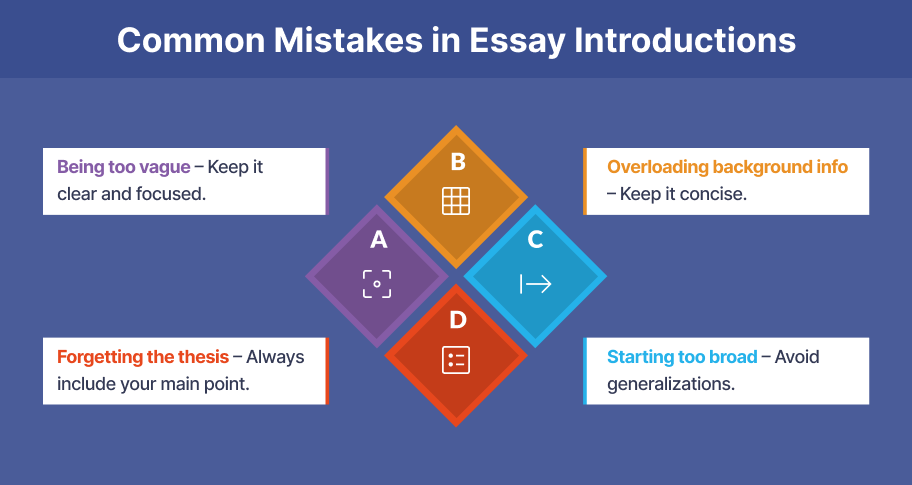
When writing an essay introduction, it's important to avoid certain common mistakes (these are what we call the three deadly sins of writing an introduction). Avoid them if you want a successful intro.
Overloading with Information
One of the most common mistakes is overloading the introduction with too much information. While it's important to provide context, the introduction should not be mistaken for the body (the meat) of the essay. Be concise and focused. If something needs or deserves more explanation, reserve a section of the body for that purpose (and say so). Don't burden your reader with too much detail up front.
A practical way to catch this mistake: if your introduction is longer than your average body paragraph, that's a warning sign. Read through it and ask, sentence by sentence, whether each one is essential to getting the reader to the thesis. If a sentence is interesting but not essential, cut it or move it. Your introduction is not a literature review, a history lesson, or a research dump. It is a door. Keep it narrow enough that the reader has to lean forward slightly to get through it—that lean is attention, and attention is everything.
Starting with Clichés
Using clichés or overused phrases in your introduction is tedious as all get out. It makes you look unpolished, unprofessional, and immature. Phrases like "Since the dawn of time…" or "In today's modern world…" are tired and trite. Don't use them!
In 2026, there's an additional cliché to watch for: the AI-flavored opener. With so many students now using AI writing tools for first drafts, certain phrases have become instantly recognizable as machine-generated filler—things like "In an era of unprecedented change…" or "It is widely acknowledged that…" or the classic four-sentence summary that begins with "Throughout history, humans have…" Instructors notice these. Write like a person. Write like you. Even a rough, specific, slightly awkward sentence that is genuinely yours will beat a polished non-sentence that could have come from anywhere.
Being Too Vague or Too Detailed
Striking the right balance between being too vague and too detailed is a challenge—but it's one you have to rise up to. A vague introduction lacks direction and focus. An overly detailed introduction can lack the same things, though. Shoot for a clear and precise introduction that provides enough information to gear up the reader for the topic but leaves room for further exploration in the body of the essay.
If you find yourself stuck between the two extremes, use your thesis as a compass. Every sentence in the introduction should either be moving the reader toward the thesis or contextualizing it. If a sentence does neither, it's either too vague (it floats free of your argument entirely) or too detailed (it gets so deep into the weeds that it crowds out the thesis before the reader even reaches it). The thesis is the destination; everything in the introduction is the road to it. Build the road cleanly, and you'll land right where you need to be.
Tips for Writing an Engaging Introduction
To write an introduction that is engaging, follow these tips:
Keeping it Concise
A good introduction is concise and to the point. Just get rid of unnecessary words or phrases that add no value to your essay. There should be no room in your essay for fluff. If the sentence adds nothing, scrap it!
Conciseness is not the same as brevity for its own sake. It means that every word is pulling weight. Read your introduction aloud—slowly, word by word—and listen for the moment when your pace flags or your attention wanders. That's where the dead weight is. Cut it, tighten what remains, and read it aloud again. Repeat until every sentence snaps.
Using Powerful and Relevant Language
The language you use in your introduction should be powerful and relevant to your topic. Don't be generic: be vivid and alive, and your reader will thank you for it.
Powerful language doesn't necessarily mean big words or fancy vocabulary. In fact, the most powerful sentences are often the shortest and the plainest. What makes language powerful in an introduction is precision—choosing the exact word that means the exact thing you want to say, rather than a near-synonym that is close enough. "Children suffer" hits harder than "young people experience negative outcomes." Say what you mean. Mean what you say. Trust that the reader can handle the truth stated plainly.
Ensuring Alignment with the Rest of the Essay
Your introduction should align with the rest of your essay in terms of tone, content, and structure. It is all one: intro, body, conclusion. They should go together like bones in a body. A well-aligned introduction starts off the logical flow of ideas throughout the rest of the essay.
A common misalignment happens when a writer revises the body of the essay after the introduction is already "finished." The argument shifts, a key point gets dropped or added, the tone becomes more formal or more casual—and suddenly the introduction is promising an essay that no longer exists. Always do one final read-through of the introduction after you have finished revising everything else, just to make sure the two halves of the contract still match. The introduction is a promise. The body is the fulfillment of that promise. Don't leave your reader holding an IOU.
FAQ
How Long Should an Essay Introduction Be?
The length of an essay introduction will vary depending on the length of the essay. As a general rule, the introduction should be about 10% of the total word count. For a standard five-paragraph essay, the introduction should be one paragraph long, or a third of one double-spaced page. Longer essays may benefit from a more detailed introduction.
Can You Use Questions in Your Introduction?
Yes, using questions in your introduction can be a great way to hook your reader. Questions get people to think critically. A well-placed question can inspire curiosity and guide the reader towards your way of thinking.
How Do You Revise an Introduction?
Revising an introduction involves reviewing it for clarity and consistency. Once finished with your first draft, step away for a bit, and come back with fresh eyes. Read the whole thing and note any parts that seem lacking. Revise them to address their flaws. Re-read the whole thing again to see if it flows more smoothly now. Repeat again until perfect.
How to Start an Argumentative Essay?
To start an argumentative essay, begin with a hook that relates to some controversy related to the topic you will be arguing. You can use a relevant quote or stat, or just pose a provocative question. Toss in some background information to establish context. Then, state your thesis to articulate your position on the issue and show the main arguments that you will discuss in the essay.
How to Start Off an Essay?
Introduce the topic with a fact, a stat, a question, a statement of interest, a story, or some other tidbit that might call the reader to mind. Once you have the reader's attention, give some background info on the topic. Follow that up with your point—i.e., your thesis statement (what you intend to show in the body of your essay).
How to Start an Essay About Yourself?
Personal essays let you talk about yourself. So, since it's an essay about you, start off with what you're doing or thinking as it pertains to the main point of the essay. A personal reflection, a personal anecdote, a personal struggle—all of it is fair use. From there, give some background information about yourself, and then tell the main point of your essay.
How to Start a Paragraph in an Essay?
Starting a paragraph in an essay involves introducing a new idea or point that supports your thesis. Begin with a topic sentence: this will be the main idea of the paragraph. Next, give evidence or examples to support the main idea, and link it back to the thesis of your essay. Conclude with some transition words that let the reader know what to expect in the next paragraph.
Should You Write the Introduction First or Last?
There's no single right answer, but many experienced writers recommend drafting the introduction last—or at least returning to revise it heavily once the body is complete. The reason is simple: you don't fully know what you've argued until you've finished arguing it. Writing the introduction last means you can make it a perfect fit for the essay that actually exists, rather than a preview of the essay you thought you were going to write. Try it both ways and see which produces the cleaner result for your particular writing process.
How Do You Write an Introduction for a Research Paper vs. a Personal Essay?
The core structure is the same—hook, context, thesis—but the tone and content shift considerably. A research paper introduction will typically open with a statistic, a finding, or a statement of scholarly significance, then briefly survey the relevant landscape of the topic, and conclude with a precise, arguable thesis grounded in evidence. A personal essay introduction can be far more conversational, anecdote-driven, and emotionally immediate. The thesis of a personal essay may even be implied rather than stated outright, though it still needs to be felt. Know your genre, and let that knowledge shape every decision you make about the opening.
Conclusion
Writing an essay introduction is one of the most important things to learn. Knowing the key elements of an essay introduction, avoiding common mistakes, and following a step-by-step approach, will help students succeed more easily in their academic endeavors. Keep it clear, keep it simple, and keep it on point.
With practice and attention to detail, you will soon master the art of writing essay introductions and create essays that win over readers with ease.
If you're looking for more tips and resources on essay writing, be sure to check out our other articles and guides [insert links here]. Happy writing!
Get help with your essay
Browse 130,000+ paper examples, use our AI writing assistant, generate citations and outlines — all included.
Try PaperDue for $1 →