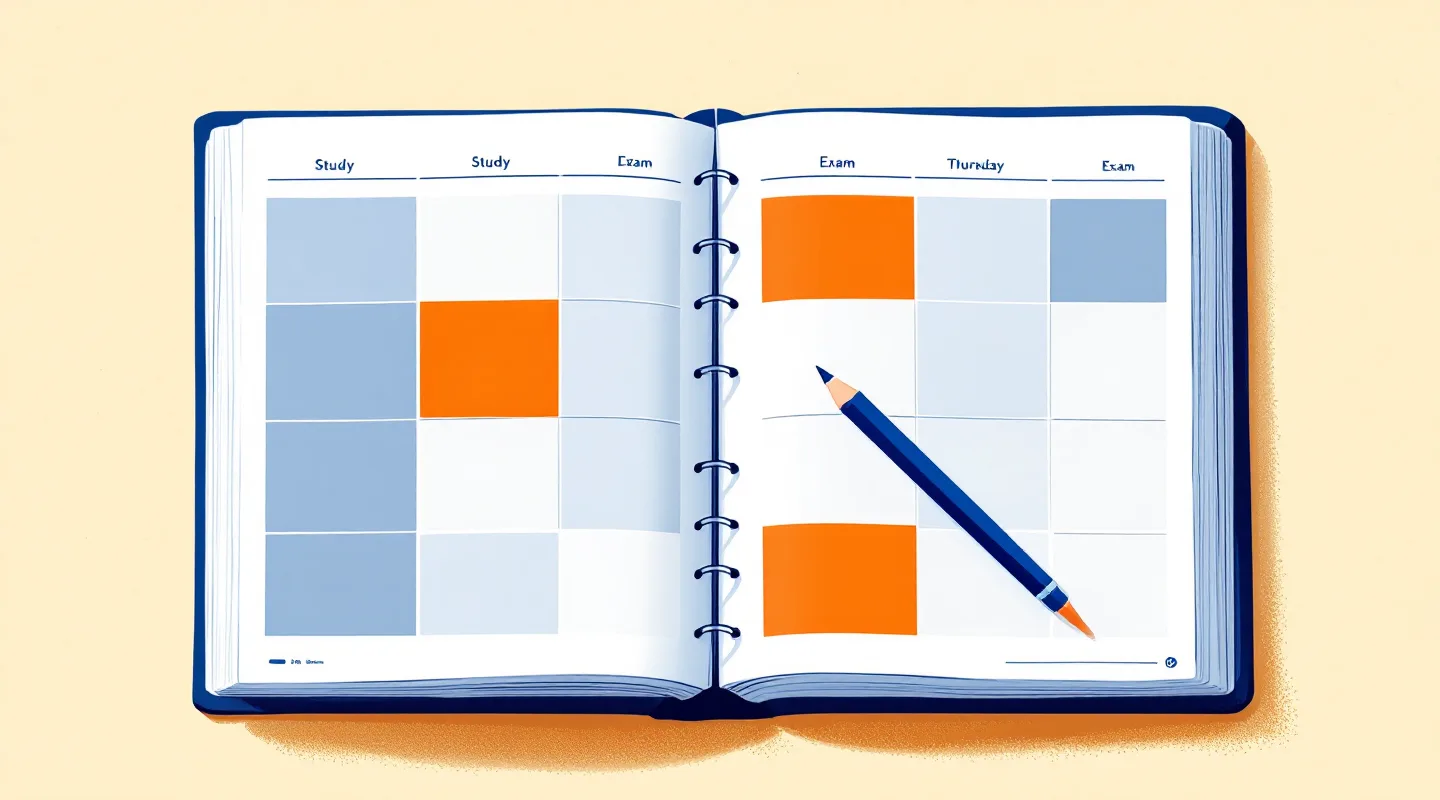
01Why Smart Students Still Struggle
Even college students who study constantly may find that they receive poor grades, despite their diligence. The problem is rarely a failure of intelligence or commitment — it is almost always the fact that they have ineffectual study habits. This distinction matters enormously, because a student who believes they are simply "not smart enough" will feel helpless, while a student who recognizes a fixable process problem can actually do something about it.
Many students have been able to get through high school turning in assignments late, doing them the night before they are due, or without doing adequate research using truly credible sources. Teachers in secondary school often provide significant scaffolding — reminders, partial credit, retakes, and lenient deadlines — that quietly compensate for poor habits. A student can coast on raw ability and last-minute bursts of effort and still earn respectable grades. The system, unintentionally, rewards the wrong behaviors.
In college, however, these bad habits are quickly unmasked. Professors assign dense reading loads, expect independent research from peer-reviewed sources, and rarely accept late work without a significant grade penalty. A paper that would have earned a B+ in high school with one evening of effort might earn a D in a university seminar where critical analysis, proper citation, and sustained argumentation are non-negotiable. The jump is not about intelligence — it is about process.
Poor grades in college often reflect weak study processes, not low ability. Recognizing that habits — not intelligence — are the problem is the first and most important step toward change.
02The Most Common Bad Academic Habits
Before you can fix a bad habit, you need to be able to name it. The following are the patterns that most frequently derail otherwise capable students once they reach college-level expectations.
1Last-Minute Assignment Completion
Cramming an entire paper or project into the night before it is due is perhaps the single most widespread bad academic habit. It feels manageable — even productive — in high school, but college assignments are designed to require sustained thinking. A research paper that demands a thesis, a literature review, and a structured argument simply cannot be done well in a single panicked session. The result is a surface-level, poorly sourced piece of work that communicates to the professor exactly how little time was invested.
The deeper problem with last-minute work is that it creates a negative feedback loop. You submit poor work, receive a poor grade, feel demoralized, and then procrastinate even harder on the next assignment because the whole process has become associated with stress and failure. Breaking the cycle requires interrupting it early — which means starting before you feel ready.
2Cramming Instead of Spaced Review
Cramming for exams — reading everything the night before a test — might produce just enough short-term retention to pass a multiple-choice quiz, but it is notoriously ineffective for exams that require application, synthesis, or extended written responses. The information simply does not consolidate into long-term memory when consumed in a single overwhelming session. Spaced, incremental review — returning to material over several days or weeks — is far more effective for retaining and genuinely understanding content.
Consider the difference between a student who reviews their biology notes for twenty minutes each day in the week before an exam versus one who reads the entire unit the night before. The first student has seen the material multiple times, processed it in different mental states, and had time to identify and address their gaps. The second student may recognize the words on the page but will struggle to apply the concepts under exam conditions.
3Relying on Poor-Quality Sources
High school assignments often accept a wide range of sources — Wikipedia, news websites, or general encyclopedias — without serious penalty. College courses, particularly in the social sciences, humanities, and natural sciences, typically require peer-reviewed journal articles, academic books, and primary sources. A student who has never practiced finding and evaluating credible sources will spend enormous time floundering in a university library database or, worse, submit papers built on unreliable information that professors will immediately flag.
Learning to use tools like your institution's library portal, Google Scholar, or discipline-specific databases is not just a nice skill to have — it is a fundamental requirement of college-level academic work.
4No Organizational System
Many students arrive at college without any consistent system for tracking assignments, deadlines, and long-term project milestones. They rely on memory, scattered sticky notes, or a vague awareness that "something is due this week." This works when your entire academic life is managed by one teacher in a single classroom. It collapses completely when you are juggling five courses, each with its own syllabus, reading schedule, and assessment calendar.
Naming your specific bad habits — cramming, poor sourcing, missing deadlines, no planning system — is more useful than a vague sense that you "need to study more." Precision makes change actionable.
03A Three-Step Framework for Building Better Habits
Changing entrenched academic behaviors is genuinely difficult. It requires more than good intentions — it requires a structured approach that accounts for the reality that motivation fluctuates and willpower alone is unreliable. The following three-step framework is designed to be concrete and realistic, not idealistic.
1Step One — Make an Honest List of the Habits You Want to Build
Start by writing down, specifically, the academic habits you wish you had. The source of this advice is important: this should not be a vague aspiration like "study more" but a concrete list of behaviors. For example:
- Maintaining a running calendar of all assignments with their due dates entered the moment the syllabus is distributed
- Studying a small amount every day rather than cramming everything into one or two sessions
- Beginning papers at least two weeks before they are due so that you have time to research, draft, revise, and proofread
- Locating and reading credible sources before you begin writing, rather than searching for sources to support conclusions you have already written
- Reviewing class notes within 24 hours of taking them while the material is still fresh
Writing this list serves two purposes. First, it forces you to be specific about what you are actually trying to change. Second, it gives you a concrete reference point — something you can return to when you drift back toward old patterns, which you will.
Fig. 1 — Instead of writing "study more," a student writes: "I will review my sociology notes for 20 minutes every Tuesday and Thursday evening immediately after dinner, before opening social media." The specificity — subject, duration, time, trigger — makes the habit far easier to actually execute and track.
2Step Two — Budget Time and Resources Into Your Schedule
Wanting a habit and making space for it are two very different things. Once you have your list, you need to build the time and resources required to act on it directly into your weekly schedule — not as aspirational intentions, but as committed blocks of time.
This means opening your calendar — whether digital or paper — and treating study blocks with the same non-negotiable status as a class that appears on your transcript. If you have a paper due in three weeks, work backwards: when will you search for sources? When will you write a rough outline? When will you produce a first draft? When will you revise? Each of those phases needs a dedicated slot in your schedule, not a vague plan to "get to it."
Budgeting resources matters just as much as budgeting time. Do you know how to access your institution's academic databases? Do you have a citation management approach? Do you know where the writing center is and how to book a session? These are not trivial logistics — they are the infrastructure that makes good habits possible. Identify the gaps in your resources before you need them urgently.
3Step Three — Do Not Be Derailed by Setbacks
This is perhaps the most psychologically important step, and it is the one most students overlook. Bad habits are extremely hard to change. You will miss a study session. You will procrastinate on a paper despite your best intentions. You will cram for an exam even after vowing not to. This is normal, expected, and — critically — not a reason to abandon the effort entirely.
The danger lies in what is sometimes called black-and-white thinking: the belief that because you slipped once, the entire endeavor has failed and there is no point continuing. A student who misses one planned study session and concludes "I'll never change, I might as well stop trying" is letting a single small failure erase multiple small wins. This kind of all-or-nothing reasoning is one of the most common reasons self-improvement attempts collapse.
The more accurate mental model is this: a good habit is built by the accumulation of many small, positive actions which add up to a greater whole — a genuinely new behavior pattern. Missing one session does not undo the four sessions you completed. It is simply a data point. The only question worth asking is: what do I do next? The answer is always the same — return to the plan and continue.
04Why Regular Studying Works Like Dental Hygiene
The comparison between studying regularly and brushing your teeth is more instructive than it first appears. Nobody brushes their teeth because they find it intrinsically rewarding in the moment. They do it because they understand, at a deep level, that the cumulative effect of daily maintenance is a healthy outcome they care about — and that skipping the habit consistently leads to consequences that are expensive, painful, and difficult to reverse.
Academic habits work on exactly the same logic. Reviewing your notes for twenty minutes after each class does not feel transformative in the moment. But over a semester, a student who does this consistently has reviewed their material dozens of times before the final exam, has identified and addressed confusing concepts in real time, and has built a level of familiarity with the content that no amount of last-minute cramming can replicate. The daily investment is modest; the compounding effect is substantial.
The key insight is that you do not wait until you feel motivated to brush your teeth. You do it regardless of how tired you are, because it is part of your routine. Building academic habits requires exactly the same approach: anchoring study behaviors to fixed points in your day — after a meal, before a regular evening activity, at a consistent time each morning — so that they become automatic rather than dependent on willpower or motivation, both of which are unreliable.
Anchor your study habits to consistent daily triggers — just as you do with brushing your teeth — so that showing up becomes automatic and doesn't depend on motivation you may not always feel.
05Producing High-Quality Work Without the Last-Minute Rush
One practical goal that ties all of these habits together is learning to produce high-quality academic work without cramming or doing anything at the last minute. This sounds obvious, but it represents a genuine shift in how you relate to your coursework — from reactive (responding to deadlines as they arrive) to proactive (shaping your workload before it shapes you).
Concretely, this means treating your assignments as multi-stage projects rather than single-sitting tasks. A research paper, for instance, has at least five distinct phases: choosing and narrowing a topic, locating and evaluating sources, developing a thesis and outline, drafting, and revising. Each of those phases deserves dedicated time. When you begin early enough to move through them deliberately, the quality of your thinking — and therefore your writing — improves significantly. You have time to reconsider your thesis when you find a source that complicates it. You have time to restructure an argument that isn't working. You have time to let a draft sit for a day and return to it with fresh eyes.
Beginning papers early also creates a more positive image of yourself as a student — not just in the eyes of professors, but in your own self-perception. When you are not perpetually behind, you engage more confidently in class discussions, ask better questions during office hours, and approach exams with less anxiety. The cumulative effect of good habits is not just a higher GPA; it is a fundamentally different relationship with your own academic identity.
If you find it difficult to get started on any given assignment, one of the most effective strategies is to begin with a structured outline. Knowing where your paper is going — what your central argument is, what evidence you'll use, and how your sections will progress — removes the paralysis of the blank page and gives you a concrete first step that feels manageable rather than overwhelming.