How to Cite a Journal Article in APA (7th Edition)
Updated · Follows the Publication Manual of the American Psychological Association, 7th edition (2020)
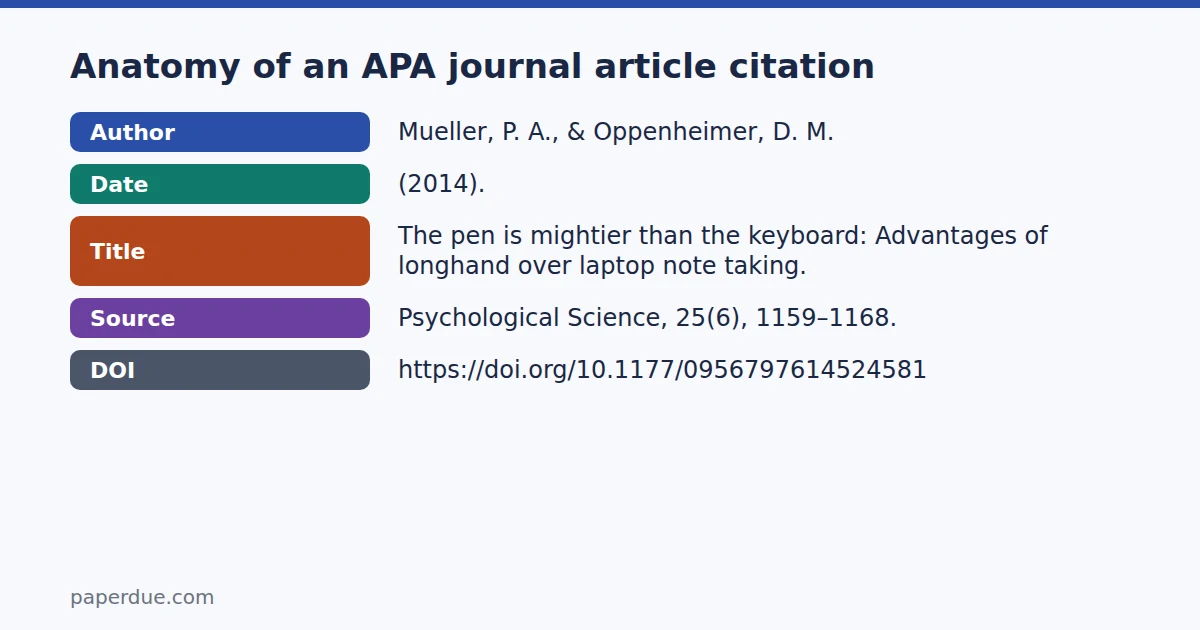
Author, A. A., & Author, B. B. (Year). Title of article. Journal Name, Volume(Issue), Pages. https://doi.org/xxxxThe journal name and volume number are italicized. Include a DOI as a full link whenever one exists. List all authors by last name and initials only.Mueller, P. A., & Oppenheimer, D. M. (2014). The pen is mightier than the keyboard: Advantages of longhand over laptop note taking. Psychological Science, 25(6), 1159–1168. https://doi.org/10.1177/0956797614524581
(Mueller & Oppenheimer, 2014)
Narrative: Mueller and Oppenheimer (2014)
Examples
1. Two authors, with a DOI
The first example shows the standard two-author case. Both authors appear in the reference list as last name followed by initials, joined by an ampersand. The article title uses sentence case, meaning only the first word and proper nouns are capitalized. The journal name is italicized and in title case, the volume number is italicized, the issue number follows in parentheses without italics, and the DOI appears as a full web address.
Mueller, P. A., & Oppenheimer, D. M. (2014). The pen is mightier than the keyboard: Advantages of longhand over laptop note taking. Psychological Science, 25(6), 1159–1168. https://doi.org/10.1177/0956797614524581
In-text(Mueller & Oppenheimer, 2014) NarrativeMueller and Oppenheimer (2014)
2. Three to 20 authors
The second example has five authors, which falls in the three-to-twenty range. All five names appear in the reference list, each reduced to last name and initials, separated by commas, with an ampersand before the final name. In the in-text citation, however, only the first author's last name is used, followed by "et al." and the year — this shortening applies from the very first citation when there are three or more authors.
Dunlosky, J., Rawson, K. A., Marsh, E. J., Nathan, M. J., & Willingham, D. T. (2013). Improving students’ learning with effective learning techniques: Promising directions from cognitive and educational psychology. Psychological Science in the Public Interest, 14(1), 4–58. https://doi.org/10.1177/1529100612453266
In-text(Dunlosky et al., 2013) NarrativeDunlosky et al. (2013)
3. Group author and an article number instead of pages
The third example demonstrates two special cases at once. The author is an organization rather than an individual, so the full group name appears in the author position with no initials. The article also uses an article number rather than a page range, so the locator is written out with the word "Article" before the identifier. The in-text citation uses the full group name just as it appears in the reference.
Open Science Collaboration. (2015). Estimating the reproducibility of psychological science. Science, 349(6251), Article aac4716. https://doi.org/10.1126/science.aac4716
In-text(Open Science Collaboration, 2015) NarrativeOpen Science Collaboration (2015)
In-text citations in APA
APA in-text citations for journal articles include the author's last name and the publication year. In the parenthetical form, both elements sit inside parentheses separated by a comma. In the narrative form, the author's name appears in the sentence itself and only the year goes in parentheses immediately after it. When two authors are listed, both last names appear in every citation, joined by an ampersand in the parenthetical form and by "and" in the narrative form. With three or more authors, use only the first author's last name followed by "et al." from the very first citation.
When you quote directly or refer to a specific passage, add a page locator after the year, separated by a comma. Use "p." before a single page number and "pp." before a range. If the article uses article numbers instead of page numbers, or if the source has no page numbers at all, use another available locator such as a paragraph number. Both the parenthetical and narrative forms accept the locator in the same position.
| Example | Parenthetical | Narrative |
|---|---|---|
| Two authors, with a DOI | (Mueller & Oppenheimer, 2014) | Mueller and Oppenheimer (2014) |
| Three to 20 authors | (Dunlosky et al., 2013) | Dunlosky et al. (2013) |
| Group author and an article number instead of pages | (Open Science Collaboration, 2015) | Open Science Collaboration (2015) |
Common mistakes
- Italicizing the article title Article titles are not italicized in APA references. Only the journal name and the volume number receive italics. Italicizing the article title is a common slip, especially for students familiar with styles that treat titles differently.
- Using title case for the article title Article titles follow sentence case in APA: capitalize only the first word, the first word after a colon, and proper nouns. Applying title case — capitalizing every major word — is one of the most frequent errors in APA reference lists.
- Omitting the DOI Whenever a journal article has a DOI, it must appear at the end of the reference as a complete link beginning with the standard resolver prefix. Leaving it out, or writing only the bare identifier without the full link format, produces an incomplete reference.
- Writing full first names in the reference list APA reference lists use initials only, never full first names. Even when the source displays a full name, reduce it to the initial or initials that correspond to the author's given name or names.
- Listing all authors in the in-text citation When a work has three or more authors, the in-text citation uses only the first author's last name followed by "et al." from the very first mention. Writing out all the names in the in-text citation is incorrect in APA 7th edition.
Frequently asked questions
What do I do if my journal article has no DOI?
If the article came from an academic research database, end the reference after the page range and add nothing further — no URL and no database name. If the article is freely available on an open website rather than a database, include the article's direct URL. Never use the journal's homepage URL.
How do I cite an article written by an organization rather than individual authors?
Write the organization's full name in the author position, followed by a period. Use the full name in the in-text citation as well, both in the parenthetical and narrative forms. Do not abbreviate the group name in the reference list.
My article uses an article number instead of page numbers — how do I handle that?
Place the word "Article" followed by the identifier in the position where page numbers would normally appear. The third example on this page illustrates this format. Do not invent page numbers or leave the locator field blank.
Do I shorten a three-author citation to et al. only after the first mention?
No. In APA 7th edition, you use the shortened form with "et al." from the very first citation whenever a work has three or more authors. There is no rule requiring you to write all names on the first mention.
How do I add a page number to an in-text citation when quoting directly?
After the year, add a comma, then "p." and the page number for a single page, or "pp." and the range for multiple pages. This applies to both the parenthetical and narrative forms. If the article has no page numbers, use a paragraph number or section name instead.
Should I use an ampersand or the word "and" when citing two authors?
Use an ampersand when the names appear inside parentheses in a parenthetical citation. Use the word "and" when the names appear as part of your sentence in a narrative citation. This distinction applies every time you cite the source.