How to Cite an Image in APA (7th Edition)
Updated · Follows the Publication Manual of the American Psychological Association, 7th edition (2020)
Artist, A. A. (Year). Title of work [Medium]. Museum or Collection, City, Country. URLThe artist's last name and initial come first, followed by the year, the italicized title, the medium in brackets, the holding institution and its location, and a URL linking directly to the work.Monet, C. (1899). Bridge over a pond of water lilies [Painting]. The Metropolitan Museum of Art, New York, NY, United States. https://www.metmuseum.org/art/collection/search/437127
(Monet, 1899)
Narrative: Monet (1899)
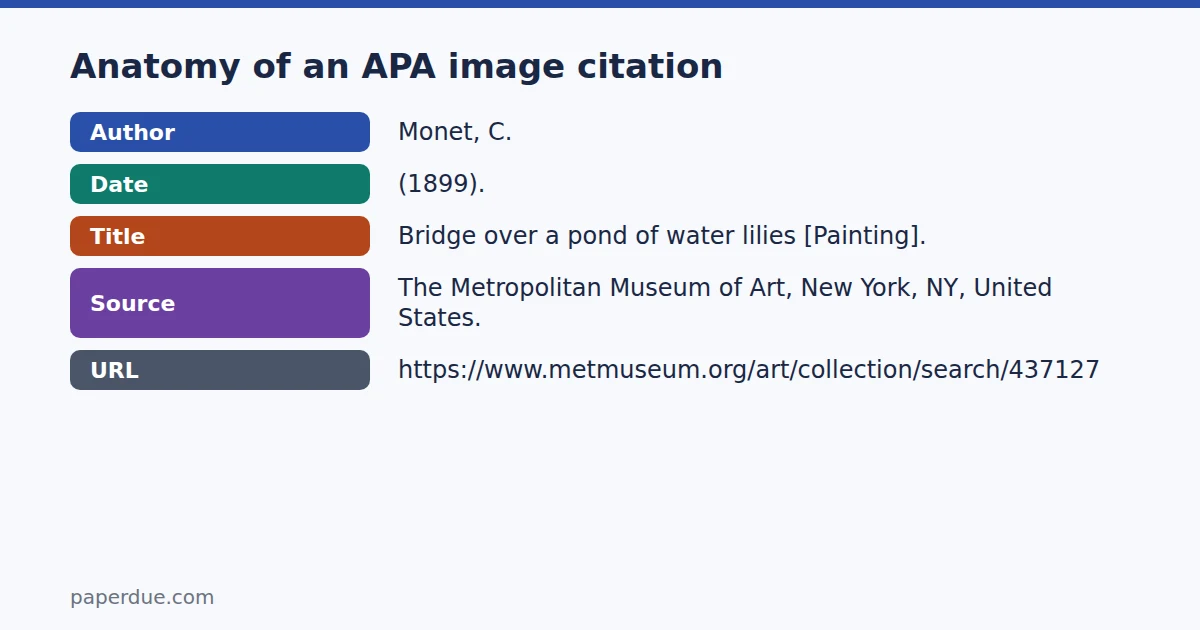
Examples
1. Painting in a museum
This example shows a painting held by a named museum. The artist's last name and first initial open the entry, followed by the year in parentheses. The title is italicized and in sentence case, and the medium appears in brackets immediately after it. The institution name, city, state, and country follow as a location string, and the entry closes with the direct URL to the museum's collection page.
Monet, C. (1899). Bridge over a pond of water lilies [Painting]. The Metropolitan Museum of Art, New York, NY, United States. https://www.metmuseum.org/art/collection/search/437127
In-text(Monet, 1899) NarrativeMonet (1899)
2. Photograph in a library collection
This example follows the same structure as the first but uses a photograph held by a library. Notice that the title is unusually long because it reflects the original descriptive caption; APA preserves the full title as given. The medium label changes to reflect the actual type of work. The location string and URL work the same way as in the first example.
Lange, D. (1936). Destitute pea pickers in California. Mother of seven children. Age thirty-two. Nipomo, California [Photograph]. Library of Congress, Washington, DC, United States. https://www.loc.gov/item/2017762891/
In-text(Lange, 1936) NarrativeLange (1936)
3. Unknown artist, approximate date
When no artist is identified, the title moves to the front of the entry and is italicized there, with the medium label following it in brackets. The date then appears in its own set of parentheses after the label. The prefix 'ca.' signals an approximate date. In the in-text citation, the italicized title replaces the author, and it appears in title case rather than sentence case.
Lineage portrait of an abbot [Painting]. (ca. 1350). The Metropolitan Museum of Art, New York, NY, United States. https://www.metmuseum.org/art/collection/search/37971
In-text(Lineage Portrait of an Abbot, ca. 1350) NarrativeLineage Portrait of an Abbot (ca. 1350)
In-text citations in APA
For images with a known artist, the in-text citation follows the standard APA pattern: the artist's last name and the year of the work. In the parenthetical form the two elements are separated by a comma and enclosed in parentheses. In the narrative form the artist's name appears in the running sentence and the year follows in parentheses directly after it.
When no artist is identified, the italicized title stands in for the author in both forms, as shown in the third example. The title appears in title case in the in-text citation even though it is in sentence case in the reference list. When a date is approximate, the 'ca.' prefix is carried into the in-text citation alongside the year.
| Example | Parenthetical | Narrative |
|---|---|---|
| Painting in a museum | (Monet, 1899) | Monet (1899) |
| Photograph in a library collection | (Lange, 1936) | Lange (1936) |
| Unknown artist, approximate date | (Lineage Portrait of an Abbot, ca. 1350) | Lineage Portrait of an Abbot (ca. 1350) |
Common mistakes
- Forgetting brackets around the medium The medium label, such as Painting or Photograph, must appear in square brackets immediately after the italicized title. Students often omit the brackets entirely or place the label in parentheses instead, which is incorrect in APA format.
- Using full first name instead of initial APA reference entries use only the author's first initial, not the full first name. Writing out the complete given name is one of the most common formatting errors when citing images by well-known artists whose full names are familiar.
- Omitting the location string The institution name, city, and country are all required elements. Students frequently stop after the medium label and jump straight to the URL, leaving out the holding institution and its location entirely.
- Using title case for the title in the reference list Image titles in APA follow sentence case in the reference list, meaning only the first word and proper nouns are capitalized. Applying title case to every major word is a common error carried over from other citation styles.
- Mishandling the unknown-artist format When no artist is identified, the title must move to the author position and the date shifts to follow the medium label in its own parentheses. Students often leave a blank author slot or write 'Anonymous' rather than restructuring the entry as the style requires.
Frequently asked questions
What do I put in the medium bracket if the image type is unclear?
Use the most accurate descriptive term you can determine from the source, such as Painting, Photograph, Drawing, or Print. If the holding institution's catalog page identifies the medium, use that. APA does not provide a fixed list of approved labels, so a plain, descriptive word is acceptable.
Do I need a retrieval date for an image on a museum website?
Generally no. APA requires a retrieval date only for sources that are explicitly designed to change over time, such as wiki pages or live databases. A stable museum collection page with a permanent URL does not require one.
How do I cite an image I found on a general website rather than a museum or library?
Use the same basic structure, replacing the institution and city with the name of the website where the image is hosted. If no artist or date is available, apply the standard APA rules: move the title to the author position and use 'n.d.' for the date.
Should the title still be italicized when there is no known artist?
Yes. When the title moves to the author position because no artist is identified, it remains italicized in both the reference entry and the in-text citation. This italicization signals that the work is a standalone item rather than part of a larger publication.
How do I cite an image that has two artists?
List both artists' last names and initials in the reference entry, separated by a comma and an ampersand. In a parenthetical in-text citation, join the two last names with an ampersand. In a narrative citation, join them with 'and' written out in full.
What if the image has no title at all?
Provide a brief description of the image in square brackets in place of the title, without italics. This description is not italicized because it is your own supplied label rather than an official title. Keep the description concise and informative enough for a reader to identify the work.