How to Cite a Website in APA (7th Edition)
Updated · Follows the Publication Manual of the American Psychological Association, 7th edition (2020)
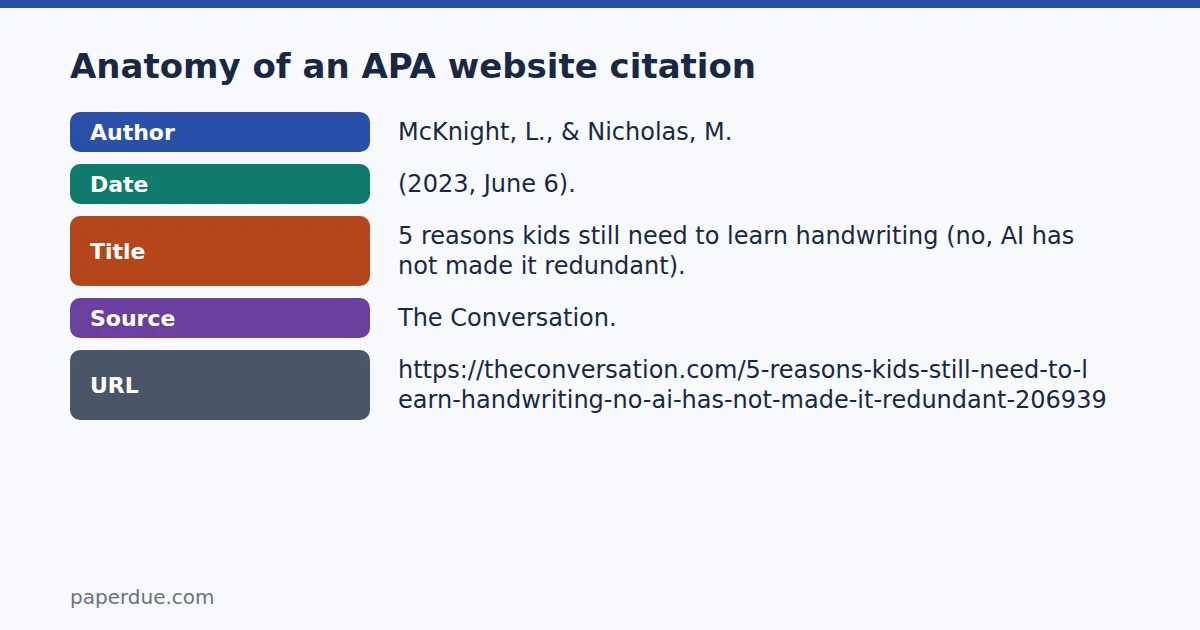
Author, A. A. (Year, Month Day). Title of page. Site Name. URLThe page title is italicized. If information such as the author or date is missing, the format adjusts, as the examples below show.McKnight, L., & Nicholas, M. (2023, June 6). 5 reasons kids still need to learn handwriting (no, AI has not made it redundant). The Conversation. https://theconversation.com/5-reasons-kids-still-need-to-learn-handwriting-no-ai-has-not-made-it-redundant-206939
(McKnight & Nicholas, 2023)
Narrative: McKnight and Nicholas (2023)
Examples
1. Standard web article (two authors, full date)
The first example shows the standard case: two authors with a full publication date. Each author appears as last name followed by initials only. The two authors are joined by an ampersand. The date includes the year, month, and day in that order. The page title is italicized and written in sentence case, meaning only the first word and proper nouns are capitalized. The site name follows, and the full URL closes the entry.
McKnight, L., & Nicholas, M. (2023, June 6). 5 reasons kids still need to learn handwriting (no, AI has not made it redundant). The Conversation. https://theconversation.com/5-reasons-kids-still-need-to-learn-handwriting-no-ai-has-not-made-it-redundant-206939
In-text(McKnight & Nicholas, 2023) NarrativeMcKnight and Nicholas (2023)
2. Three or more authors
The second example shows what happens with three or more authors. All three are listed in the reference entry in the same last-name-then-initials format, separated by commas, with an ampersand before the final name. Notice that a hyphenated given name produces a hyphenated initial pair. In the in-text citation, however, only the first author's last name appears, followed by 'et al.' This shortening applies from the very first citation.
Van Bergen, P., Burns, E., & Wang, H.-C. (2025, February 25). Which type of note-taking is better for learning: Laptop or pen and paper? The Conversation. https://theconversation.com/which-type-of-note-taking-is-better-for-learning-laptop-or-pen-and-paper-250404
In-text(Van Bergen et al., 2025) NarrativeVan Bergen et al. (2025)
3. Organization as author
The third example shows an organization as the author. The organization's full name is written out with no initials. Because the organization and the website are the same entity, the site name is not repeated after the title — doing so would be redundant. The reference moves directly from the title to the URL. In-text, the organization's full name is used every time.
World Health Organization. (2025, December 4). Malaria. https://www.who.int/news-room/fact-sheets/detail/malaria
In-text(World Health Organization, 2025) NarrativeWorld Health Organization (2025)
4. No author and no date
The fourth example shows two adjustments at once: no named author and no date. When there is no author, the page title shifts to the author position at the start of the entry, and 'n.d.' replaces the year. Because this type of page is likely to change over time, a retrieval date is added just before the URL, introduced by 'Retrieved' and followed by 'from'. In the in-text citation, the italicized title in title case stands in for the author name, paired with 'n.d.'
Tips and examples for writing thesis statements. (n.d.). Purdue OWL. Retrieved November 17, 2026, from https://owl.purdue.edu/owl/general_writing/the_writing_process/thesis_statement_tips.html
In-text(Tips and Examples for Writing Thesis Statements, n.d.) NarrativeTips and Examples for Writing Thesis Statements (n.d.)
In-text citations in APA
For most website citations, the parenthetical in-text citation contains the author's last name and the year of publication. In the narrative form, the author's name appears in the sentence itself and the year follows in parentheses immediately after. When there are two authors, use an ampersand between their names in the parenthetical form and the word 'and' in the narrative form. With three or more authors, use only the first author's last name followed by 'et al.' in both forms.
When no author is identified, the page title moves to the author position: in sentence case in the reference list, and in italic title case in the in-text citation. When no date is available, 'n.d.' replaces the year in both positions. If you quote directly from a web page or refer to a specific passage, add a page number after the year using 'p.' for a single page or 'pp.' for a range. Many web pages are not paginated, so a page number will not always be possible.
| Example | Parenthetical | Narrative |
|---|---|---|
| Standard web article (two authors, full date) | (McKnight & Nicholas, 2023) | McKnight and Nicholas (2023) |
| Three or more authors | (Van Bergen et al., 2025) | Van Bergen et al. (2025) |
| Organization as author | (World Health Organization, 2025) | World Health Organization (2025) |
| No author and no date | (Tips and Examples for Writing Thesis Statements, n.d.) | Tips and Examples for Writing Thesis Statements (n.d.) |
Common mistakes
- Using full first names in the reference list APA requires initials only, not full given names, for all individual authors in the reference list. Write the last name, a comma, and then the initial or initials followed by periods. Full names belong in the text of your paper, not in the citation.
- Repeating the site name when it matches the author When an organization is both the author and the website, the site name is omitted from the reference entry. Including it twice is an error. Check whether the author name and the site name refer to the same entity before adding the site name field.
- Forgetting to italicize the page title The title of a standalone web page is italicized in the reference list. Students frequently leave it in plain text. The title is also written in sentence case, so resist the urge to capitalize every major word.
- Omitting the retrieval date on undated, changeable pages When a page has no publication date and its content is likely to be updated, a retrieval date is required. Without it, a reader cannot know what version of the page you consulted. Add the date you accessed the page, introduced by 'Retrieved' and followed by 'from' before the URL.
- Using 'et al.' incorrectly for two authors 'Et al.' is used only when there are three or more authors. With exactly two authors, both last names must appear in every in-text citation, joined by an ampersand in parenthetical form or by 'and' in narrative form. Dropping one name is not permitted.
Frequently asked questions
What do I do if the web page has no author at all?
Move the page title to the author position at the start of your reference entry. In your in-text citation, use the italicized title in title case where the author name would normally go, paired with the year or 'n.d.' if there is no date. Shorten a very long title to the first few words so the in-text citation stays readable.
Do I need to include the date I accessed the website?
Only in specific circumstances. A retrieval date is added when the page has no publication date and its content is the kind that changes over time, such as a live statistics page or a wiki entry. For most ordinary web articles with a clear publication date, no retrieval date is needed.
How do I handle a web page that lists a year but no specific month or day?
Use only the year in the date parentheses in your reference entry. The in-text citation also uses the year alone. You do not need to estimate or leave the date out simply because the month and day are unavailable.
Should I include the site name if it is already obvious from the URL?
Yes, include the site name as a separate element in the reference unless the site name is the same as the author. APA treats the site name as a source container that helps readers locate the work, so it belongs in the entry regardless of what the URL reveals.
How do I cite a web page in-text when I am quoting directly from it?
Add a page locator after the year inside the parentheses. Use 'p.' followed by the page number for a single page, or 'pp.' for a range. Many web pages have no page numbers, in which case you may omit the locator or, if the page uses numbered paragraphs, use 'para.' followed by the paragraph number.
What if the same organization is listed as both the author and the site name?
Omit the site name from the reference entry. Repeating the same name in both the author position and the site name field is redundant, and APA instructs you to leave the site name out in this situation. The reference moves directly from the title to the URL.