How to Cite a YouTube Video in APA (7th Edition)
Updated · Follows the Publication Manual of the American Psychological Association, 7th edition (2020)
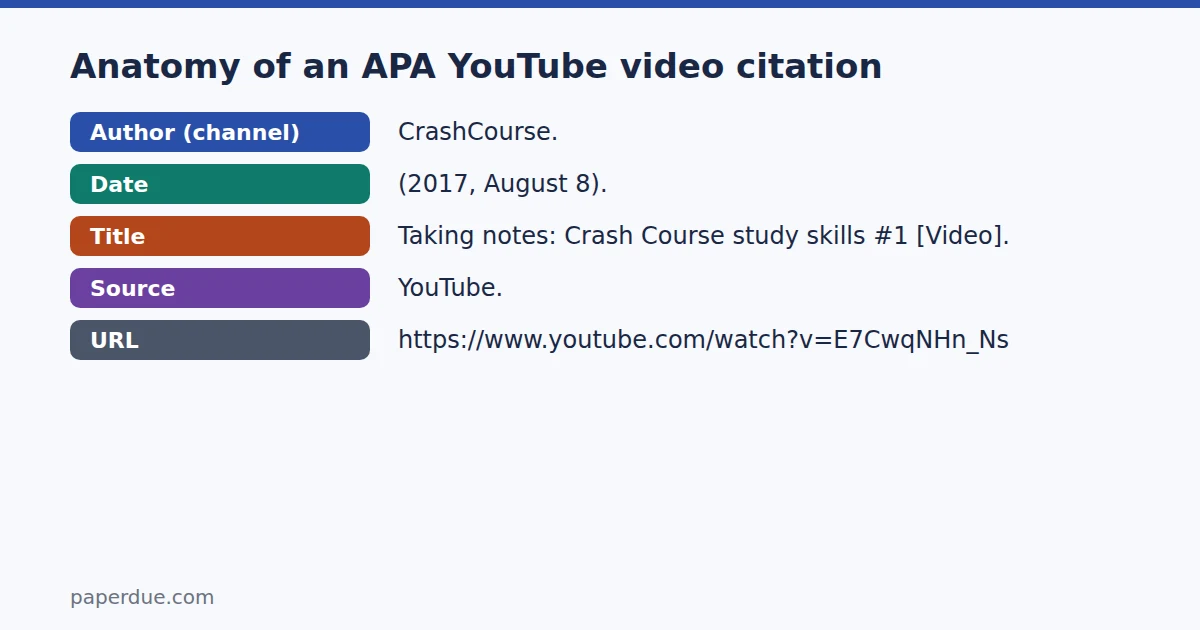
Channel Name. (Year, Month Day). Title of video [Video]. YouTube. URLThe channel name acts as the author, the full upload date appears in parentheses, the video title is italicized and in sentence case, and the label [Video] follows in brackets.CrashCourse. (2017, August 8). Taking notes: Crash Course study skills #1 [Video]. YouTube. https://www.youtube.com/watch?v=E7CwqNHn_Ns
(CrashCourse, 2017)
Narrative: CrashCourse (2017)
Examples
1. Channel as author
The first example shows the most common case: a channel with no individual author listed. The channel name fills the author position, followed by the full date in parentheses. The video title is italicized and written in sentence case, meaning only the first word and proper nouns are capitalized. The bracketed label [Video] identifies the source type, and the reference closes with the site name and the full URL.
CrashCourse. (2017, August 8). Taking notes: Crash Course study skills #1 [Video]. YouTube. https://www.youtube.com/watch?v=E7CwqNHn_Ns
In-text(CrashCourse, 2017) NarrativeCrashCourse (2017)
2. Organization channel with the speaker in the title
The second example shows an organizational channel where a speaker's name appears inside the video title itself. Because no individual is listed as an author in the source's metadata, the channel name still takes the author position. The speaker's name is not pulled out and reformatted; it stays exactly as it appears in the title. The in-text citation therefore uses the channel name, not the speaker's name.
TED. (2014, December 17). The power of believing that you can improve | Carol Dweck | TED [Video]. YouTube. https://www.youtube.com/watch?v=_X0mgOOSpLU
In-text(TED, 2014) NarrativeTED (2014)
3. Citing a specific moment (timestamp)
The third example shows how to direct a reader to a specific moment in a video. The reference entry itself is identical to the first example — the timestamp does not appear there. The timestamp appears only in the in-text citation, added after the year and separated by a comma, as shown in the parenthetical and narrative forms in the table below.
CrashCourse. (2017, August 8). Taking notes: Crash Course study skills #1 [Video]. YouTube. https://www.youtube.com/watch?v=E7CwqNHn_Ns
In-text(CrashCourse, 2017, 1:30) NarrativeCrashCourse (2017, 1:30)
In-text citations in APA
For a YouTube video, the in-text citation uses the channel name and the upload year. In the parenthetical form, both appear inside parentheses separated by a comma, as shown in the first example in the table. In the narrative form, the channel name appears in the running sentence and the year follows in parentheses immediately after it.
When you refer to a specific moment in a video — a particular scene, statement, or demonstration — add the timestamp after the year, separated by a comma, as the third example shows. This works the same way in both the parenthetical and narrative forms. No additional label such as "p." is used; the timestamp is written exactly as it appears on the video player.
| Example | Parenthetical | Narrative |
|---|---|---|
| Channel as author | (CrashCourse, 2017) | CrashCourse (2017) |
| Organization channel with the speaker in the title | (TED, 2014) | TED (2014) |
| Citing a specific moment (timestamp) | (CrashCourse, 2017, 1:30) | CrashCourse (2017, 1:30) |
Common mistakes
- Using title case for the video title APA 7th edition uses sentence case for video titles in the reference list, meaning only the first word, the first word after a colon, and proper nouns are capitalized. Capitalizing every major word is a common error carried over from other styles.
- Omitting the [Video] descriptor The bracketed label [Video] must appear directly after the italicized title. Students often leave it out entirely. It tells the reader what kind of source they are looking at and is a required element of the reference.
- Putting the timestamp in the reference entry A timestamp belongs only in the in-text citation, not in the reference list entry. The reference entry is the same whether you cite the whole video or a single moment within it.
- Using the video creator's name instead of the channel name When no individual author is credited in the source metadata, the channel name is the author. If a speaker's name appears only inside the video title, it stays there and is not moved to the author position.
- Shortening or paraphrasing the video title Copy the title exactly as it appears on the YouTube page, including any subtitles or additional text after a pipe symbol. Changing or shortening the title makes the source harder to locate and does not follow APA guidelines.
Frequently asked questions
What if the YouTube channel name is the same as the website name?
When the channel name and the site name are the same, you do not repeat the name in the site position. However, for YouTube videos the channel name is almost never identical to the platform name itself, so in practice you will list the channel name as the author and YouTube as the site.
Do I need a retrieval date for a YouTube video?
APA 7th edition does not require a retrieval date for most online sources, including YouTube videos, because the URL points to a stable page. You only add a retrieval date when the content is explicitly designed to change over time, which is not typical of YouTube videos.
How do I cite a YouTube video with no upload date shown?
If no date is available, use "n.d." in place of the year in both the reference entry and the in-text citation. This signals to the reader that the date could not be determined from the source.
How do I handle a YouTube video that has an individual creator and a channel name?
If the video lists an individual person as the creator, use that person's last name and initials in the author position, following standard APA author formatting. The channel name would then appear in brackets after the author name. When no individual is credited, the channel name alone serves as the author.
Does the URL need to be formatted in a special way?
Include the full URL exactly as it appears in your browser. APA 7th edition does not require you to add a "Retrieved from" label before the URL. Do not add a period after the URL at the end of the reference entry.