How to Cite a Book in MLA (9th Edition)
Updated · Follows the MLA Handbook, 9th edition (2021)
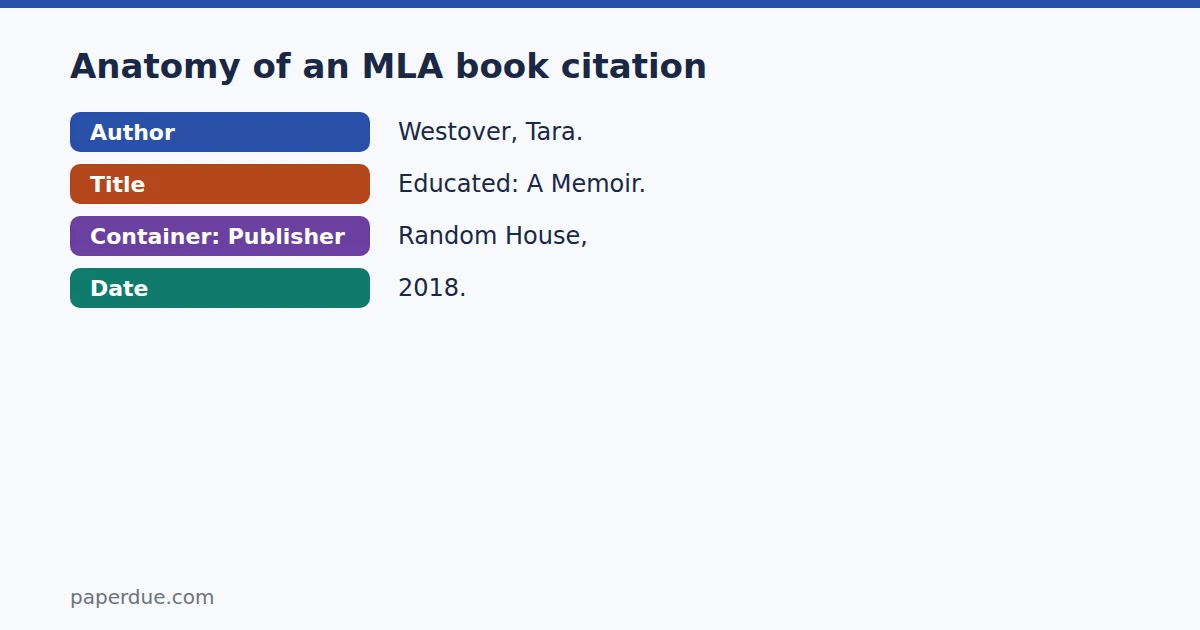
Author Last Name, First Name. Title of Book. Publisher, Year.Every element must appear in this order, with the book title italicized and title case applied throughout.Westover, Tara. Educated: A Memoir. Random House, 2018.
(Westover)
Narrative: Westover
Examples
1. One author
The first example shows the most common case: a single author. The author's last name comes first, followed by a comma and the first name, then a period. The book title is italicized and written in title case even if the source itself uses different capitalization. The publisher and year follow, each separated by a comma, with a final period closing the entry.
Westover, Tara. Educated: A Memoir. Random House, 2018.
In-text(Westover) NarrativeWestover
2. Two authors
The second example shows two authors. Only the first author's name is inverted; the second appears in normal order after a comma and the word 'and'. Title case is again applied to the full subtitle as well as the main title.
Heath, Chip, and Dan Heath. Made to Stick: Why Some Ideas Survive and Others Die. Random House, 2007.
In-text(Heath and Heath) NarrativeHeath and Heath
3. Organization as author and publisher, with an edition
The third example shows what happens when an organization is both the author and the publisher. Because listing the same entity twice would be redundant, MLA drops the author position entirely and the entry opens directly with the italicized title. The edition appears immediately after the title as '7th ed.,' before the publisher and year.
Publication Manual of the American Psychological Association. 7th ed., American Psychological Association, 2020.
In-text(Publication Manual of the American Psychological Association) NarrativePublication Manual of the American Psychological Association
In-text citations in MLA
In MLA, a book's in-text citation gives the author's last name, followed by a page number when you refer to a specific passage. There is no comma between the name and the page number, and no 'p.' or 'pp.' label. The closing punctuation of your sentence goes after the closing parenthesis, not before it.
In a narrative citation you work the author's name into your sentence naturally, and any page number goes in parentheses at the end of the clause or sentence. When an organization is both author and publisher, the in-text citation uses the italicized book title instead of an author name, as shown in the third example in the table. For two authors, both last names appear joined by 'and'; for three or more, only the first last name is used followed by 'et al.'
| Example | Parenthetical | Narrative |
|---|---|---|
| One author | (Westover) | Westover |
| Two authors | (Heath and Heath) | Heath and Heath |
| Organization as author and publisher, with an edition | (Publication Manual of the American Psychological Association) | Publication Manual of the American Psychological Association |
Common mistakes
- Inverting both authors' names When a book has two authors, only the first author's name is inverted to last name, first name. The second author is written in normal order. Inverting both is a common error that will make your entry incorrect.
- Forgetting title case on the book title MLA requires title case on Works Cited entries regardless of how the title appears on the cover or title page. Major words are capitalized, including the first word of any subtitle following a colon.
- Adding 'p.' before a page number in-text Unlike some other styles, MLA does not use 'p.' or 'pp.' before page numbers in parenthetical citations. Write the number alone, with no label and no comma separating it from the author's name.
- Listing an organization author that is also the publisher When an organization is both the author and the publisher, MLA omits the author from the entry and begins with the title. Listing the organization in both positions is incorrect and will confuse readers trying to match your in-text citation to the Works Cited entry.
- Placing sentence punctuation before the closing parenthesis The period or comma that ends your sentence belongs after the closing parenthesis of an in-text citation, not before it. Placing it inside is a consistent error that affects every parenthetical citation in a paper.
Frequently asked questions
Do I need to include a page number every time I cite a book in MLA?
You should include a page number whenever you are referring to a specific passage, quotation, or piece of information from a particular page. If you are making a general claim about the book as a whole, a page number is not required. When you do include one, place it after the author's last name with no comma and no 'p.' label.
What do I do if a book has three or more authors?
In both the Works Cited entry and the in-text citation, give only the first author's name followed by 'et al.' This applies to books with three or more authors. The Works Cited entry inverts the first author's name as usual, then adds 'et al.' in place of listing everyone.
How do I cite a book with no individual author, just an organization?
If the organization is not also the publisher, treat it as the author, placing its full name in the author position. If the organization is both author and publisher, omit it from the author position and begin the entry with the title. Your in-text citation then uses the italicized title rather than an author name.
Does the edition need to be included, and how is it formatted?
Include the edition only when the book is not a first edition, since readers need that information to locate the correct version. Place it after the title, written as '2nd ed.,' or '7th ed.,' and so on, before the publisher name.
Where does the Works Cited page go in my paper?
The Works Cited page appears at the end of your paper on a new page. It is alphabetized by the first word of each entry, which is usually the author's last name. This is why your in-text citation must begin with the same word as the Works Cited entry, so readers can find the full source quickly.
Can I shorten a long book title in an in-text citation?
You may shorten a title used in an in-text citation when the full title is very long, but begin with the first word of the title as it appears in the Works Cited entry so readers can locate it. Keep enough of the title to make the source identifiable, and maintain italics for book titles.