How to Cite a Website in MLA (9th Edition)
Updated · Follows the MLA Handbook, 9th edition (2021)
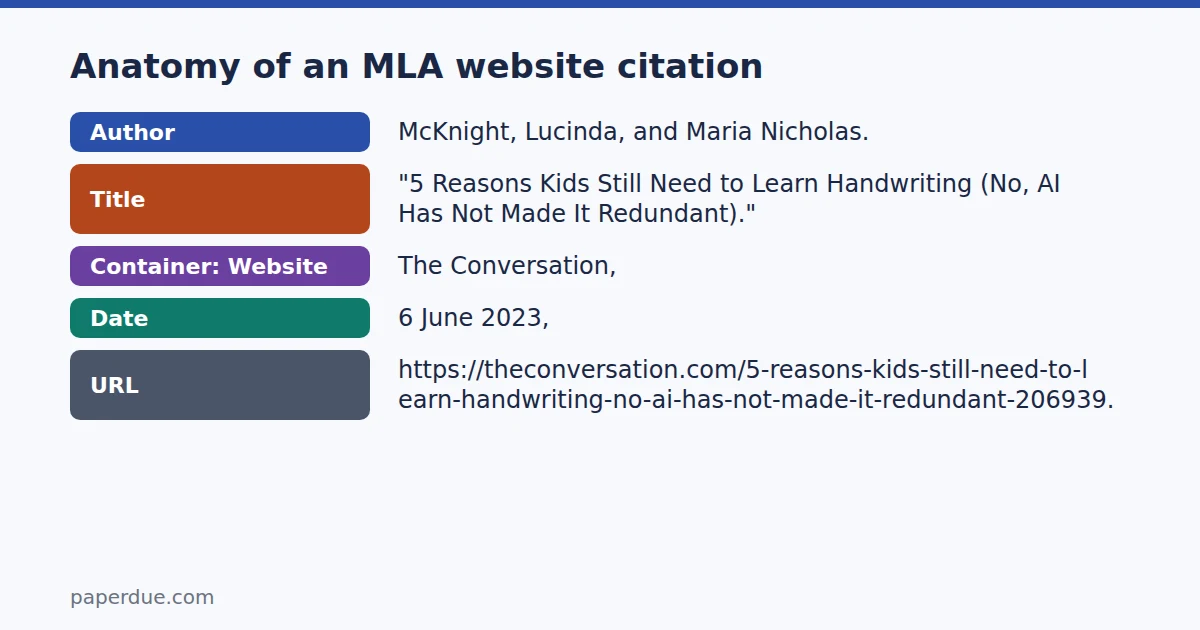
Author Last Name, First Name. "Title of Page." Website Name, Day Month Year, URL.The website name is italicized. If no author is listed, begin with the page title in quotation marks. Add an access date at the end when the page has no publication date.McKnight, Lucinda, and Maria Nicholas. "5 Reasons Kids Still Need to Learn Handwriting (No, AI Has Not Made It Redundant)." The Conversation, 6 June 2023, https://theconversation.com/5-reasons-kids-still-need-to-learn-handwriting-no-ai-has-not-made-it-redundant-206939.
(McKnight and Nicholas)
Narrative: McKnight and Nicholas
Examples
1. Standard web article (two authors, full date)
The first example shows a standard two-author web article. Both authors are named in full, with the first author inverted. The page title appears in quotation marks with title case applied throughout. Notice that the month is written in full because June is four letters or fewer. The website name is italicized as the container.
McKnight, Lucinda, and Maria Nicholas. "5 Reasons Kids Still Need to Learn Handwriting (No, AI Has Not Made It Redundant)." The Conversation, 6 June 2023, https://theconversation.com/5-reasons-kids-still-need-to-learn-handwriting-no-ai-has-not-made-it-redundant-206939.
In-text(McKnight and Nicholas) NarrativeMcKnight and Nicholas
2. Three or more authors
The second example shows how three or more authors are handled. Only the first author is named, followed by "et al." in place of the remaining names. This applies in both the reference entry and the in-text citation. Also notice that February is abbreviated to "Feb." because it exceeds four letters.
Van Bergen, Penny, et al. "Which Type of Note-Taking Is Better for Learning: Laptop or Pen and Paper?" The Conversation, 25 Feb. 2025, https://theconversation.com/which-type-of-note-taking-is-better-for-learning-laptop-or-pen-and-paper-250404.
In-text(Van Bergen et al.) NarrativeVan Bergen et al.
3. No individual author (organization page)
The third example shows an organization that is both the author and the website. Because the organization and the site name are the same entity, the entry begins directly with the page title rather than repeating the organization's name. The in-text citation therefore uses the page title in quotation marks instead of an author name.
"Malaria." World Health Organization, 4 Dec. 2025, https://www.who.int/news-room/fact-sheets/detail/malaria.
In-text("Malaria") Narrative"Malaria"
4. No author and no date
The fourth example shows a page with no author and no publication date. The entry begins with the title, and the URL is followed by an access date introduced by the word "Accessed." The access date helps readers know when the page was retrieved, which is especially useful when content may change over time.
"Tips and Examples for Writing Thesis Statements." Purdue OWL, https://owl.purdue.edu/owl/general_writing/the_writing_process/thesis_statement_tips.html. Accessed 17 Nov. 2026.
In-text("Tips and Examples for Writing Thesis Statements") Narrative"Tips and Examples for Writing Thesis Statements"
In-text citations in MLA
For most website citations, the parenthetical in-text citation contains only the author's last name, since web pages rarely have page numbers. There is no comma between the name and any locator, and no "p." or "pp." label. The closing punctuation of your sentence goes after the closing parenthesis, not before it.
When there is no individual author and the organization is also the publisher, the in-text citation uses the page title in quotation marks instead, as shown in the third and fourth examples above. If that title is long, you may shorten it, but the shortened version must begin with the same word as the full title so readers can locate the matching Works Cited entry. In a narrative citation, you work the author name or title into your sentence and place any locator in parentheses at the end of the clause.
| Example | Parenthetical | Narrative |
|---|---|---|
| Standard web article (two authors, full date) | (McKnight and Nicholas) | McKnight and Nicholas |
| Three or more authors | (Van Bergen et al.) | Van Bergen et al. |
| No individual author (organization page) | ("Malaria") | "Malaria" |
| No author and no date | ("Tips and Examples for Writing Thesis Statements") | "Tips and Examples for Writing Thesis Statements" |
Common mistakes
- Forgetting to italicize the website name The website name is a container in MLA and must always be italicized. Students frequently leave it in plain text, which makes it harder for readers to distinguish the page title from the site name.
- Repeating an organization as both author and site When the organization that created the page is also the website, MLA drops it from the author position entirely and begins the entry with the page title. Listing the organization twice is incorrect.
- Omitting the access date for undated pages When a page has no publication date, an access date tells readers when you retrieved the content. Leaving it out makes the citation less useful, since web content can change or disappear.
- Wrong title case in the page title MLA title case lowercases articles, coordinating conjunctions, and prepositions unless they open the title or subtitle. Students often capitalize every word or leave the title in sentence case as it appears on the webpage.
- Abbreviating short month names MLA only abbreviates months longer than four letters. May, June, and July are always written in full. Writing "Jun." or "Jul." in a Works Cited entry is incorrect.
Frequently asked questions
What do I put in the in-text citation if the webpage has no author?
Use the page title in quotation marks, shortened if it is long. The shortened title must start with the same word as the full title in your Works Cited entry so your reader can match the two. This is shown in the third and fourth examples on this page.
Do I need to include the URL in my Works Cited entry?
Yes. MLA 9th edition includes the full URL as part of the standard website entry. You can see this in all four examples above. If your instructor asks you to omit URLs, follow their instructions, but the default format includes them.
When should I add an access date to a website citation?
An access date is most useful when the page has no publication date, since it gives readers a reference point for when the content existed. It is optional for dated pages but never wrong to include.
How do I cite a page written by a large organization like a government agency?
If the organization is also the name of the website, begin the entry with the page title and omit the organization from the author slot entirely, exactly as shown in the third example. If the organization and the website have different names, treat the organization as the author.
Does the period go before or after the closing parenthesis in an in-text citation?
The period goes after the closing parenthesis. The parenthetical citation is considered part of the sentence's punctuation, so you write your sentence, add the citation in parentheses, and then place the period outside.
How do I handle a webpage with four or more authors?
List only the first author's name in inverted order, then add "et al." in place of the remaining authors. Use the same form in the in-text citation. The second example on this page demonstrates this with a three-author source, and the same rule applies for four or more.