How to Cite an Image in MLA (9th Edition)
Updated · Follows the MLA Handbook, 9th edition (2021)
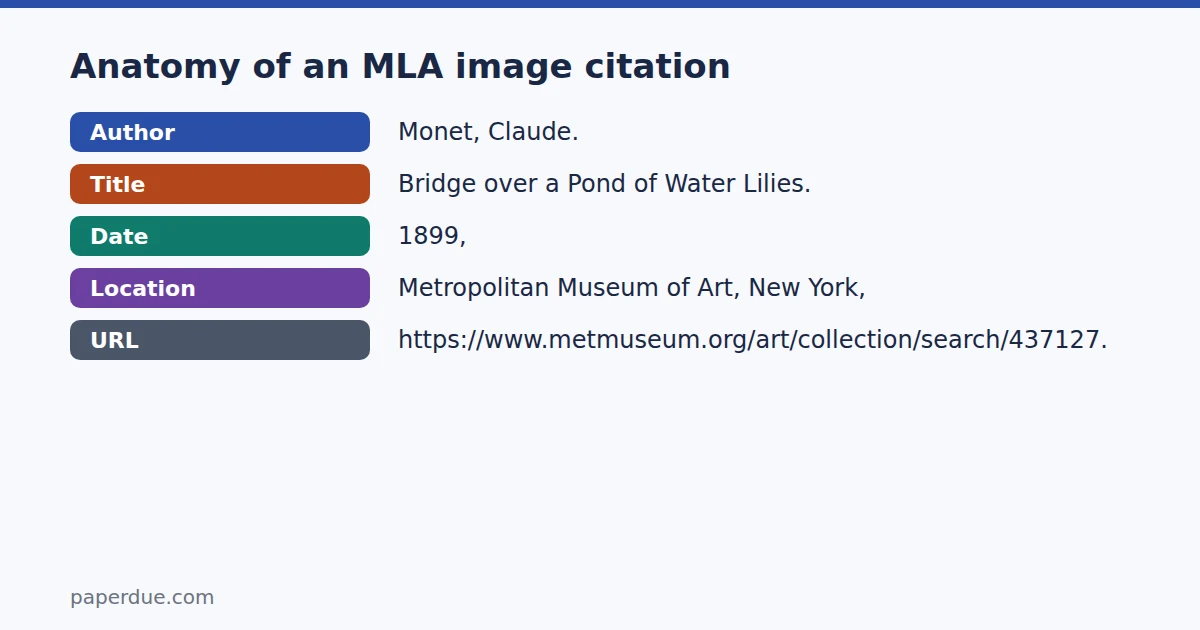
Artist Last Name, First Name. Title of Work. Year, Museum or Collection, City, URL.Include as much of this information as your source provides, and place the completed entry on your Works Cited page. The artist's last name anchors both the reference entry and the in-text citation.Monet, Claude. Bridge over a Pond of Water Lilies. 1899, Metropolitan Museum of Art, New York, https://www.metmuseum.org/art/collection/search/437127.
(Monet)
Narrative: Monet
Examples
1. Painting in a museum
The first example shows a painting held by a museum. The artist's name appears inverted at the start, followed by the title in italics and title case. The year, institution, and city follow as a comma-separated sequence, and the entry closes with the URL to the specific collection page. Every element is present because the source provides all of them.
Monet, Claude. Bridge over a Pond of Water Lilies. 1899, Metropolitan Museum of Art, New York, https://www.metmuseum.org/art/collection/search/437127.
In-text(Monet) NarrativeMonet
2. Photograph in a library collection
The second example shows a photograph in a library collection. Notice that the long, descriptive original title is reproduced in full, converted to title case, and italicized. The city appears as given in the collection record. The structure is otherwise identical to the first example, confirming that the format does not change based on whether the image is a painting or a photograph.
Lange, Dorothea. Destitute Pea Pickers in California. Mother of Seven Children. Age Thirty-Two. Nipomo, California. 1936, Library of Congress, Washington, DC, https://www.loc.gov/item/2017762891/.
In-text(Lange) NarrativeLange
3. Unknown artist, approximate date
The third example shows what happens when no artist is identified. Because there is no author, the entry begins directly with the italicized title, and the in-text citation uses the title in italics rather than a name. The year is prefixed with 'ca.' to signal an approximate date.
Lineage Portrait of an Abbot. ca. 1350, Metropolitan Museum of Art, New York, https://www.metmuseum.org/art/collection/search/37971.
In-text(Lineage Portrait of an Abbot) NarrativeLineage Portrait of an Abbot
In-text citations in MLA
For images with a known artist, the in-text citation uses only the artist's last name. No page number is needed because images do not have pages. In a parenthetical citation the name sits inside parentheses at the end of the relevant sentence, before the closing period. In a narrative citation the artist's name appears in your sentence itself and no parenthetical element is needed unless you are adding a locator.
When no artist is named, the in-text citation uses the title of the work instead, italicized to match the Works Cited entry. If the title is long, you may shorten it, but the shortened form must begin with the same word as the Works Cited entry so readers can locate it. The first word is what connects your in-text reference to the full entry on the Works Cited page, so never cut from the front.
| Example | Parenthetical | Narrative |
|---|---|---|
| Painting in a museum | (Monet) | Monet |
| Photograph in a library collection | (Lange) | Lange |
| Unknown artist, approximate date | (Lineage Portrait of an Abbot) | Lineage Portrait of an Abbot |
Common mistakes
- Forgetting to italicize the image title Image titles in MLA are italicized in both the Works Cited entry and, when used as a stand-in for an author, in the in-text citation. Leaving the title in plain roman type is one of the most common formatting errors with this source type.
- Using quotation marks instead of italics Quotation marks are reserved in MLA for shorter works such as articles and web pages. A standalone image, painting, or photograph is treated as an independent work and its title is italicized, not placed in quotation marks.
- Including the artist's first name in the in-text citation The in-text citation uses only the last name. Writing the full name inside the parentheses does not match MLA style and makes the citation longer than necessary. Reserve the full inverted name for the Works Cited entry.
- Omitting the city when citing a museum or collection MLA expects the city to follow the institution name in the reference entry. Students sometimes stop after the institution name, but the city is part of the standard sequence for physical collections and should be included when known.
- Starting the in-text citation with the title's middle word When a title stands in for an author, the in-text citation must begin with the first word of the title as it appears in Works Cited. Shortening from the front breaks the alphabetical link between the citation and the entry.
Frequently asked questions
What if I found the image on a museum website rather than viewing it in person — does the format change?
The format stays the same. You still list the artist, title, year, institution, and city, then add the URL to the specific page where you found the image. The physical location of the work and the online address where you accessed it are both part of the entry.
Do I need an access date for an image URL?
An access date is optional in MLA 9th edition and is most useful when a page has no publication or creation date. For museum collection pages that carry a clear date for the artwork, an access date is generally unnecessary, though you may add one if your instructor requires it.
How do I cite an image if I only know the approximate date?
Write 'ca.' before the year, as in the third example.
What if the image has two artists — how does the in-text citation look?
For two artists, the Works Cited entry lists the first artist's name inverted and the second in normal order, joined by 'and'. The in-text citation uses both last names joined by 'and' as well. For three or more artists, only the first last name appears, followed by 'et al.'
Should I include the medium or type of image, such as oil on canvas, in the entry?
MLA 9 does not require the medium, but you may add it as an optional element when it helps readers (for example, 'oil on canvas'). Follow your instructor's guidance.
Can I cite an image that has no title?
If the image has no title, MLA practice is to supply a brief description in place of a title, without italics or quotation marks. Because this page's examples all involve titled works, check the MLA Handbook directly for the precise formatting of untitled images.