MLA In-Text Citations: Format and Examples (9th Edition)
Updated · Follows the MLA Handbook, 9th edition (2021)
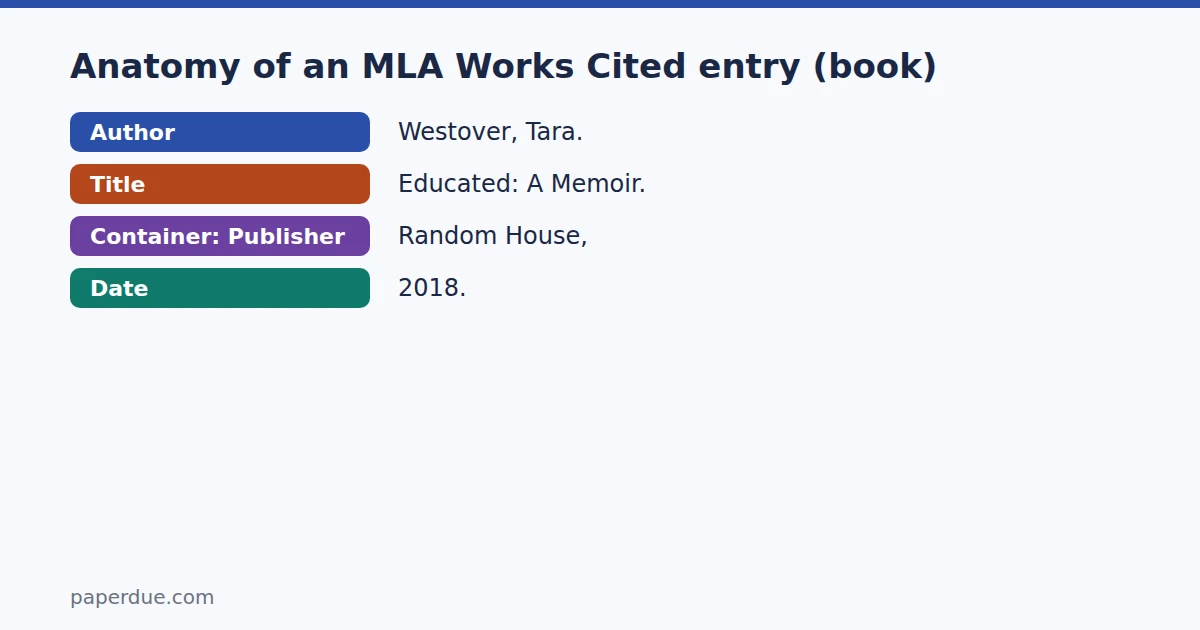
(Author Last Name Page Number)Place it at the end of the sentence or clause that uses the source, before the period. The author's last name and the page number are separated only by a space — no comma, no "p." or "pp." abbreviation.Westover, Tara. Educated: A Memoir. Random House, 2018.
(Westover 52)
Narrative: Westover (52)
MLA in-text citation examples
Page numbers and the timestamp in these examples are placeholders that show the format; use the page or time you are actually citing.
1. One author, with a page number
The first example shows the simplest case: one author and a page number. The last name appears first, followed by a single space and the page number, all inside one pair of parentheses. No comma separates the name from the number, and no label like "p." precedes it. The period ending the sentence falls after the closing parenthesis, not before it.
In-text(Westover 52)
NarrativeWestover (52)
Works Cited
Westover, Tara. Educated: A Memoir. Random House, 2018.
2. Two authors, with a page number
The second example has two authors who share a last name. Both last names appear, joined by "and" — no ampersand, no comma before "and". The page number follows the second name after a space. Because both names are included, a reader can locate the correct entry in the Works Cited list without confusion.
In-text(Heath and Heath 16)
NarrativeHeath and Heath (16)
Works Cited
Heath, Chip, and Dan Heath. Made to Stick: Why Some Ideas Survive and Others Die. Random House, 2007.
3. Journal article, with a page number
The third example is a journal article. The citation works exactly like a book citation: last names joined by "and" and then the specific page cited. Even though the article spans a range of pages, the in-text citation gives only the particular page being referenced, not the full range. The DOI and volume information belong only in the Works Cited entry.
In-text(Mueller and Oppenheimer 1160)
NarrativeMueller and Oppenheimer (1160)
Works Cited
Mueller, Pam A., and Daniel M. Oppenheimer. "The Pen Is Mightier Than the Keyboard: Advantages of Longhand over Laptop Note Taking." Psychological Science, vol. 25, no. 6, 2014, pp. 1159–1168. https://doi.org/10.1177/0956797614524581.
4. Three or more authors, no page numbers (web page)
The fourth example has three authors and comes from a web page with no page numbers. With three or more authors, MLA uses only the first author's last name followed by "et al." — a Latin phrase meaning "and others." Because the web page has no page numbers, nothing follows "et al." and the parentheses contain only those two words. The narrative form drops the parentheses entirely and works "et al." into the sentence.
In-text(Van Bergen et al.)
NarrativeVan Bergen et al.
Works Cited
Van Bergen, Penny, et al. "Which Type of Note-Taking Is Better for Learning: Laptop or Pen and Paper?" The Conversation, 25 Feb. 2025, https://theconversation.com/which-type-of-note-taking-is-better-for-learning-laptop-or-pen-and-paper-250404.
5. No individual author: use the title
The fifth example has no individual author. The source is published by an organization that is also the website, so the Works Cited entry begins with the article title instead of a name. The in-text citation must begin with the same word as that entry, so it uses the title in quotation marks. Because the page has no locator, the title alone fills the parentheses.
In-text("Malaria")
Narrative"Malaria"
Works Cited
"Malaria." World Health Organization, 4 Dec. 2025, https://www.who.int/news-room/fact-sheets/detail/malaria.
6. Video: a timestamp instead of a page
The sixth example is a video with no credited individual author. The title stands in for the author, placed in quotation marks. Instead of a page number, a timestamp marks the specific moment being cited. In the narrative form, the title appears in the sentence and the timestamp goes in its own parentheses immediately after, following the same logic as a page number in any other narrative citation.
In-text("Taking Notes: Crash Course Study Skills #1" 1:30)
Narrative"Taking Notes: Crash Course Study Skills #1" (1:30)
Works Cited
"Taking Notes: Crash Course Study Skills #1." YouTube, uploaded by CrashCourse, 8 Aug. 2017, https://www.youtube.com/watch?v=E7CwqNHn_Ns.
Parenthetical vs. narrative citations
MLA in-text citations come in two forms. In a parenthetical citation, both the author's name and the locator sit inside parentheses at the end of the sentence or clause, just before the period. In a narrative citation, you work the author's name naturally into your sentence — as the subject of a verb, for example — and place only the locator in parentheses at the end of the clause. Each example on this page shows both forms.
A few details stay consistent across both forms. There is never a comma between the author's name and the page number, and you never write "p." or "pp." before the number. The citation must open with the same word that begins the corresponding Works Cited entry, so your reader can find the source. When a source has no page numbers, such as most web pages, you simply omit the locator; when a source uses timestamps rather than pages, the timestamp takes the place of the page number.
Common mistakes
- Adding a comma before the page number MLA places only a space between the author's last name and the page number. Inserting a comma between them is an APA habit that does not belong in MLA citations. Check every citation to make sure no comma appears in that position.
- Writing "p." or "pp." before the number MLA in-text citations never label the page number with "p." or "pp." — the number stands alone after the author's name. Those abbreviations appear in the Works Cited entry for a journal article's page range, not in the in-text citation.
- Putting the period inside the parentheses The sentence's closing period always goes after the closing parenthesis, not before it. Placing the period inside the parentheses is one of the most common punctuation errors in MLA formatting.
- Using an ampersand instead of "and" for two authors MLA spells out "and" between two authors' names in an in-text citation. An ampersand is used in APA style, not MLA. This applies to both parenthetical and narrative forms.
- Citing the full page range instead of the specific page When you cite a journal article or a chapter, the in-text citation should give the exact page you are drawing from, not the full range of pages the source covers. The full range belongs in the Works Cited entry.
Frequently asked questions
What do I do if a source has no author and no page number?
Use a shortened version of the title in place of the author's name. If the full title is long, shorten it, but always keep the first word the same so it matches the Works Cited entry. Article and web page titles go in quotation marks; book titles are italicized. Because there is no page number, the title alone fills the parentheses.
Do I need an in-text citation every time I mention the same source?
Generally yes, but MLA allows an exception when you cite the same source several times in a row and there is no risk of confusion. In that situation, later citations may give only the page number. As soon as you cite a different source in between, you must return to including the author's name.
How do I cite a source with four authors?
Use the first author's last name followed by "et al." — the same form used for three authors. MLA uses "et al." for any source with three or more authors, both in the Works Cited entry and in the in-text citation.
Where exactly in the sentence does the in-text citation go?
Place it at the end of the sentence or clause that uses the source, immediately before the period or other closing punctuation. If a long sentence draws on a source for only part of its content, you can place the citation at the end of the relevant clause rather than waiting until the very end of the sentence.
Can I use a narrative citation to avoid repeating the author's name in parentheses?
Yes. If you name the author in your sentence — for example, as the subject of a verb — you only need to put the page number in parentheses at the end of the clause. This is the narrative form, and it is fully acceptable in MLA. It can also make your writing flow more naturally when you are discussing a source at length.
How do I cite a video if I am not referring to a specific moment?
If you are making a general point about the video rather than referencing a particular moment, you can omit the timestamp. The citation then contains only the title in quotation marks, since videos typically have no individual author and no page numbers. If you are pointing to something said or shown at a specific time, include the timestamp in place of a page number.