Macbeth Summary
Updated
At a glance
- Author
- William Shakespeare
- Written
- Around 1606
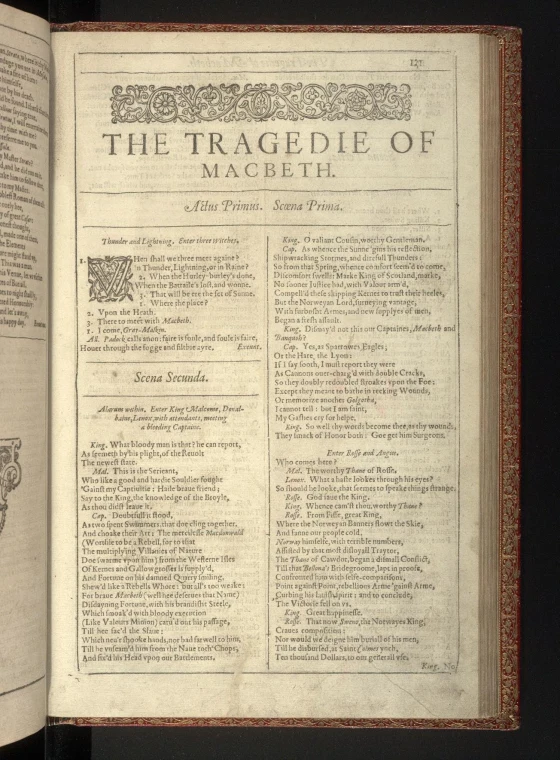
- First printed
- 1623 (First Folio)
- Setting
- Scotland, and England in Act 4
- Acts
- 5 (28 scenes)
Detailed summary of Macbeth
The play opens on a blasted heath where three witches agree to meet with Macbeth after a battle. In Act 1, a wounded soldier reports to King Duncan that Macbeth has fought brilliantly against rebels and the Norwegian army, and Duncan rewards him with the title Thane of Cawdor. When Macbeth and Banquo encounter the witches on the heath, the witches hail Macbeth as Thane of Glamis, Thane of Cawdor, and king hereafter, and they tell Banquo that he will father a line of kings though he will not be one himself. When Ross arrives and confirms the new title, Macbeth is shaken: one prophecy has already come true. He writes to his wife, and she immediately resolves to push him toward the crown. Duncan announces that his son Malcolm will be Prince of Cumberland and heir to the throne, which Macbeth recognizes as an obstacle. When Duncan arrives at Macbeth's castle at Inverness, Lady Macbeth urges her husband to look welcoming while concealing murderous intent. Macbeth wavers, arguing that Duncan is his kinsman, his king, and his guest, and that the king has been a virtuous ruler. Lady Macbeth overcomes his hesitation by questioning his courage and laying out a plan to drug Duncan's chamberlains and blame them for the murder.
In Act 2, Macbeth sees a vision of a dagger leading him toward Duncan's chamber and then carries out the killing. He returns shaken, unable to say amen when he heard two sleepers pray, and haunted by a voice crying that he has murdered sleep. Lady Macbeth takes the daggers back to smear the grooms with blood. When Macduff and Lennox arrive the next morning and discover the body, Macbeth kills the grooms before they can be questioned, claiming he acted out of grief and rage. Malcolm and Donalbain, fearing for their own lives, flee to England and Ireland respectively, and their flight casts suspicion on them. Macbeth is named king and goes to Scone to be crowned.
Act 3 shows Macbeth on the throne but deeply uneasy. The witches' prophecy that Banquo will father kings torments him, and he hires two murderers to kill both Banquo and his son Fleance. At a royal banquet that evening, a murderer reports that Banquo is dead but Fleance has escaped. Macbeth is then visited by Banquo's ghost, which only he can see, and his wild behavior at the table alarms the assembled lords. Lady Macbeth tries to cover for him, but the feast breaks up in disorder. Alone afterward, Macbeth resolves to visit the witches again. Meanwhile, Lennox and a lord speak cautiously but clearly about Macbeth's tyranny, and they reveal that Macduff has gone to England to seek help from Malcolm and the English king.
In Act 4, Macbeth seeks out the witches in their cave. They show him three apparitions: an armed head that warns him to beware Macduff; a bloody child that tells him no man of woman born can harm him; and a crowned child holding a tree, who says he will never be defeated until Birnam Wood comes to Dunsinane. Macbeth takes comfort in the last two prophecies but still resolves to kill Macduff. Learning that Macduff has fled to England, he orders the slaughter of Macduff's entire household. The scene then shifts to England, where Malcolm tests Macduff's loyalty by pretending to be a man of monstrous vices. When Macduff despairs for Scotland, Malcolm reveals he was testing him and confirms that an English army under Siward is ready to march. Ross arrives with the news that Lady Macduff and her children have been murdered, and Macduff's grief hardens into a fierce determination to confront Macbeth personally.
Act 5 brings the final collapse of Macbeth's reign. Lady Macbeth has been sleepwalking, reliving the murders in fragmented speech, rubbing her hands as if washing away blood she cannot see. A doctor and her gentlewoman observe her but can do nothing. As Malcolm's army advances, Scottish thanes desert Macbeth one by one. Malcolm orders his soldiers to cut boughs from Birnam Wood and carry them as camouflage, fulfilling the third apparition. When a messenger reports that the wood appears to be moving, Macbeth recognizes that the prophecies are turning against him but resolves to fight to the end. He learns of Lady Macbeth's death and delivers a bleak meditation on the emptiness of life. On the battlefield he kills young Siward, still believing no man of woman born can harm him. Macduff confronts him and reveals that he was taken from his mother’s womb before his time (usually read as a caesarean birth) and was therefore not, in the witches' sense, born of woman. Macbeth's confidence shatters, but he refuses to yield. The two fight, and Macduff kills him. Malcolm is hailed as King of Scotland, promises to reward his supporters, and invites all to his coronation at Scone.
Where does Macbeth take place?
The play is set mainly in Scotland, with locations including a heath, the royal court at Forres, Macbeth's castle at Inverness, and the castle at Dunsinane. One scene takes place in England, before the palace of the English king. In the play's world, witches and apparitions are treated as real, and courage in battle is the measure of a man's worth. Shakespeare's play is usually dated to around 1606.
How does Macbeth end?
In the final scenes, Malcolm's army advances on Dunsinane carrying boughs cut from Birnam Wood, fulfilling the witches' prophecy. Lady Macbeth dies; Malcolm later says she is thought to have taken her own life. Macbeth fights on desperately until Macduff reveals he was not born of woman in the ordinary sense but was taken from his mother’s womb before his time, usually read as a caesarean birth. Macbeth's last supernatural protection gone, he refuses to surrender and is killed by Macduff in combat. Macduff enters carrying Macbeth's severed head, and the assembled thanes hail Malcolm as King of Scotland. Malcolm promises justice, names his thanes as earls, and invites everyone to his coronation at Scone.
“Fair is foul, and foul is fair:
Hover through the fog and filthy air.”
Act-by-act summary
- Act 1 Witches prophesy Macbeth's rise to kingship, and he and Lady Macbeth plot to murder King Duncan. Read the scene-by-scene summary →
- Act 2 Macbeth murders Duncan, the crime is discovered, and he is named king as Duncan's sons flee Scotland. Read the scene-by-scene summary →
- Act 3 King Macbeth arranges Banquo's murder, but Banquo's ghost haunts him publicly at a royal banquet. Read the scene-by-scene summary →
- Act 4 The witches give Macbeth new prophecies, and he orders the slaughter of Macduff's family in revenge. Read the scene-by-scene summary →
- Act 5 Lady Macbeth dies, Malcolm's army defeats Macbeth, and Macduff kills him in single combat. Read the scene-by-scene summary →
Characters
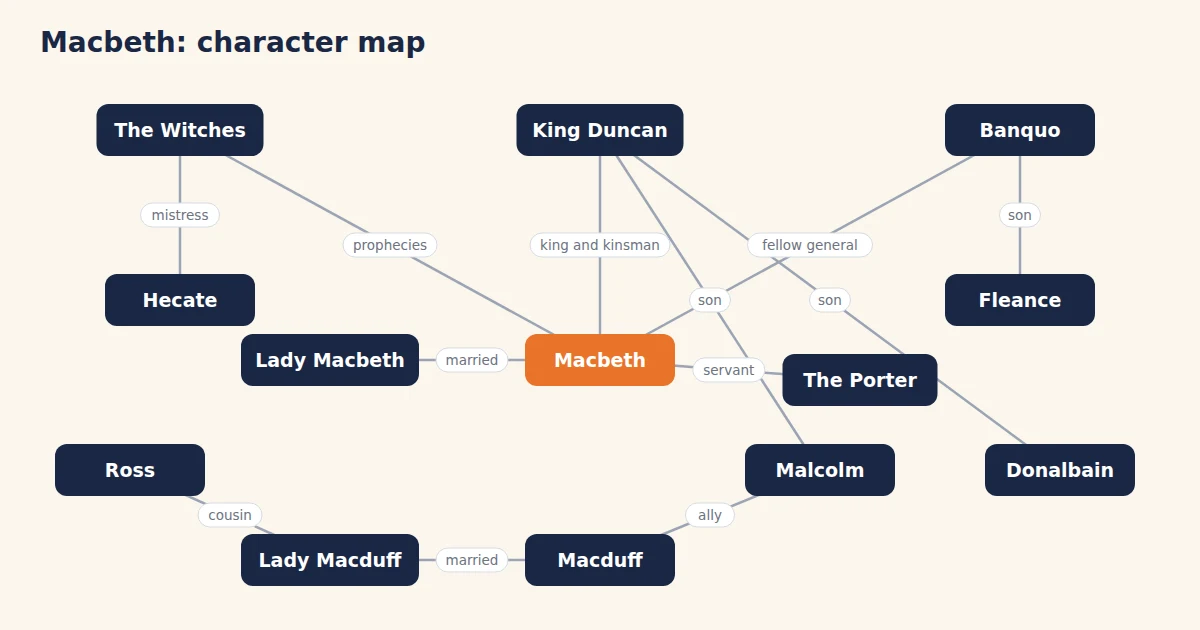 Who’s who in Macbeth
Macbeth, Lady Macbeth, Banquo, the Witches, Duncan, Malcolm, Macduff and more, and how they are connected.
See all characters →
Famous quotes
“Fair is foul, and foul is fair:
Hover through the fog and filthy air.”
Frequently asked questions
What is Macbeth about?
Macbeth is a tragedy about ambition, guilt, and the corrupting nature of power. A brave Scottish general is told by three witches that he will become king. Urged on by his wife, he murders King Duncan to seize the throne, then commits further killings to protect his position. His reign descends into tyranny, his mental state deteriorates, and he is ultimately overthrown and killed.
What do the witches predict for Macbeth?
The witches first hail Macbeth as Thane of Glamis, Thane of Cawdor, and king hereafter. Later, in Act 4, three apparitions they conjure warn him to beware Macduff, assure him that no man of woman born can harm him, and promise he will not be defeated until Birnam Wood marches to Dunsinane. All three of these later prophecies are fulfilled in ways Macbeth did not foresee.
How does Macbeth end?
Macbeth ends with the defeat and death of Macbeth. Lady Macbeth, who has been sleepwalking and reliving the murders, dies, and Malcolm later says she is thought to have taken her own life. Malcolm's army advances on Dunsinane carrying branches from Birnam Wood, fulfilling the witches' prophecy. Answering Macbeth’s boast, Macduff replies with “And let the angel whom thou still hast serv’d / Tell thee, Macduff was from his mother’s womb / Untimely ripp’d.” (Act 5, Scene 8), meaning he was not born of woman in the ordinary sense, and he kills Macbeth in single combat. Malcolm is then proclaimed King of Scotland and invites the assembled thanes to his coronation at Scone.
When was Macbeth written?
Macbeth is usually dated to around 1606. It was first printed in the First Folio of 1623, so the date of writing comes from scholars’ estimates rather than from an early printed edition.
Where does Macbeth take place?
The play is set in Scotland, with scenes at a heath, the royal court at Forres, Macbeth's castle at Inverness, Macduff's castle in Fife, and the castle at Dunsinane. One scene takes place in England, before the palace of the English king, where Malcolm has taken refuge and where Macduff comes to seek his help in overthrowing Macbeth.
Essays on Macbeth
- Power and Inhumanity in Macbeth and One Flew Over the Cuckoo's Nest
- Symbolism in Macbeth: Blood, Water, and Weather
- Macbeth and Martin Luther: Conviction vs. Ambition
- Macduff as the True Hero of Shakespeare's Macbeth
- Macbeth's Porter Scene: Prose-Poetry and Dark Imagery
- Manipulation and Disaster in Shakespeare's Macbeth
- Ambition, Blood, and Evil in Shakespeare's Macbeth
- Shakespeare's Macbeth vs. Polanski's 1971 Film Adaptation