Macbeth Act 3 Summary
Updated · Macbeth by William Shakespeare
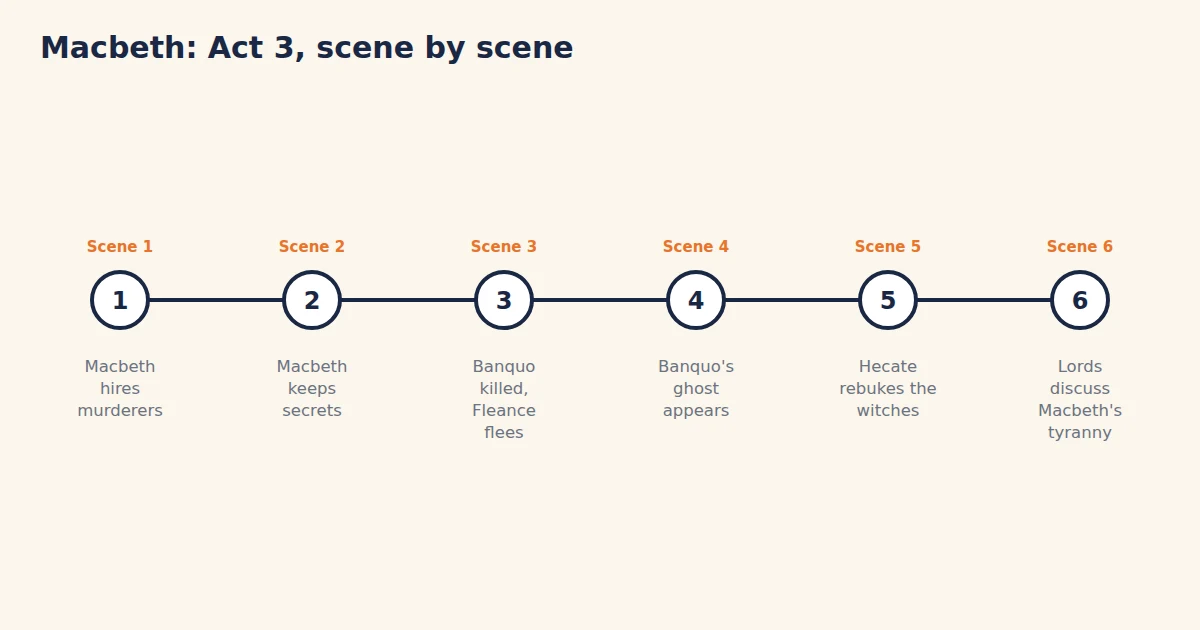
Act 3 summary
Act 3 shows Macbeth at the height of his power and the beginning of his unraveling. Now king, he fears Banquo, whose children were prophesied to inherit the throne, and hires murderers to kill both Banquo and his son Fleance. Banquo is killed, but Fleance escapes. At the royal banquet, Banquo's ghost appears to Macbeth, causing him to behave so wildly that Lady Macbeth is forced to dismiss the guests. Alone afterward, Macbeth tells his wife he intends to seek out the witches again and that he is now so deep in blood that he must press forward. Meanwhile, a short scene on the heath introduces Hecate scolding the witches for acting without her. The act closes with Lennox and a lord speaking cautiously but clearly about Macbeth's tyranny and reporting that Macduff has gone to England to seek help from Malcolm.
Act 3, Scene 1: Forres. A Room in the Palace
Banquo opens the scene alone, suspecting that Macbeth has played foully for the crown but also wondering whether the witches' promise that his own children will be kings might yet come true. Macbeth enters in royal procession and invites Banquo to a feast that evening, then questions him about his afternoon ride and confirms that Fleance will accompany him. After dismissing the court, Macbeth reflects in soliloquy that Banquo alone frightens him, since the witches placed a barren crown on his own head while promising Banquo a line of kings. He meets with two murderers he has already primed against Banquo, persuades them that Banquo is their enemy, and instructs them to kill both Banquo and Fleance that night away from the palace.
“Upon my head they plac’d a fruitless crown,
And put a barren sceptre in my gripe,
Thence to be wrench’d with an unlineal hand,
No son of mine succeeding.”
Macbeth's image of a fruitless crown captures his fear that all his crimes have benefited Banquo's heirs rather than himself, suggesting the hollowness of his ambition.
“It is concluded. Banquo, thy soul’s flight,
If it find heaven, must find it out tonight.”
Macbeth's final couplet shows his cold resolve; many readers see it as marking the point where he fully commits to murder as a political tool.
Act 3, Scene 2: The same. Another Room in the Palace
Lady Macbeth sends a servant to fetch Macbeth and reflects briefly that gaining the crown without contentment has left them with nothing. When Macbeth arrives, she urges him to appear cheerful at the feast. He replies that his mind is full of scorpions because Banquo and Fleance still live. Lady Macbeth reminds him they are mortal and can be dealt with. Macbeth tells her a deed of dreadful note will be done before nightfall but refuses to share the details, asking her to remain innocent of the knowledge until she can applaud the act. He ends with an observation that darkness is gathering and that bad things begun must be strengthened by further ill.
“Naught’s had, all’s spent,
Where our desire is got without content:
’Tis safer to be that which we destroy,
Than by destruction dwell in doubtful joy.”
Lady Macbeth's aside can be read as her first private admission that the murder of Duncan has brought neither safety nor happiness.
Act 3, Scene 3: The same. A Park or Lawn, with a gate leading to the Palace
Three murderers wait in a park near the palace gate. A third murderer has joined the original two, claiming to have been sent by Macbeth. As Banquo and Fleance approach on foot carrying a torch, the murderers attack. Banquo is struck down but manages to cry out to Fleance to flee and take revenge before he dies. Fleance escapes in the darkness. The murderers realize they have killed only one of their two targets and prepare to report back to Macbeth.
“O, treachery! Fly, good Fleance, fly, fly, fly!
Thou mayst revenge—O slave!”
Banquo's dying words to Fleance keep the prophecy of a royal line alive and set up the threat that Macbeth has failed to extinguish.
Act 3, Scene 4: The same. A Room of state in the Palace
A state banquet is in progress. Macbeth steps aside to receive news from one of the murderers that Banquo is dead but Fleance has escaped. Shaken, he returns to his guests. When Lennox invites him to sit, Macbeth sees Banquo's ghost occupying his place and reacts with terror, speaking to the apparition while the lords look on in confusion. Lady Macbeth tries to cover for him, first explaining that he has suffered such fits since youth and then privately urging him to control himself. The ghost disappears and Macbeth recovers, but it rises again when he proposes a toast to Banquo. His second outburst forces Lady Macbeth to send the guests away. Alone with his wife, Macbeth notes that Macduff did not attend and resolves to visit the witches again, acknowledging that he is now so steeped in blood that going back would be as hard as going forward.
“Avaunt! and quit my sight! let the earth hide thee!
Thy bones are marrowless, thy blood is cold;
Thou hast no speculation in those eyes
Which thou dost glare with!”
Macbeth's address to the ghost, visible only to him, can be read as evidence that guilt is beginning to destroy his ability to function as a king and a host.
“For mine own good,
All causes shall give way: I am in blood
Stepp’d in so far that, should I wade no more,
Returning were as tedious as go o’er.”
This image of wading through blood is often seen as Macbeth's clearest acknowledgment that his crimes have created a momentum he can no longer stop.
Act 3, Scene 5: The heath
On the heath, Hecate meets the three witches and rebukes them for dealing with Macbeth without her involvement. She tells them that Macbeth is a wayward, selfish client who acts only for his own ends. She instructs them to meet her at the pit of Acheron the next morning, where Macbeth will come to learn his destiny. She plans to use a drop caught from the corner of the moon to conjure illusions that will lead him to his ruin by making him overconfident. She departs to music, and the witches hurry after her. Some scholars attribute this scene to Thomas Middleton rather than Shakespeare.
“He shall spurn fate, scorn death, and bear
His hopes ’bove wisdom, grace, and fear.
And you all know, security
Is mortals’ chiefest enemy.”
Hecate's warning that security is mortals' greatest enemy can be read as foreshadowing Macbeth's downfall through overconfidence in the witches' promises.
Act 3, Scene 6: Forres. A Room in the Palace
Lennox speaks with a lord in carefully ironic terms, implying that everyone can see Macbeth is guilty of Duncan's murder and Banquo's death, though he phrases it as if the official version were true. He notes that Macduff has fallen out of favor for refusing to attend the tyrant's feast. The lord reports that Malcolm is living honorably at the English court under King Edward, and that Macduff has gone there to ask for military help from Northumberland and the English commander Siward. Macbeth, hearing of this, is preparing for war. Lennox hopes a holy angel will carry the message to England quickly so that Scotland may be freed from its suffering under a cursed hand.
“only, I say,
Thing’s have been strangely borne.”
Characters in Act 3
- Macbeth: Now king, he plots Banquo's murder, is haunted by his ghost, and resolves to pursue further violence.
- Lady Macbeth: Tries to steady Macbeth at the banquet and cover his breakdown before the lords, but is increasingly shut out.
- Banquo: Suspects Macbeth of foul play, is murdered by hired killers, and returns as a ghost at the feast.
- Fleance: Escapes the murderers when his father is killed, leaving Macbeth's plan to end Banquo's line incomplete.
- Lennox: Witnesses Macbeth's strange behavior at the banquet and later speaks ironically about Macbeth's crimes.
- Hecate: Rebukes the witches for acting without her and plans to use illusions to lead Macbeth to his destruction.
- Ross: Attends the banquet and observes Macbeth's disturbing conduct before the guests are dismissed.
Frequently asked questions
What happens in Act 3 of Macbeth?
Macbeth, now king, arranges the murder of Banquo to prevent his children from inheriting the throne. Banquo is killed but his son Fleance escapes. At a royal banquet, Banquo's ghost appears and causes Macbeth to behave so erratically that the guests are sent away. The act ends with Macbeth determined to seek the witches again and with Scottish lords quietly turning against him.
Why does Macbeth want Banquo killed?
Macbeth fears Banquo for two reasons. First, Banquo is noble and wise and suspects Macbeth of foul play. Second, the witches prophesied that Banquo's descendants, not Macbeth's, would be kings. Macbeth feels he has committed murder only to benefit Banquo's line, and he wants both Banquo and his son Fleance dead to prevent that prophecy from coming true.
What does the ghost of Banquo represent in Act 3?
The ghost appears only to Macbeth during the banquet. Many readers see it as a manifestation of his guilt, showing that the murders he has committed are beginning to destroy his mental stability. It can also be read as a sign that the natural order he has violated is reasserting itself, making it impossible for him to enjoy the power he has seized.
Essays on Macbeth
- Power and Inhumanity in Macbeth and One Flew Over the Cuckoo's Nest
- Symbolism in Macbeth: Blood, Water, and Weather
- Macbeth and Martin Luther: Conviction vs. Ambition
- Macduff as the True Hero of Shakespeare's Macbeth
- Macbeth's Porter Scene: Prose-Poetry and Dark Imagery
- Manipulation and Disaster in Shakespeare's Macbeth
- Ambition, Blood, and Evil in Shakespeare's Macbeth
- Shakespeare's Macbeth vs. Polanski's 1971 Film Adaptation