Macbeth Act 2 Summary
Updated · Macbeth by William Shakespeare
Act 2 summary
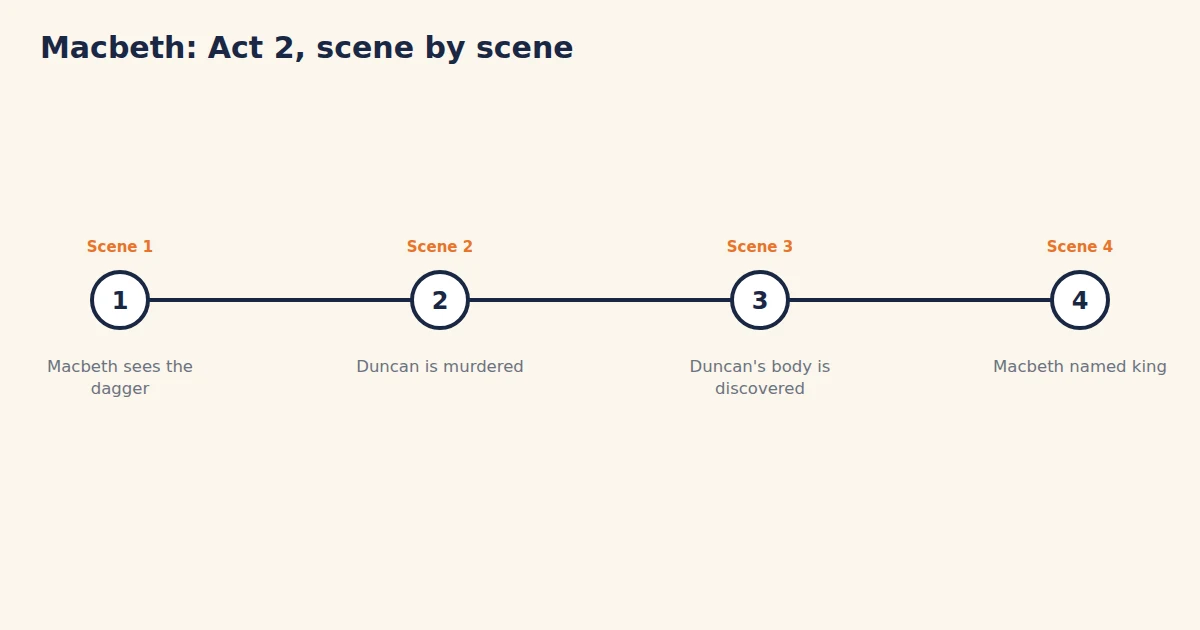
Act 2 begins late at night in Macbeth's castle. Macbeth, unable to sleep, sees a vision of a dagger leading him toward Duncan's chamber. He murders the king and returns shaken, still holding the daggers. Lady Macbeth takes charge, returning the daggers and smearing the grooms with blood. A knocking at the gate signals the arrival of Macduff and Lennox, who discover the body. Macbeth kills the grooms, claiming he acted out of grief and loyalty. Duncan's sons Malcolm and Donalbain, fearing for their own lives, flee to England and Ireland respectively. Their flight makes them suspects. Outside the castle, Ross and an Old Man discuss the unnatural omens that accompanied the night of the murder. Macduff reports that Macbeth has already been named king and is heading to Scone to be invested, while Duncan's body is carried to Colmekill.
Act 2, Scene 1: Inverness. Court within the Castle
Late at night, Banquo and his son Fleance cross the castle courtyard. Banquo tells Fleance he is weary but does not want to sleep, troubled by cursed thoughts. Macbeth enters and the two men speak briefly. Banquo mentions he dreamed of the Weird Sisters, but Macbeth dismisses the subject, hinting they may speak of it later and suggesting Banquo's loyalty could be rewarded. After Banquo leaves, Macbeth sends his servant away and is left alone. He sees a vision of a dagger pointing toward Duncan's chamber, its blade becoming covered in blood. He questions whether it is real or a product of his heated imagination. A bell rings, the signal Lady Macbeth promised, and Macbeth moves toward the murder.
“Is this a dagger which I see before me,
The handle toward my hand? Come, let me clutch thee:—”
The dagger hallucination marks the moment Macbeth's imagination takes over, and many readers see it as a sign of the psychological cost of his murderous intent.
Act 2, Scene 2: The same
Lady Macbeth waits alone, having drugged the grooms. She hears Macbeth cry out from within and fears the plan has failed. Macbeth enters having committed the murder. He is deeply disturbed: he could not say 'Amen' when he heard two sleepers pray, and he believes he heard a voice cry that he would sleep no more. He has brought the daggers away from the scene, which Lady Macbeth says was a mistake. When Macbeth refuses to return them, she takes the daggers herself and goes to smear the grooms. Knocking is heard at the gate. Lady Macbeth returns and urges Macbeth to wash his hands and put on his nightgown so they will not appear to have been awake. Macbeth, staring at his bloodied hands, despairs that no amount of water can wash away his guilt.
“Methought I heard a voice cry, “Sleep no more!
Macbeth does murder sleep,”—the innocent sleep;
Sleep that knits up the ravell’d sleave of care,
The death of each day’s life, sore labour’s bath,
Balm of hurt minds, great nature’s second course,
Chief nourisher in life’s feast.”
The voice Macbeth imagines condemning him to sleeplessness can be read as the first sign that his guilt will haunt him, making sleep a recurring symbol of innocence lost.
“Will all great Neptune’s ocean wash this blood
Clean from my hand? No, this my hand will rather
The multitudinous seas incarnadine,
Making the green one red.”
Macbeth's image of his hand staining the seas red suggests the enormity of his guilt feels infinite and irreversible, a stark contrast to Lady Macbeth's claim that a little water clears them.
Act 2, Scene 3: The same
The Porter, still half-drunk, comically delays answering the gate, imagining himself as the porter of hell and admitting various sinners. He finally opens the gate to Macduff and Lennox. Macbeth appears and leads Macduff to the king's chamber. Lennox describes the violent, unnatural storm of the previous night. Macduff returns in horror, having discovered Duncan's body. The alarm bell is rung and the household assembles. Macbeth and Lennox go to see the body. Lady Macbeth and Banquo arrive. Macbeth returns and, explaining that he acted out of furious love for Duncan, reveals he has killed the grooms. Macduff questions this. Malcolm and Donalbain, learning their father is dead, privately agree to flee separately to England and Ireland, fearing that whoever killed their father may target them next.
“Where we are,
There’s daggers in men’s smiles: the near in blood,
The nearer bloody.”
Donalbain's warning that those closest in blood are in the most danger captures the atmosphere of paranoia and mistrust that Macbeth's crime has unleashed.
Act 2, Scene 4: The same. Without the Castle
Outside the castle, Ross meets an Old Man who reflects that in seventy years he has never seen a night as terrible as this one. Ross describes how darkness has covered the day even though it should be light. The Old Man reports that a falcon was killed by a mousing owl, and that Duncan's horses broke free and turned wild, even eating each other. Macduff arrives and tells Ross that the grooms are blamed for the murder, that they were apparently bribed, and that Malcolm and Donalbain's flight has cast suspicion on them. Macduff tells Ross that Macbeth has already been named king and has gone to Scone to be invested. Duncan's body has been taken to Colmekill. Macduff, notably, says he will go to Fife rather than to Scone, suggesting unease about the new order.
“Ha, good father,
Thou seest the heavens, as troubled with man’s act,
Threatens his bloody stage: by the clock ’tis day,
And yet dark night strangles the travelling lamp.
Is’t night’s predominance, or the day’s shame,
That darkness does the face of earth entomb,
When living light should kiss it?”
Ross's description of darkness smothering daylight mirrors the moral disorder caused by Duncan's murder, and many readers see the natural world here as reflecting the disruption of rightful order.
“Well, may you see things well done there. Adieu!
Lest our old robes sit easier than our new!”
Macduff's parting remark hints at his skepticism about the new reign, suggesting that old loyalties may sit more comfortably than new political arrangements.
Characters in Act 2
- Macbeth: Murders Duncan, is tormented by guilt, and helps cover up the crime
- Lady Macbeth: Drugs the grooms, returns the daggers, and manages Macbeth's visible distress
- Banquo: Encounters Macbeth before the murder and calls for investigation of Duncan's death
- Macduff: Discovers Duncan's body, questions Macbeth's killing of the grooms, and declines to attend the coronation
- Malcolm: Flees to England after his father's murder to avoid becoming the next victim
- Donalbain: Flees to Ireland, recognizing that those nearest in blood face the greatest danger
- Lennox: Accompanies Macduff to discover the body and describes the night's unnatural storms
- Ross: Reports the unnatural omens and confirms that Macbeth has been named king
Frequently asked questions
What happens in Act 2 of Macbeth?
Macbeth murders King Duncan in his sleep, guided by a vision of a dagger. Lady Macbeth helps conceal the crime by placing the daggers on the drugged grooms. When the body is discovered, Macbeth kills the grooms before they can be questioned. Duncan's sons flee, making them suspects, and Macbeth is named king.
Why does Macbeth kill the grooms in Act 2?
Macbeth tells the assembled household that he killed the grooms in a burst of grief and love for Duncan when he saw them covered in blood beside the body. Many readers interpret this as a calculated move to silence the only witnesses who could contradict the story that the grooms committed the murder.
What is the significance of the dagger vision in Act 2, Scene 1?
Before the murder, Macbeth sees a dagger floating in the air pointing toward Duncan's chamber. He questions whether it is real or a creation of his own disturbed mind. Many readers see it as a sign of the psychological strain his murderous ambition is already placing on him, foreshadowing the hallucinations that will follow.
Essays on Macbeth
- Power and Inhumanity in Macbeth and One Flew Over the Cuckoo's Nest
- Symbolism in Macbeth: Blood, Water, and Weather
- Macbeth and Martin Luther: Conviction vs. Ambition
- Macduff as the True Hero of Shakespeare's Macbeth
- Macbeth's Porter Scene: Prose-Poetry and Dark Imagery
- Manipulation and Disaster in Shakespeare's Macbeth
- Ambition, Blood, and Evil in Shakespeare's Macbeth
- Shakespeare's Macbeth vs. Polanski's 1971 Film Adaptation