Macbeth Characters
Updated · Macbeth by William Shakespeare
Lady Macbeth
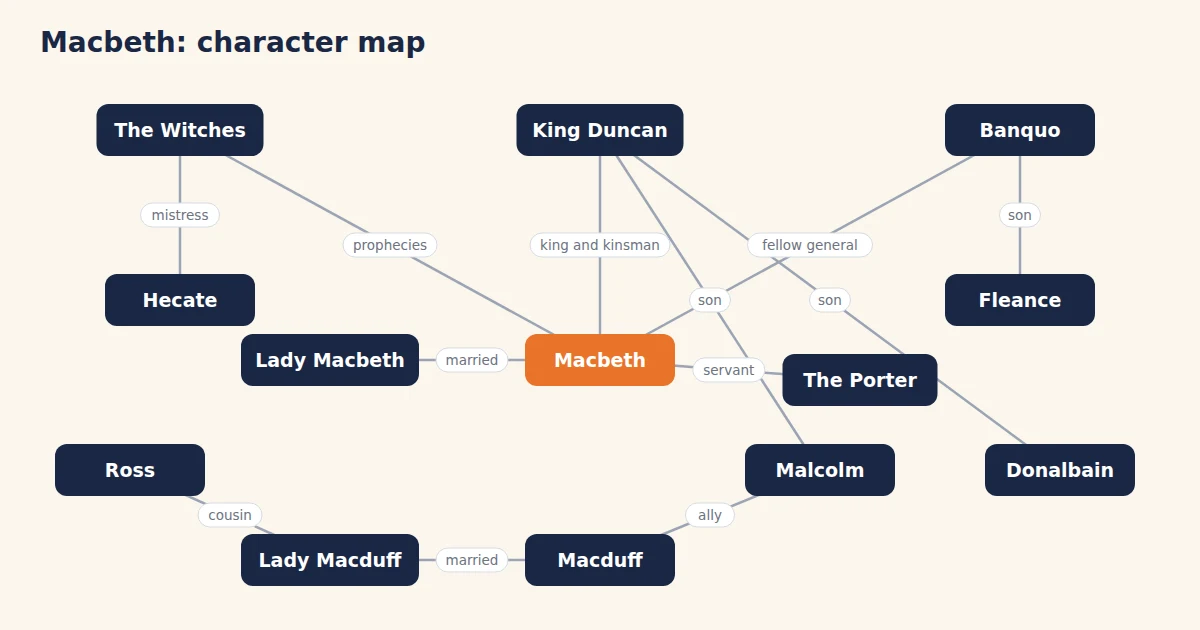
Lady Macbeth is Macbeth's wife and, in the early acts, the more ruthless of the two. When she reads his letter about the witches' prophecy in Act 1, Scene 5, she immediately resolves to push him toward murdering Duncan, calling on dark spirits to strip away her own compassion. She plans the killing, drugs the guards, and steadies her husband when he falters. Yet guilt gradually destroys her. By Act 5, Scene 1, she is sleepwalking, obsessively rubbing her hands as if washing away blood, and murmuring about the murders. At the play's close Malcolm calls her Macbeth's fiend-like queen and says she is thought to have taken her own life. Many readers see her as a figure who suppresses her humanity to gain power, only to be consumed by the conscience she tried to extinguish.
Macbeth
Macbeth is a celebrated Scottish general and Thane of Glamis who becomes Thane of Cawdor and then king through murder. Brave in battle at the play's opening, he is undone by ambition and the witches' prophecies. He kills King Duncan in Act 2, then arranges the murders of Banquo and Macduff's family to secure his position. As the play progresses he grows increasingly isolated, tyrannical, and reckless. He sees Banquo's ghost at the banquet in Act 3, Scene 4, and returns to the witches in Act 4, Scene 1 for further prophecies. Many readers see him as a study in how unchecked ambition corrupts a person of genuine ability. He is killed by Macduff in Act 5, Scene 8.
“I am in blood
Stepp’d in so far that, should I wade no more,
Returning were as tedious as go o’er.”
Banquo
Banquo is a Scottish general and Macbeth's companion who is present when the witches deliver their prophecies in Act 1, Scene 3. The witches tell him he will father a line of kings, though he will not be one himself. Unlike Macbeth, Banquo is cautious about the prophecies and suspects they may be instruments of darkness. He privately suspects Macbeth of foul play after Duncan's murder, as his opening speech in Act 3, Scene 1 makes clear. Macbeth, fearing the prophecy about Banquo's descendants, has him murdered in Act 3, Scene 3, though his son Fleance escapes. Banquo's ghost then appears at Macbeth's banquet, visible only to Macbeth, driving him to a public breakdown.
“And oftentimes to win us to our harm,
The instruments of darkness tell us truths;
Win us with honest trifles, to betray’s
In deepest consequence.”
The Witches
The three Witches, also called the Weird Sisters, open the play and set its events in motion. They greet Macbeth with three titles in Act 1, Scene 3, predicting he will be Thane of Cawdor and king, and they tell Banquo he will father kings. In Act 4, Scene 1, they show Macbeth three apparitions that deliver further prophecies he fatally misinterprets. They can be read as embodiments of fate, temptation, or the darker forces of nature. Their famous refrain “Fair is foul, and foul is fair: / Hover through the fog and filthy air.” (Act 1, Scene 1) establishes the play's central theme of deceptive appearances. Scholars sometimes attribute the Hecate scenes and parts of Act 4, Scene 1 to Thomas Middleton rather than Shakespeare.
“The Weird Sisters, hand in hand,
Posters of the sea and land,
Thus do go about, about:
Thrice to thine, and thrice to mine,
And thrice again, to make up nine.
Peace!—the charm’s wound up.”
Lady Macduff
Lady Macduff appears only in Act 4, Scene 2, but her brief scene is one of the play's most affecting. Left behind in Fife when her husband flees to England, she is angry and bewildered by his departure, telling Ross that Macduff lacks the natural instinct even a wren shows in defending its nest. She engages in a sharp, tender exchange with her young son before a messenger arrives to warn her of approaching danger. She has no time to escape. Murderers sent by Macbeth kill her son before her eyes and then pursue her offstage. Her death, reported to Macduff in Act 4, Scene 3, becomes the emotional catalyst that drives him to seek revenge against Macbeth.
“to leave his wife, to leave his babes,
His mansion, and his titles, in a place
From whence himself does fly? He loves us not:
He wants the natural touch; for the poor wren,
The most diminutive of birds, will fight,
Her young ones in her nest, against the owl.”
Macduff
Macduff is the Thane of Fife and one of the Scottish nobles loyal to Duncan. He is the one who discovers Duncan's body in Act 2, Scene 3. His decision to flee to England in Act 4 to join Malcolm's cause leaves his family unprotected, and Macbeth orders their slaughter. When Ross brings him the news of his wife and children's deaths in Act 4, Scene 3, his grief is raw and powerful. He ultimately fulfills the witches' prophecy by killing Macbeth in Act 5, Scene 8, revealing that he was taken from his mother’s womb before his time (usually read as a caesarean birth) and thus not born of woman in the conventional sense. He enters the final scene carrying Macbeth's severed head.
“He has no children.—All my pretty ones?
Did you say all?—O hell-kite!—All?
What, all my pretty chickens and their dam
At one fell swoop?”
King Duncan
Duncan is the King of Scotland at the play's opening, a gracious and trusting ruler who rewards Macbeth generously for his valor in battle. In Act 1, Scene 4, he names his son Malcolm as Prince of Cumberland and heir, which Macbeth immediately recognizes as an obstacle to his own ambitions. Duncan arrives at Macbeth's castle in Act 1, Scene 6, praising its pleasant air, unaware of the danger he is in. He is murdered offstage by Macbeth in Act 2. His virtues are described by Macbeth himself before the killing, and many readers see his death as the original sin that corrupts Scotland and sets the rest of the tragedy in motion. His body is carried to Colmekill for burial.
“There’s no art
To find the mind’s construction in the face:
He was a gentleman on whom I built
An absolute trust.”
Malcolm
Malcolm is Duncan's eldest son and the rightful heir to the Scottish throne. After his father's murder in Act 2, he flees to England with his brother Donalbain, a decision that temporarily casts suspicion on both of them. In Act 4, Scene 3, set in England, he tests Macduff's loyalty by falsely claiming to be vicious and unfit to rule, before revealing his true character and committing to the campaign against Macbeth. He leads the army that marches on Dunsinane in Act 5, ordering his soldiers to carry boughs from Birnam Wood. At the play's close he is hailed King of Scotland, announces new titles for his thanes, and promises to restore order to the kingdom.
Donalbain
Donalbain is Duncan's younger son and Malcolm's brother. He has a small but significant role. After their father's murder is discovered in Act 2, Scene 3, he and Malcolm speak privately and agree to flee separately, Donalbain to Ireland and Malcolm to England, reasoning that where they are there are daggers in men's smiles and that those nearest in blood are nearest in danger. His flight, like Malcolm's, briefly makes both brothers appear suspicious. He does not appear again after Act 2, and in Act 5, Scene 2, Lennox confirms that Donalbain is not among the forces marching against Macbeth.
“What should be spoken here, where our fate,
Hid in an auger hole, may rush, and seize us?
Let’s away. Our tears are not yet brew’d.”
Fleance
Fleance is Banquo's son. The witches' prophecy that Banquo will father a line of kings makes Fleance a direct threat to Macbeth's ambitions, and Macbeth instructs the murderers to kill both father and son in Act 3, Scene 1. In Act 3, Scene 3, Banquo is killed but Fleance escapes into the darkness, warned by his dying father to fly. His escape is reported to Macbeth at the banquet in Act 3, Scene 4, causing Macbeth to say his fit returns. Fleance does not appear again in the play, but his survival keeps alive the prophecy that Banquo's descendants will be kings, a fact underscored by the vision of eight kings in Act 4, Scene 1.
“Fly, good Fleance, fly, fly, fly!
Thou mayst revenge—O slave!”
Ross
Ross is a Scottish thane who serves as a messenger and witness throughout the play. In Act 1, Scene 2, he brings Duncan news of Macbeth's victory and the treachery of the Thane of Cawdor. In Act 1, Scene 3, he delivers to Macbeth the news that he has been named Thane of Cawdor. He appears at several key moments of transition, including the scene after Duncan's murder in Act 2, Scene 4. In Act 4, Scene 2, he visits Lady Macduff before her death, and in Act 4, Scene 3, he travels to England to bring Macduff the devastating news that his wife and children have been slaughtered. He joins Malcolm's forces for the final campaign.
Hecate
Hecate is the goddess or mistress of the witches, appearing in Act 3, Scene 5, and briefly in Act 4, Scene 1. In Act 3, Scene 5, she rebukes the three witches for dealing with Macbeth without her involvement and outlines a plan to lead him to his destruction through false confidence, saying that security is mortals' chiefest enemy. She then departs to prepare enchantments. Her role is to oversee the supernatural manipulation of Macbeth. Scholars often attribute the Hecate scenes to Thomas Middleton rather than Shakespeare.
“He shall spurn fate, scorn death, and bear
His hopes ’bove wisdom, grace, and fear.
And you all know, security
Is mortals’ chiefest enemy.”
The Porter
The Porter appears only in Act 2, Scene 3, in a brief comic interlude immediately following Duncan's murder. Responding to knocking at the castle gate, he delivers a drunken monologue imagining himself as the porter of hell gate, admitting various sinners including a farmer, an equivocator, and a tailor. He then engages in bawdy wordplay with Macduff about the effects of drink. Many readers see the Porter's scene as deliberate comic relief that also deepens the play's themes: his references to equivocation echo the witches' deceptive prophecies, and his hell-gate imagery reinforces the sense that Macbeth's castle has become a place of damnation.
Frequently asked questions
Who kills Duncan in Macbeth?
Macbeth kills King Duncan. He stabs the sleeping king in his bedchamber in Act 2, Scene 2, while Duncan is a guest at Macbeth's castle. Lady Macbeth drugs the king's guards beforehand, and afterward she returns the daggers and smears the guards with blood to frame them for the murder.
Who is Macduff in Macbeth?
Macduff is the Thane of Fife and one of the Scottish nobles loyal to King Duncan. He discovers Duncan's body, later flees to England to join Malcolm's cause, and ultimately kills Macbeth in Act 5, Scene 8. His family is murdered on Macbeth's orders while he is away, making his revenge deeply personal.
What role do the Witches play in Macbeth?
The three Witches open the play and deliver prophecies that ignite Macbeth's ambition. They tell him he will be king and tell Banquo he will father kings. In Act 4, Scene 1, they show Macbeth apparitions with further prophecies he fatally misreads. They can be interpreted as agents of fate, temptation, or supernatural evil.
What happens to Lady Macbeth at the end of the play?
Lady Macbeth descends into madness from guilt. In Act 5, Scene 1, she is observed sleepwalking, compulsively washing imaginary blood from her hands, and murmuring about the murders. She dies before the play ends, and Malcolm at the close suggests she took her own life, calling her a fiend-like queen.
Essays on Macbeth
- Power and Inhumanity in Macbeth and One Flew Over the Cuckoo's Nest
- Symbolism in Macbeth: Blood, Water, and Weather
- Macbeth and Martin Luther: Conviction vs. Ambition
- Macduff as the True Hero of Shakespeare's Macbeth
- Macbeth's Porter Scene: Prose-Poetry and Dark Imagery
- Manipulation and Disaster in Shakespeare's Macbeth
- Ambition, Blood, and Evil in Shakespeare's Macbeth
- Shakespeare's Macbeth vs. Polanski's 1971 Film Adaptation