Macbeth Act 1 Summary
Updated · Macbeth by William Shakespeare
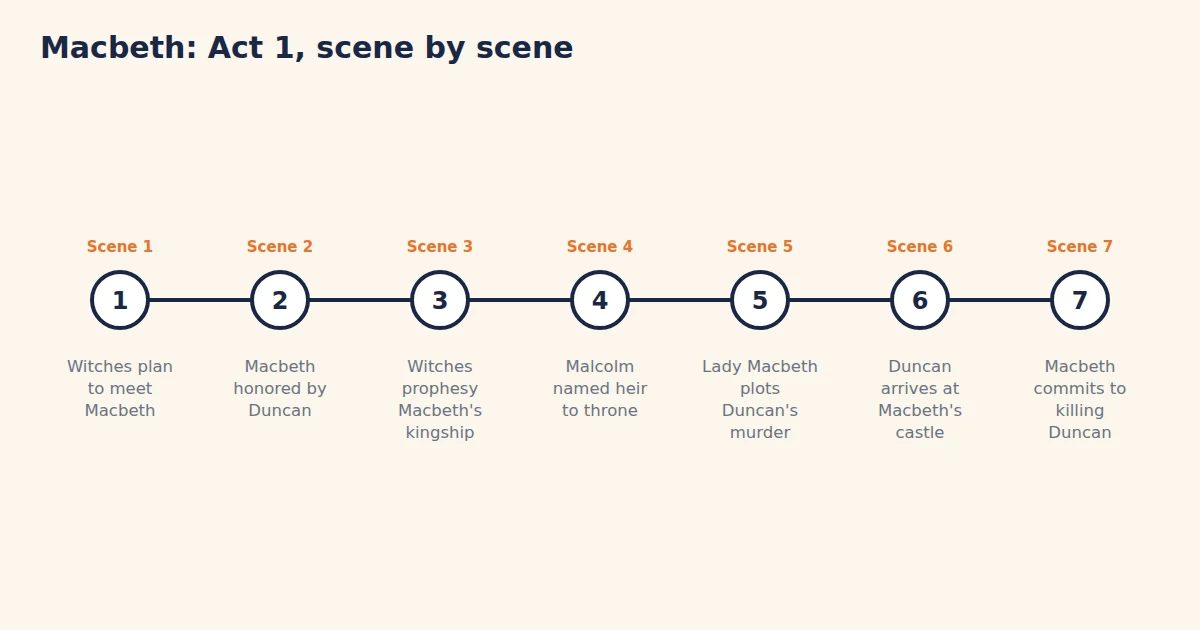
Act 1 summary
Act 1 opens with three witches planning to meet Macbeth after a battle. A wounded soldier reports Macbeth's heroic victory, and King Duncan rewards him with the title Thane of Cawdor. On a heath, the witches greet Macbeth with three prophecies: Thane of Glamis, Thane of Cawdor, and future king. They tell Banquo he will father kings though never be one himself. When Ross arrives and confirms the Cawdor title, Macbeth begins to entertain dark thoughts about the crown. Duncan names his son Malcolm as heir, which Macbeth sees as an obstacle. Lady Macbeth, reading her husband's letter about the prophecies, fears he lacks the ruthlessness to seize the throne and calls on dark spirits to harden her resolve. Duncan arrives at Macbeth's castle as a guest. In a lobby, Macbeth wavers, but Lady Macbeth overcomes his hesitation with a detailed plan to murder Duncan and frame his chamberlains.
Act 1, Scene 1: An open Place
The play opens on a stormy open place where three witches gather amid thunder and lightning. Speaking in riddles, they agree to meet again when the current battle is over, naming Macbeth as the one they will seek out. Their brief exchange establishes the play's atmosphere of disorder and moral confusion. The scene immediately frames the world of the play as one where normal distinctions between good and evil are unstable. Their parting words, spoken together, suggest that in this world appearances cannot be trusted and that what seems fair may in fact be foul, and vice versa. Many readers see this opening as a signal that the entire action of the play will unfold under the influence of deception and ambiguity.
“Fair is foul, and foul is fair:
Hover through the fog and filthy air.”
The witches' shared motto introduces the play's central theme of inverted appearances, suggesting a world where moral categories are deliberately confused.
Act 1, Scene 2: A Camp near Forres
King Duncan and his sons receive news of the battle from a bleeding soldier, who describes how Macbeth fought with extraordinary ferocity against the rebel Macdonwald, killing him and fixing his head on the battlements. The soldier also reports a second assault by the Norwegian king before fainting from his wounds. Ross then arrives with further news: the Thane of Cawdor has betrayed Scotland by siding with Norway, but Macbeth defeated the enemy and forced the Norwegian king to beg for terms. Duncan, moved by Macbeth's loyalty and valor, orders the treacherous Thane of Cawdor to be executed and decrees that Macbeth shall receive his title as a reward.
“For brave Macbeth (well he deserves that name),
Disdaining Fortune, with his brandish’d steel,
Which smok’d with bloody execution,
Like Valour’s minion, carv’d out his passage,
Till he fac’d the slave;”
Act 1, Scene 3: A heath
On a heath, the three witches wait for Macbeth, passing the time with tales of malicious mischief. When Macbeth and Banquo arrive, the witches greet Macbeth as Thane of Glamis, Thane of Cawdor, and future king. They tell Banquo he will be lesser than Macbeth yet greater, not happy yet happier, and that he will father a line of kings though never be one himself. The witches then vanish. Almost immediately, Ross and Angus arrive to inform Macbeth that the king has granted him the title Thane of Cawdor, fulfilling the second prophecy. Macbeth is shaken: in an aside he acknowledges that the thought of murder has already entered his mind, though he tries to reason that chance alone might make him king. Banquo warns that instruments of darkness often tell partial truths to lead men toward harm.
“And oftentimes to win us to our harm,
The instruments of darkness tell us truths;
Win us with honest trifles, to betray’s
In deepest consequence.”
Banquo's warning can be read as a moral counterpoint to Macbeth's temptation, suggesting that the witches' truths are bait for a larger trap.
Act 1, Scene 4: Forres. A Room in the Palace
At the palace in Forres, Duncan learns that the former Thane of Cawdor died with dignity and repentance. When Macbeth arrives, Duncan praises him warmly and speaks of his inability to repay such service. He then makes a public announcement that his eldest son Malcolm will be Prince of Cumberland and heir to the throne. For Macbeth, this is an unwelcome obstacle: in a brief aside he acknowledges that Malcolm now stands between him and the crown, and he calls on the stars to hide their light so that his dark desires remain unseen. Duncan, unaware of any of this, speaks of Macbeth with great affection and follows him toward Inverness.
“There’s no art
To find the mind’s construction in the face:”
Act 1, Scene 5: Inverness. A Room in Macbeth’s Castle
In Macbeth's castle at Inverness, Lady Macbeth reads aloud a letter from her husband describing the witches' prophecies. She immediately resolves that Macbeth must become king, but fears his nature is too full of human kindness to take the necessary action. She calls on dark spirits to strip her of feminine compassion and fill her with cruelty. A messenger announces that Duncan will arrive that very night. Lady Macbeth greets this news as an opportunity and continues her invocation of darkness. When Macbeth arrives, she takes charge at once, telling him to look innocent while she manages the night's business. Macbeth says only that they will speak further, and Lady Macbeth instructs him to leave everything to her.
“Glamis thou art, and Cawdor; and shalt be
What thou art promis’d. Yet do I fear thy nature;
It is too full o’ th’ milk of human kindness
To catch the nearest way. Thou wouldst be great;
Art not without ambition, but without
The illness should attend it.”
Her assessment of Macbeth's character establishes her as the more ruthlessly ambitious of the two at this point in the play.
Act 1, Scene 6: The same. Before the Castle
Duncan and his party arrive before Macbeth's castle. Duncan admires the pleasant air and the swallows nesting in the walls, remarking on how welcoming the place seems. Banquo agrees that the castle feels gentle and wholesome. Lady Macbeth comes out to greet the king, and the two exchange elaborate courtesies. Duncan praises her hospitality and asks after Macbeth, noting that his host rode ahead so swiftly out of eagerness to welcome them. He takes Lady Macbeth's hand and asks to be led inside. The scene is brief and ironic: the king's warmth and trust contrast sharply with what the audience already knows Lady Macbeth is planning.
“This castle hath a pleasant seat. The air
Nimbly and sweetly recommends itself
Unto our gentle senses.”
Duncan's praise of the castle's pleasant air is deeply ironic, since the audience knows the welcome conceals a murder plot, suggesting the play's theme of deceptive appearances.
Act 1, Scene 7: The same. A Lobby in the Castle
Alone in a lobby while the banquet proceeds, Macbeth weighs the reasons against killing Duncan. He acknowledges that Duncan is his kinsman, his king, and his guest, and that the king has been a virtuous ruler whose death will provoke outrage. He concludes that he has no motive beyond ambition. When Lady Macbeth enters, he tells her he will go no further with the plan. She attacks his resolve fiercely, questioning his courage and his love, and invoking the image of a nursing infant to show how far she would go to keep a sworn promise. She then lays out the practical plan: she will drug Duncan's chamberlains so that Macbeth can kill the king and the grooms can be blamed. Macbeth is persuaded and commits himself to the deed.
“I have given suck, and know
How tender ’tis to love the babe that milks me:
I would, while it was smiling in my face,
Have pluck’d my nipple from his boneless gums
And dash’d the brains out, had I so sworn as you
Have done to this.”
Lady Macbeth's shocking image is often read as the rhetorical peak of her manipulation, using the language of maternal love to shame Macbeth into violence.
Characters in Act 1
- Macbeth: Celebrated Scottish general who receives the witches' prophecies and is pushed toward regicide.
- Lady Macbeth: Macbeth's wife, who reads his letter, invokes dark spirits, and drives the murder plan forward.
- Duncan: The virtuous King of Scotland who rewards Macbeth and arrives as a trusting guest at his castle.
- Banquo: Macbeth's fellow general, who hears the witches' prophecies and warns against trusting instruments of darkness.
- Malcolm: Duncan's eldest son, named Prince of Cumberland and heir, which Macbeth sees as an obstacle to the crown.
- Ross: A Scottish thane who brings news of the battle's outcome and delivers Macbeth's new title from the king.
Frequently asked questions
What happens in Act 1 of Macbeth?
Act 1 establishes the world of the play and sets the murder plot in motion. Macbeth is celebrated as a war hero, receives a new title from King Duncan, and is then met by three witches who prophesy he will be king. Lady Macbeth reads his letter about the prophecies and resolves to push him toward murdering Duncan, who arrives as a guest at their castle. By the end of the act, Macbeth has committed to the killing.
Why does Lady Macbeth call on spirits in Act 1, Scene 5?
Lady Macbeth fears that her husband's nature is too gentle and conscientious to commit murder. She calls on dark spirits to remove her own compassion and fill her with cruelty, so that nothing will stop her from carrying out the plan. Many readers interpret this invocation as evidence that she recognizes the moral weight of what she intends and feels she must actively suppress her own humanity to proceed.
What do the witches prophesy in Act 1?
The witches greet Macbeth with three titles: Thane of Glamis, Thane of Cawdor, and king hereafter. To Banquo they say he will be lesser than Macbeth yet greater, not happy yet happier, and that he will father a line of kings though he will never be king himself. The second prophecy is almost immediately confirmed when Ross arrives to name Macbeth Thane of Cawdor.
Essays on Macbeth
- Power and Inhumanity in Macbeth and One Flew Over the Cuckoo's Nest
- Symbolism in Macbeth: Blood, Water, and Weather
- Macbeth and Martin Luther: Conviction vs. Ambition
- Macduff as the True Hero of Shakespeare's Macbeth
- Macbeth's Porter Scene: Prose-Poetry and Dark Imagery
- Manipulation and Disaster in Shakespeare's Macbeth
- Ambition, Blood, and Evil in Shakespeare's Macbeth
- Shakespeare's Macbeth vs. Polanski's 1971 Film Adaptation