Macbeth Act 5 Summary
Updated · Macbeth by William Shakespeare
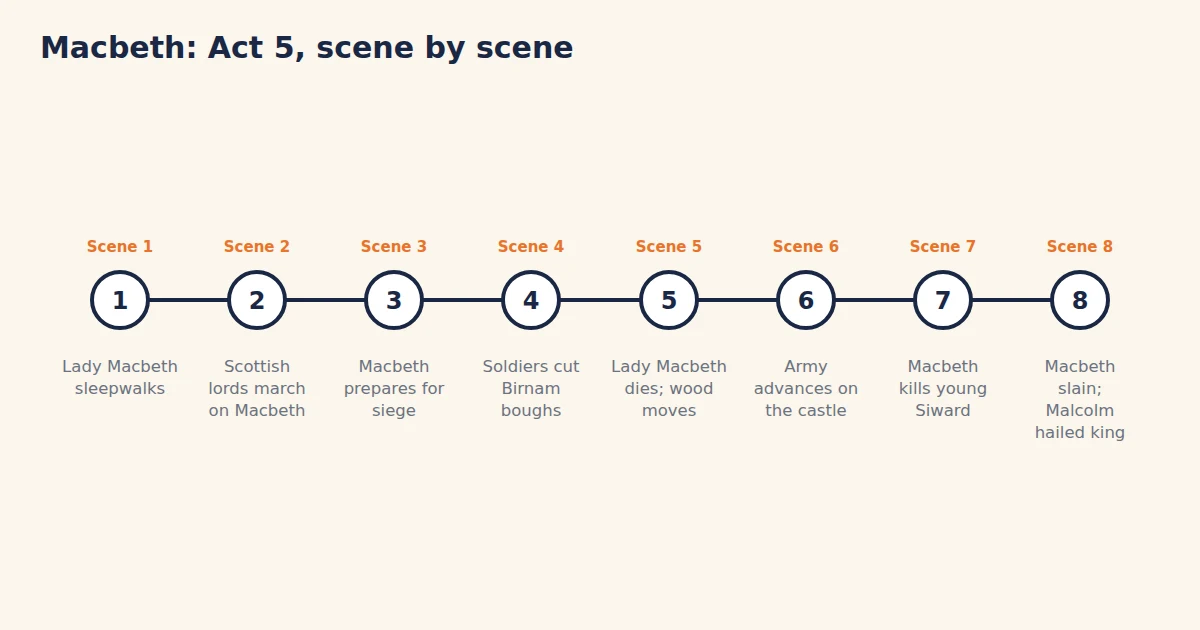
Act 5 summary
Act 5 brings the play to its violent conclusion. Lady Macbeth, tormented by guilt, sleepwalks and relives the murders in Act 5, Scene 1. Meanwhile, Scottish and English forces led by Malcolm, Macduff, and Siward march on Dunsinane. Malcolm orders his soldiers to cut boughs from Birnam Wood to conceal their numbers, fulfilling the witches' prophecy. Inside his castle, Macbeth clings to the apparitions' promises, believing that no man of woman born can harm him. Facing Macduff in the final battle, Macbeth boasts, “I bear a charmed life, which must not yield / To one of woman born.” (Act 5, Scene 8). When he learns Lady Macbeth has died, he delivers a bleak meditation on the meaninglessness of life. The news that Birnam Wood appears to move toward Dunsinane shakes his confidence. In the battle that follows, Macbeth kills young Siward but is finally confronted by Macduff, who reveals he was taken from his mother’s womb before his time and therefore not born of woman in the ordinary sense. Macbeth fights on and is slain. Macduff enters carrying Macbeth's head, and Malcolm is proclaimed King of Scotland.
Act 5, Scene 1: Dunsinane. A Room in the Castle
A doctor and a gentlewoman watch Lady Macbeth sleepwalk. She enters carrying a candle, rubs her hands as if washing them, and speaks fragments that reveal her knowledge of Duncan's murder, the blood of Banquo, and the death of Lady Macduff. The gentlewoman refuses to repeat what she has heard without a witness. The doctor concludes that Lady Macbeth's illness is beyond medicine and that she needs spiritual rather than physical care. He advises the gentlewoman to watch her closely and remove anything she might use to harm herself.
“Here’s the smell of the blood still: all the perfumes of Arabia will not sweeten this little hand. Oh, oh, oh!”
Lady Macbeth's cry that no perfume can sweeten her hand suggests her guilt has become permanent and inescapable, a powerful image of psychological torment.
“Foul whisp’rings are abroad. Unnatural deeds
Do breed unnatural troubles: infected minds
To their deaf pillows will discharge their secrets.
More needs she the divine than the physician.—”
The doctor's conclusion that unnatural deeds breed unnatural troubles can be read as the play's moral verdict on the consequences of Macbeth and Lady Macbeth's crimes.
Act 5, Scene 2: The Country near Dunsinane
Scottish lords — Menteith, Caithness, Angus, and Lennox — march with soldiers toward Birnam Wood to join the English-led forces of Malcolm, Macduff, and Siward. They discuss Macbeth's deteriorating state: some say he is mad, others call it furious bravery. Angus observes that those who serve Macbeth do so only under compulsion, and that his stolen title sits uneasily on him. The lords resolve to march on and give their loyalty to the rightful cause, framing their campaign as a remedy for a sick nation.
“Those he commands move only in command,
Nothing in love: now does he feel his title
Hang loose about him, like a giant’s robe
Upon a dwarfish thief.”
The image of a giant's robe on a dwarfish thief continues the play's clothing metaphor and suggests Macbeth's kingship was never truly his to wear.
Act 5, Scene 3: Dunsinane. A Room in the Castle
Macbeth, inside Dunsinane castle, dismisses reports of deserting thanes and the approaching army, relying on the witches' prophecies for confidence. He berates a frightened servant and calls for Seyton, his officer. In a moment of self-reflection, he acknowledges that he has lived long enough and that old age will bring him none of the things that should accompany it — honour, love, and friendship. He asks the doctor about Lady Macbeth; the doctor says she is troubled by thick-coming fancies. Macbeth demands a cure for her mind, then for Scotland itself, before declaring he will not fear until Birnam Wood comes to Dunsinane.
“Canst thou not minister to a mind diseas’d,
Pluck from the memory a rooted sorrow,
Raze out the written troubles of the brain,
And with some sweet oblivious antidote
Cleanse the stuff’d bosom of that perilous stuff
Which weighs upon the heart?”
Macbeth's question about curing a diseased mind can be read as an indirect acknowledgment of his own guilt and the impossibility of undoing what has been done.
Act 5, Scene 4: Country near Dunsinane: a Wood in view
Malcolm leads his army, including old Siward, his son, Macduff, and other lords, through the country near Dunsinane. When they reach Birnam Wood, Malcolm orders every soldier to cut down a bough and carry it before him, so that the true size of their force will be hidden from Macbeth's scouts. Siward reports that Macbeth remains confidently inside Dunsinane and intends to withstand a siege. Malcolm and Macduff urge disciplined soldiership rather than premature confidence, and the army marches forward.
“Let every soldier hew him down a bough,
And bear’t before him. Thereby shall we shadow
The numbers of our host, and make discovery
Err in report of us.”
Malcolm's order to carry boughs is the moment the witches' prophecy about Birnam Wood begins to come true, though through entirely natural means.
Act 5, Scene 5: Dunsinane. Within the castle
Macbeth orders his banners hung and boasts that the castle will withstand any siege. A cry of women is heard within, and Seyton reports that the queen is dead. Macbeth responds with a speech reflecting on the emptiness of time and life. A messenger then arrives to report that Birnam Wood appears to be moving toward Dunsinane. Macbeth is shaken, recognizing that the prophecy may be turning against him. He resolves to fight regardless, calling for the alarm bell and declaring that he would rather die in battle than surrender.
“I pull in resolution; and begin
To doubt th’ equivocation of the fiend,
That lies like truth. “Fear not, till Birnam wood
Do come to Dunsinane;” and now a wood
Comes toward Dunsinane.—Arm, arm, and out!—”
Macbeth's acknowledgment that the fiend has lied to him marks the moment his false security finally collapses, though he chooses defiance over surrender.
Act 5, Scene 6: The same. A Plain before the Castle
Malcolm's army arrives before Dunsinane castle. Malcolm orders the soldiers to throw down their leafy boughs and reveal themselves. He assigns old Siward and his son to lead the first battle, while he and Macduff will handle whatever else remains. Siward declares that if they find the tyrant's forces, they must fight and win. Macduff calls for the trumpets to sound, and the army advances toward the castle.
“Make all our trumpets speak; give them all breath,
Those clamorous harbingers of blood and death.”
Macduff's call for the trumpets to speak as harbingers of blood and death underlines his personal drive for vengeance as much as his role as a military commander.
Act 5, Scene 7: The same. Another part of the Plain
Macbeth enters the battlefield and compares himself to a bear tied to a stake, forced to fight. He encounters young Siward, who challenges him by name. Macbeth kills young Siward, confident that no man born of woman can harm him. Macduff then enters searching for Macbeth, declaring he will not waste his sword on lesser soldiers. Old Siward and Malcolm appear; Siward reports that the castle has surrendered easily and that many of Macbeth's own people have turned against him. Malcolm and Siward enter the castle.
“They have tied me to a stake. I cannot fly,
But, bear-like I must fight the course.—What’s he
That was not born of woman? Such a one
Am I to fear, or none.”
Macbeth's bear-baiting image suggests he feels trapped and cornered, yet his defiance in the face of that entrapment can be read as a form of grim courage.
Act 5, Scene 8: The same. Another part of the field
Macbeth re-enters and refuses to die by his own hand. Macduff confronts him and they fight. Macbeth declares he bears a charmed life and cannot be harmed by one of woman born. Macduff reveals he was untimely ripped from his mother's womb, destroying Macbeth's last protection. Macbeth curses the deceiving witches but refuses to yield, and the two exit fighting. Macbeth is killed. Malcolm and the others gather; Ross tells old Siward that his son died bravely with his wounds on the front. Macduff enters carrying Macbeth's head and hails Malcolm as king. Malcolm is proclaimed King of Scotland and announces rewards for his followers, promising to call home exiles and bring Macbeth's cruel agents to justice, and invites them to see him crowned at Scone.
“And be these juggling fiends no more believ’d,
That palter with us in a double sense;
That keep the word of promise to our ear,
And break it to our hope!—I’ll not fight with thee.”
Macbeth's recognition that the witches kept the word of promise to his ear but broke it to his hope is the play's clearest statement on the theme of equivocation and deceptive prophecy.
“Producing forth the cruel ministers
Of this dead butcher, and his fiend-like queen,
Who, as ’tis thought, by self and violent hands
Took off her life;”
Malcolm's description of Macbeth as a dead butcher and Lady Macbeth as a fiend-like queen offers the play's final moral judgment on both characters.
Characters in Act 5
- Macbeth: Defends Dunsinane, clings to prophecies, and dies fighting Macduff in battle.
- Lady Macbeth: Sleepwalks and speaks of the murders in her sleep before her death, which Malcolm says is thought to be by her own hand.
- Malcolm: Leads the army against Macbeth and is proclaimed King of Scotland at the end.
- Macduff: Searches out Macbeth on the battlefield, kills him, and presents his head to Malcolm.
- Siward: Commands part of the army; learns his son died bravely and accepts the news with stoic resolve.
- Ross: Delivers the news of young Siward's death and is present at Malcolm's proclamation as king.
- the Doctor: Observes Lady Macbeth's sleepwalking and concludes her illness is beyond medical treatment.
Frequently asked questions
What happens in Act 5 of Macbeth?
Act 5 shows the fall of Macbeth. Lady Macbeth sleepwalks and betrays her guilt before dying. Malcolm's army advances on Dunsinane, fulfilling the Birnam Wood prophecy when soldiers carry cut boughs. Macbeth fights to the end but is killed by Macduff, who was taken from his mother’s womb before his time and thus not born of woman in the ordinary sense. Malcolm is hailed king.
Why does Lady Macbeth sleepwalk in Act 5?
The play shows Lady Macbeth sleepwalking and reliving the murders she and Macbeth committed. Many readers see her sleepwalking as a sign that guilt has overwhelmed her mind, breaking through even in sleep. The doctor who observes her concludes that her condition is spiritual rather than medical and that she needs a divine rather than a physician.
How does Macbeth die in Act 5?
Macbeth is killed by Macduff in single combat in Act 5, Scene 8. Macbeth initially believes he is safe because the witches told him no man born of woman could harm him, but Macduff reveals he was taken from his mother’s womb before his time. Macbeth refuses to yield even after this revelation and is slain. Macduff enters carrying his head.
Essays on Macbeth
- Power and Inhumanity in Macbeth and One Flew Over the Cuckoo's Nest
- Symbolism in Macbeth: Blood, Water, and Weather
- Macbeth and Martin Luther: Conviction vs. Ambition
- Macduff as the True Hero of Shakespeare's Macbeth
- Macbeth's Porter Scene: Prose-Poetry and Dark Imagery
- Manipulation and Disaster in Shakespeare's Macbeth
- Ambition, Blood, and Evil in Shakespeare's Macbeth
- Shakespeare's Macbeth vs. Polanski's 1971 Film Adaptation