Macbeth Act 4 Summary
Updated · Macbeth by William Shakespeare
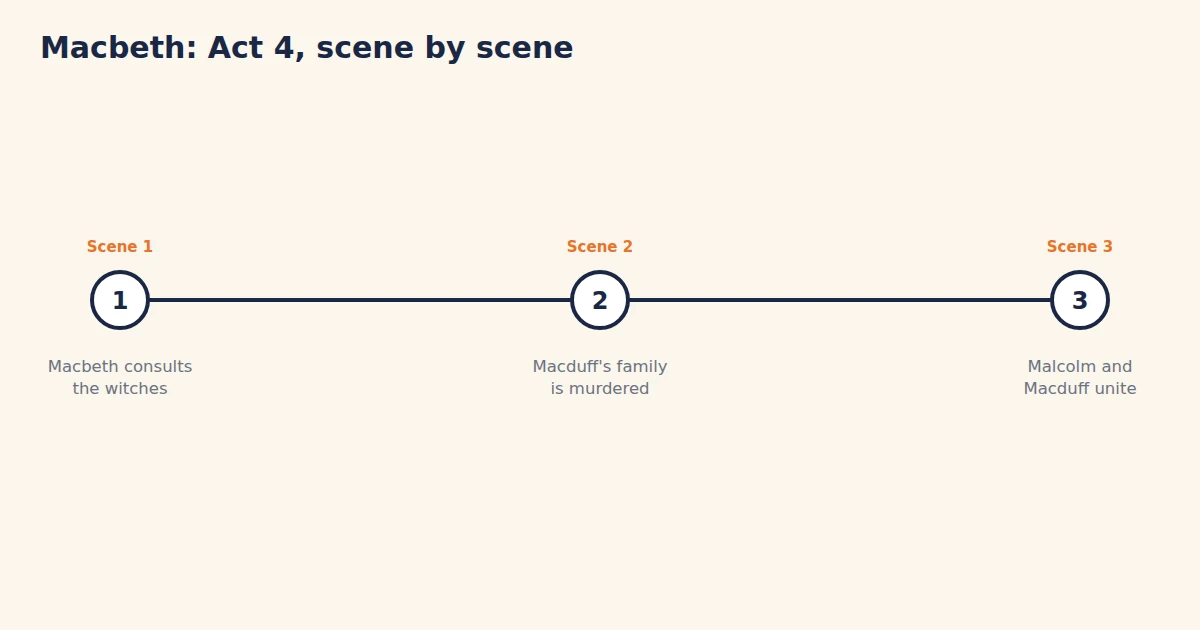
Act 4 summary
Act 4 opens with the three witches preparing their cauldron. Macbeth arrives demanding to know his fate, and three apparitions deliver prophecies: he should beware Macduff, no man born of woman can harm him, and he is safe until Birnam Wood moves to Dunsinane. A vision of eight kings descended from Banquo deeply disturbs him. Learning that Macduff has fled to England, Macbeth immediately orders the attack on Macduff's castle. In Scene 2, Lady Macduff and her son are left unprotected; a messenger warns them too late, and murderers kill the boy and pursue Lady Macduff. In Scene 3, set in England, Malcolm tests Macduff's loyalty by falsely claiming to be vicious and corrupt. Satisfied by Macduff's genuine despair for Scotland, Malcolm reveals his true character and confirms that an army is ready. Ross then arrives with the devastating news that Macduff's wife and children have been slaughtered, and Macduff vows revenge.
Act 4, Scene 1: A dark Cave. In the middle, a Cauldron Boiling
The witches dance around their boiling cauldron, throwing in a grotesque collection of ingredients. Hecate appears briefly to praise their work before departing. Macbeth then enters and demands to know his destiny. The witches summon three apparitions: an armed head warns him to beware Macduff; a bloody child tells him no man born of woman shall harm him; a crowned child holding a tree says he will never be defeated until Birnam Wood marches to Dunsinane. Macbeth takes comfort in the last two prophecies but is horrified by a vision of eight kings, all resembling Banquo, who smiles and points to them as his descendants. When the witches vanish, Lennox enters and tells Macbeth that Macduff has fled to England. Macbeth resolves on the spot to attack Macduff's castle and kill his family before his resolve can cool.
“Double, double, toil and trouble;
Fire, burn; and cauldron, bubble.”
The witches' refrain punctuates the scene and can be read as a symbol of the destructive cycle Macbeth is now fully caught up in.
“From this moment
The very firstlings of my heart shall be
The firstlings of my hand. And even now,
To crown my thoughts with acts, be it thought and done”
Macbeth declares he will act on impulse without reflection, showing how far he has moved from the agonized hesitation of earlier acts.
Act 4, Scene 2: Fife. A Room in Macduff’s Castle
At Macduff's castle in Fife, Lady Macduff complains bitterly to Ross that her husband has abandoned his family by fleeing to England. Ross defends Macduff as wise and judicious before departing. Lady Macduff tells her young son that his father is dead, and the two engage in a sharp, witty exchange about traitors and survival. A messenger arrives to warn Lady Macduff that danger is approaching and urges her to flee immediately, but she has nowhere to go. Murderers sent by Macbeth enter almost at once. When the boy defiantly calls the first murderer a liar and a villain, the murderer stabs him. The boy dies urging his mother to run, and Lady Macduff flees crying murder, pursued by the killers.
“Whither should I fly?
I have done no harm. But I remember now
I am in this earthly world, where to do harm
Is often laudable; to do good sometime
Accounted dangerous folly: why then, alas,
Do I put up that womanly defence,
To say I have done no harm?”
Lady Macduff's words suggest she recognizes the moral disorder of Macbeth's Scotland, where innocence offers no protection.
“Thou liest, thou shag-ear’d villain!”
The son's fearless defiance of the murderer is often read as a moment of moral courage that contrasts sharply with the corruption surrounding it.
Act 4, Scene 3: England. Before the King’s Palace
In England, Malcolm is cautious about trusting Macduff and tests him by claiming to be consumed by lust, greed, and every vice, declaring himself unfit to rule. Macduff endures each confession until Malcolm claims he has no kingly virtues at all, at which point Macduff despairs for Scotland and prepares to leave. Satisfied that Macduff is genuinely loyal, Malcolm reveals that everything he said was false and that old Siward is already leading ten thousand soldiers toward Scotland. A doctor briefly mentions the English king Edward's miraculous healing of the sick. Ross then arrives and, after hesitating, tells Macduff that his castle has been seized and his wife and children savagely killed. Macduff is devastated and blames himself. Malcolm urges him to turn grief into anger, and Macduff vows to meet Macbeth face to face. The two men prepare to march back to Scotland.
“All my pretty ones?
Did you say all?—O hell-kite!—All?
What, all my pretty chickens and their dam
At one fell swoop”
Macduff's anguished response to the news of his family's deaths is widely seen as one of the play's most emotionally direct expressions of grief.
Characters in Act 4
- Macbeth: Seeks prophecies from the witches and orders the murder of Macduff's family.
- Malcolm: Tests Macduff's loyalty in England and prepares to lead an army back to Scotland.
- Macduff: Flees to England, joins Malcolm, and learns his family has been slaughtered.
- Lady Macduff: Left unprotected in Fife, she is killed by Macbeth's murderers along with her son.
- Ross: Visits Lady Macduff before her death and later delivers the news of the massacre to Macduff.
- Macduff's son: Engages in a brave exchange with his mother before being stabbed by the murderers.
Frequently asked questions
What happens in Act 4 of Macbeth?
Macbeth visits the witches, who show him three apparitions with prophecies that make him feel invincible. He then orders the killing of Macduff's family. In England, Macduff and Malcolm join forces after Malcolm tests Macduff's loyalty, and Ross brings the terrible news that Lady Macduff and her children have been murdered. Macduff vows revenge.
What are the three prophecies the witches give Macbeth in Act 4?
The first apparition warns Macbeth to beware Macduff. The second tells him that no man born of woman can harm him. The third says he will never be defeated until Birnam Wood comes to Dunsinane. Macbeth finds comfort in the last two, believing them impossible to fulfill, though the first still prompts him to act against Macduff.
Why does Malcolm pretend to be wicked when he meets Macduff in Act 4?
Malcolm explains that Macbeth has previously tried to lure him into traps through agents, so he tests Macduff by claiming to be full of lust, greed, and every vice. When Macduff's despair for Scotland convinces Malcolm of his genuine loyalty, Malcolm takes back everything he said and reveals his true character.
Essays on Macbeth
- Power and Inhumanity in Macbeth and One Flew Over the Cuckoo's Nest
- Symbolism in Macbeth: Blood, Water, and Weather
- Macbeth and Martin Luther: Conviction vs. Ambition
- Macduff as the True Hero of Shakespeare's Macbeth
- Macbeth's Porter Scene: Prose-Poetry and Dark Imagery
- Manipulation and Disaster in Shakespeare's Macbeth
- Ambition, Blood, and Evil in Shakespeare's Macbeth
- Shakespeare's Macbeth vs. Polanski's 1971 Film Adaptation