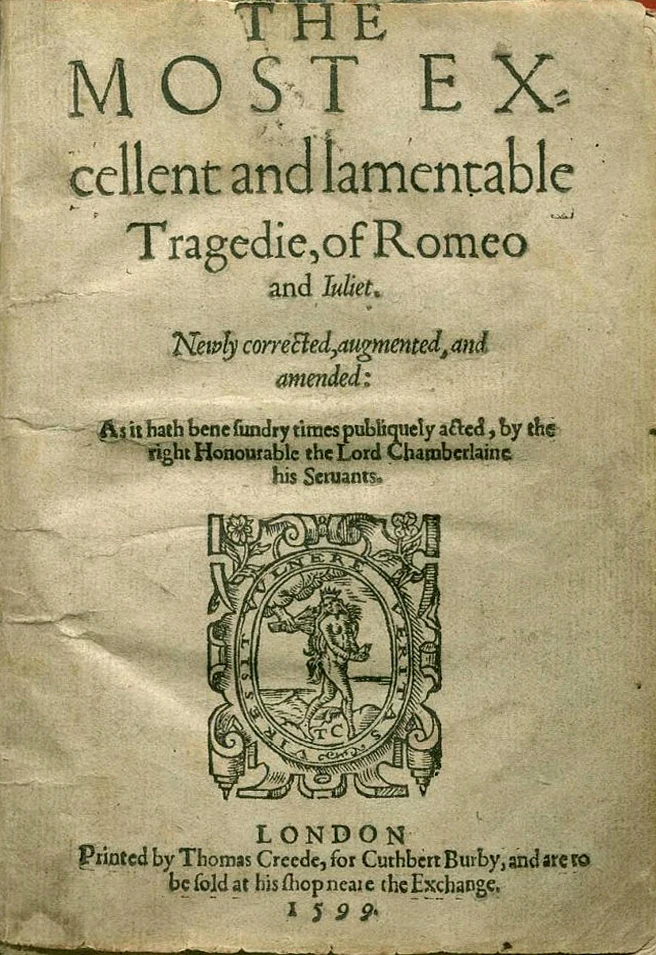
Romeo and Juliet Summary
Updated
At a glance
- Author
- William Shakespeare
- Written
- Around 1594–96
- First printed
- 1597
- Setting
- Verona, and Mantua in Act 5
- Acts
- 5 (24 scenes, a Prologue and a Chorus)
Plot summary
The play opens in Verona, where the Montague and Capulet families have long been at war with each other. A street brawl between their servants draws in noblemen on both sides and prompts Prince Escalus to warn that any further violence will be punished by death. Romeo, a young Montague, is lovesick over a woman named Rosaline when his friend Benvolio persuades him to attend a Capulet feast in disguise. There, Romeo sees Juliet, the daughter of Capulet, and instantly forgets Rosaline. The two speak, share a kiss, and only afterward discover they belong to enemy houses.
That same night Romeo climbs into the Capulet orchard and the two declare their love beneath Juliet's window. They agree to marry the very next day. With the help of Friar Laurence, who hopes the union will end the families' feud, and Juliet's Nurse, who carries messages between them, Romeo and Juliet are secretly wed at Friar Laurence's cell.
Joy turns to catastrophe in Act 3. On a hot afternoon in Verona's streets, Tybalt kills Mercutio after Romeo refuses to fight his new kinsman. Romeo then kills Tybalt in revenge and is banished from Verona by Prince Escalus. Juliet is devastated but resolves to remain loyal to her husband. Her father, knowing nothing of the secret marriage, arranges for her to wed the nobleman Paris on Thursday. Juliet refuses, and Capulet threatens to disown her.
Desperate, Juliet goes to Friar Laurence, who gives her a potion that will make her appear dead for roughly forty-two hours. The plan is for Romeo to be summoned by letter, meet her when she wakes in the Capulet tomb, and carry her away to Mantua. Juliet drinks the potion the night before the forced wedding, is found apparently dead the next morning, and is laid in the family vault. Friar Laurence's letter, however, never reaches Romeo because the messenger is quarantined during a plague outbreak.
Romeo hears only that Juliet is dead. He buys poison from an apothecary in Mantua and rushes back to Verona. At the tomb he encounters Paris, kills him in a fight, then enters the vault, drinks the poison beside Juliet's body, and dies. Juliet wakes moments later to find Romeo dead. She kisses his lips hoping for poison, then stabs herself with his dagger and dies. The Prince, the Capulets, and Montague gather at the tomb. Friar Laurence confesses the whole story. Faced with the cost of their hatred, Capulet and Montague clasp hands and each vows to raise a golden statue in honor of the other's child.
Where does Romeo and Juliet take place?
The play is set in Verona, a city in northern Italy, with one scene taking place in Mantua, where Romeo lives during his banishment. Shakespeare gives no precise historical period for the action. The Prologue establishes Verona as the location from the outset, and the text presents it as a place governed by a prince and divided by a bitter feud between two noble households.
How does Romeo and Juliet end?
Romeo, believing Juliet to be truly dead, drinks poison at her side in the Capulet tomb and dies. Juliet wakes moments later, finds Romeo dead, and kills herself with his dagger. Paris has also been slain by Romeo at the tomb entrance. Prince Escalus, the Capulets, and Montague arrive to find all three dead. Friar Laurence confesses the secret marriage and the failed plan. The Prince declares that all are punished. Capulet and Montague reconcile over their children's bodies and each promises to raise a golden statue in the other's child's memory.
“But soft, what light through yonder window breaks?
It is the east, and Juliet is the sun!”
“What’s in a name? That which we call a rose
By any other name would smell as sweet;”
Act-by-act summary
- Act 1 Romeo and Juliet meet and fall in love at a Capulet feast, only to discover they belong to enemy families. Read the scene-by-scene summary →
- Act 2 Romeo and Juliet declare their love, and Friar Laurence secretly marries them the following day. Read the scene-by-scene summary →
- Act 3 Mercutio and Tybalt are killed, Romeo is banished, and Juliet's father orders her to marry Paris. Read the scene-by-scene summary →
- Act 4 Friar Laurence gives Juliet a sleeping potion so she can fake her death and escape the forced marriage. Read the scene-by-scene summary →
- Act 5 Romeo poisons himself beside Juliet's body; she wakes and kills herself, and the feuding families finally reconcile. Read the scene-by-scene summary →
Characters
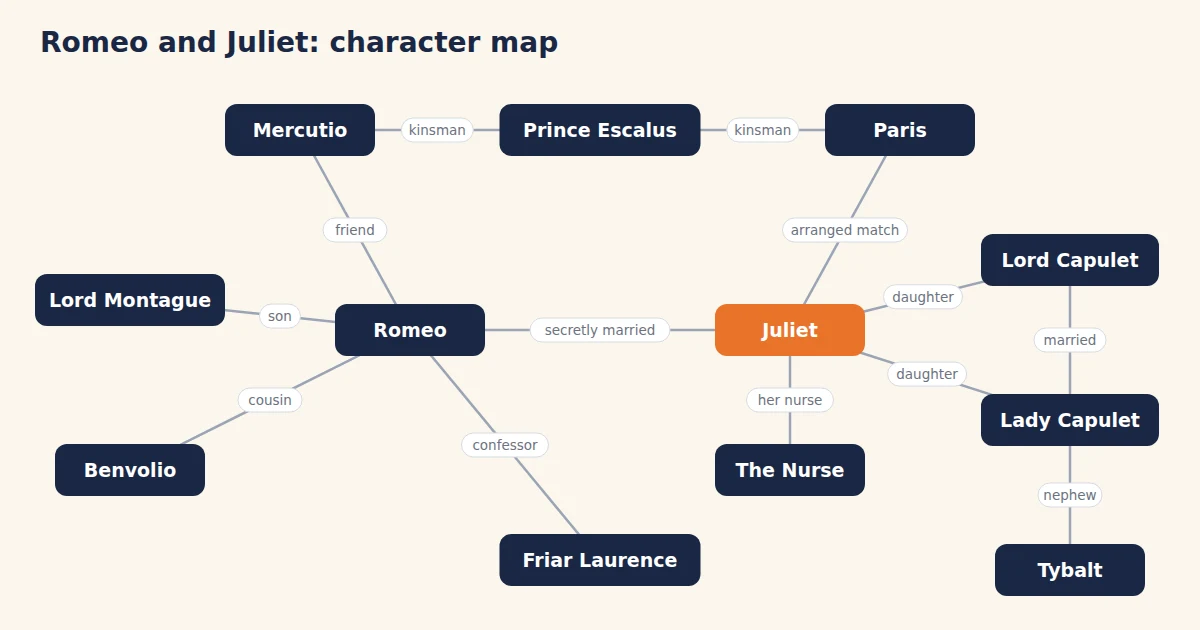 Who’s who in Romeo and Juliet
Juliet, Romeo, the Nurse, Mercutio, Tybalt, Friar Laurence, the Capulets and the Montagues, and how they are connected.
See all characters →
Famous quotes
“O Romeo, Romeo, wherefore art thou Romeo?
Deny thy father and refuse thy name.
Or if thou wilt not, be but sworn my love,
And I’ll no longer be a Capulet.”
“But soft, what light through yonder window breaks?
It is the east, and Juliet is the sun!”
Frequently asked questions
How old were Romeo and Juliet?
Juliet is not yet fourteen. Lady Capulet says “She’s not fourteen.” (Act 1, Scene 3), and the Nurse replies “Come Lammas Eve at night shall she be fourteen.” (Act 1, Scene 3); Lammas Eve is a fortnight and a few days away. The play never states Romeo's age, and no reliable guess can be made from the text.
How did Romeo and Juliet die?
Romeo, believing Juliet to be truly dead, buys poison from an apothecary in Mantua and drinks it beside her body in the Capulet tomb. Juliet wakes to find him dead, and, refusing to leave, stabs herself with Romeo's dagger and dies on his body.
Is Romeo and Juliet a true story?
There is no historical evidence that Romeo and Juliet were real people. Shakespeare based the play on Arthur Brooke's 1562 poem The Tragicall Historye of Romeus and Juliet, which was itself a work of fiction.
How does Romeo and Juliet end?
Both lovers die in the Capulet tomb: Romeo by poison and Juliet by her own dagger. Paris is also killed there. The Prince, the Capulets, and Montague gather at the scene; Friar Laurence confesses everything, and the two families finally reconcile, each promising a golden statue in the other's child's honor.
Where does Romeo and Juliet take place?
Nearly all of the action takes place in Verona. Romeo spends part of Act 5 in Mantua, where he lives during his banishment, before returning to Verona for the play's tragic conclusion.
When was Romeo and Juliet written?
Romeo and Juliet was written by William Shakespeare around 1594 to 1596 and was first printed in 1597. Shakespeare’s source story was Arthur Brooke’s 1562 poem, and there is no historical evidence the lovers were real people.
Essays on Romeo and Juliet
- Romeo and Juliet: Love or Infatuation in Shakespeare
- Love and Hate in Shakespeare's Romeo and Juliet
- Tchaikovsky's Romeo and Juliet Fantasy: A Romantic Analysis
- Pain and Joy of Love in Shakespeare's Romeo and Juliet
- Teaching Romeo and Juliet: Engaging Students With Shakespeare
- Romeo and Juliet: Teenage Love, Impulsiveness, and Tragedy
- Shot-by-Shot Analysis: Mercutio's Death in Romeo + Juliet 1996
- Love's Definition in Shakespeare's Romeo and Juliet