Romeo and Juliet Act 2 Summary
Updated · Romeo and Juliet by William Shakespeare
Act 2 summary
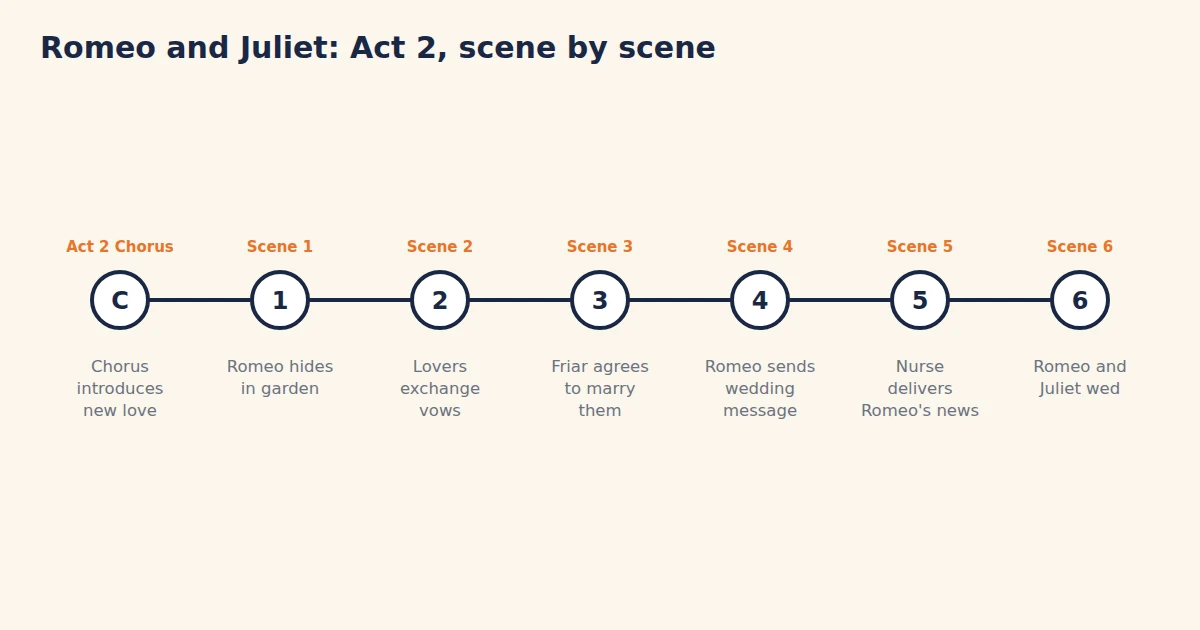
Act 2 opens with the Chorus noting that Romeo's old love for Rosaline has been replaced by his feeling for Juliet. Romeo slips into the Capulet garden, where he and Juliet exchange vows of love from below and above a window. Juliet proposes that Romeo arrange a marriage and send word the next morning. Romeo goes at dawn to Friar Laurence, who agrees to perform the ceremony, hoping the union will end the feud between the families. On a street, Mercutio and Benvolio trade jokes with Romeo, and the Nurse arrives to collect Romeo's message for Juliet. Romeo instructs the Nurse to tell Juliet to come to Friar Laurence's cell that afternoon to be married. Juliet, waiting anxiously, finally receives the news and hurries to the friar's cell. There, in Act 2, Scene 6, Romeo and Juliet are married by Friar Laurence.
Act 2 Chorus
The Chorus delivers a sonnet explaining that Romeo's desire for Rosaline is dead and that a new love has taken its place. Romeo and Juliet are equally captivated by each other, yet their situation is difficult: as members of enemy families, they have little opportunity to meet or exchange vows openly. The Chorus notes that passion itself will find a way to give them the time and means to be together despite the obstacles their families' enmity creates.
“Now old desire doth in his deathbed lie,
And young affection gapes to be his heir;”
The Chorus signals that Romeo's infatuation with Rosaline is over, framing the shift to Juliet as a complete replacement of the old desire.
“But passion lends them power, time means, to meet,
Tempering extremities with extreme sweet.”
Many readers see this couplet as the Chorus's central claim: that the intensity of the lovers' passion will overcome the practical barriers keeping them apart.
Act 2, Scene 1: An open place adjoining Capulet’s Garden
Romeo, unable to leave the Capulet property, climbs the orchard wall and hides. Benvolio and Mercutio search for him, calling his name and mocking his lovesick state with jokes about Rosaline. Mercutio's teasing is bawdy and irreverent, but Romeo does not respond. Benvolio concludes that Romeo is hiding deliberately and does not wish to be found, so the two friends give up and leave. Romeo remains concealed in the garden, drawn back by his feelings for Juliet.
“Can I go forward when my heart is here?
Turn back, dull earth, and find thy centre out.”
Romeo's opening lines suggest he cannot move forward because his heart is already with Juliet, establishing the pull that keeps him in the garden.
“Go then; for ’tis in vain
To seek him here that means not to be found.”
Benvolio's parting words can be read as an ironic comment on Romeo's deliberate concealment, contrasting with the friends' inability to understand his transformed feelings.
Act 2, Scene 2: Capulet’s Garden
Romeo watches Juliet appear at her window and compares her to the sun. Juliet, not knowing she is overheard, speaks aloud her wish that Romeo were not a Montague. Romeo reveals himself, and the two declare their love. Juliet cautions against swearing by the inconstant moon and worries the exchange is too sudden. She proposes marriage: if Romeo's intentions are honorable, he should send word the next day about when and where the wedding will take place. The Nurse calls Juliet inside repeatedly, and the scene ends with the lovers reluctantly parting after agreeing that Juliet will send a messenger to Romeo by nine the next morning.
“But soft, what light through yonder window breaks?
It is the east, and Juliet is the sun!”
Romeo's comparison of Juliet to the sun is one of the play's most celebrated images, suggesting she outshines everything around her.
“My bounty is as boundless as the sea,
My love as deep; the more I give to thee,
The more I have, for both are infinite.”
Juliet's description of her love as boundless as the sea is often read as a sign of her emotional depth and the sincerity that distinguishes her from conventional romantic heroines.
Act 2, Scene 3: Friar Lawrence’s Cell
Friar Laurence is gathering herbs at dawn when Romeo arrives. The friar is surprised to see him so early and guesses he has not been to bed. Romeo explains that he has fallen in love with Juliet Capulet and asks the friar to marry them that very day. Friar Laurence chides Romeo for abandoning Rosaline so quickly, suggesting his love is more in his eyes than his heart. Nevertheless, the friar agrees to perform the marriage, reasoning that the union between a Montague and a Capulet might help end the long feud between the two families.
“For this alliance may so happy prove,
To turn your households’ rancour to pure love.”
Friar Laurence's stated motive for helping Romeo can be read as well-intentioned but also as a sign that he is acting on political hope rather than careful judgment.
“Wisely and slow; they stumble that run fast.”
The friar's warning about haste is often seen as foreshadowing, suggesting that the speed of the lovers' actions will contribute to the tragedy ahead.
Act 2, Scene 4: A Street
Mercutio and Benvolio discuss Romeo's absence and note that Tybalt has sent a challenge to the Montague household. When Romeo arrives, he is in good spirits and trades rapid wordplay with Mercutio. The Nurse then appears with her servant Peter, seeking Romeo on Juliet's behalf. Mercutio mocks the Nurse, and after he and Benvolio leave, Romeo speaks privately with her. He instructs her to tell Juliet to come to Friar Laurence's cell that afternoon under the pretense of going to confession, where they will be married. He also arranges for a rope ladder to be delivered so he can climb to Juliet's room that night.
“Bid her devise
Some means to come to shrift this afternoon,
And there she shall at Friar Lawrence’ cell
Be shriv’d and married. Here is for thy pains.”
Romeo's instructions to the Nurse are the practical hinge of the act, setting the secret marriage in motion and showing his decisive shift from passive lover to active planner.
Act 2, Scene 5: Capulet’s Garden
Juliet waits impatiently for the Nurse to return with news from Romeo. She has sent the Nurse at nine in the morning and it is now noon, making the three-hour wait feel unbearable. When the Nurse finally arrives, she delays further by complaining of aches and exhaustion, frustrating Juliet. Eventually the Nurse reveals that Romeo has arranged for Juliet to go to Friar Laurence's cell that afternoon, where he will marry her. She also says she must go and fetch the rope ladder Romeo will climb that night. Juliet hurries off joyfully to meet Romeo.
“O, she is lame. Love’s heralds should be thoughts,
Which ten times faster glides than the sun’s beams,
Driving back shadows over lowering hills:
Therefore do nimble-pinion’d doves draw love,
And therefore hath the wind-swift Cupid wings.”
Juliet's impatient speech about love's messengers reveals her passionate nature and contrasts with the Nurse's slow, comic return, creating dramatic tension through delay.
“Then hie you hence to Friar Lawrence’ cell;
There stays a husband to make you a wife.”
The Nurse's plain announcement that a husband awaits Juliet marks the moment the marriage plan becomes concrete and immediate for Juliet.
Act 2, Scene 6: Friar Lawrence’s Cell
Friar Laurence and Romeo wait in the friar's cell for Juliet to arrive. The friar urges Romeo to love moderately, warning that violent delights have violent ends. Romeo declares that whatever sorrow may come, nothing can outweigh the joy of this moment with Juliet. Juliet arrives, and she and Romeo exchange brief, joyful words. The friar then leads them away to perform the marriage ceremony, closing the act on the moment the two are formally wed.
“These violent delights have violent ends,
And in their triumph die; like fire and powder,
Which as they kiss consume.”
Friar Laurence's warning that violent delights have violent ends is widely read as the play's most explicit foreshadowing of the tragedy to come.
“But my true love is grown to such excess,
I cannot sum up sum of half my wealth.”
Juliet's claim that her love has grown beyond what she can measure echoes her earlier speech about boundless love and reinforces her as the more eloquent voice of the pair's devotion.
Characters in Act 2
- Romeo: Declares love for Juliet, seeks out Friar Laurence, and arranges the secret marriage.
- Juliet: Exchanges vows with Romeo, proposes marriage, and travels to Friar Laurence's cell to be wed.
- Friar Laurence: Agrees to marry Romeo and Juliet, hoping the union will end the families' feud.
- Mercutio: Searches for Romeo with Benvolio and trades comic wordplay with him on the street.
- Benvolio: Accompanies Mercutio in searching for Romeo and tries to keep the peace in their banter.
- the Nurse: Acts as go-between for Romeo and Juliet, carrying the message that arranges their marriage.
- the Chorus: Opens Act 2 with a sonnet explaining that Romeo's love has shifted from Rosaline to Juliet.
Frequently asked questions
What happens in Act 2 of Romeo and Juliet?
In Act 2, Romeo and Juliet declare their love in the Capulet garden and agree to marry. Romeo visits Friar Laurence, who consents to perform the ceremony. The Nurse carries messages between the two lovers, and by the end of the act Romeo and Juliet are secretly married in Friar Laurence's cell.
Why does Friar Laurence agree to marry Romeo and Juliet so quickly?
Friar Laurence is skeptical of Romeo's sudden change of heart after his infatuation with Rosaline, but he agrees to the marriage because he hopes it will turn the hatred between the Capulet and Montague families into love. His decision is motivated by a desire for peace in Verona rather than full confidence in Romeo's constancy.
What is the significance of the balcony scene in Act 2?
In Act 2, Scene 2, Romeo and Juliet exchange declarations of love and vows of commitment. Juliet raises the practical question of marriage, and the scene ends with a plan to wed the next day. Many readers see it as the emotional and dramatic center of the play, establishing the depth and sincerity of the lovers' bond before the complications of later acts.
Essays on Romeo and Juliet
- Romeo and Juliet: Love or Infatuation in Shakespeare
- Love and Hate in Shakespeare's Romeo and Juliet
- Tchaikovsky's Romeo and Juliet Fantasy: A Romantic Analysis
- Pain and Joy of Love in Shakespeare's Romeo and Juliet
- Teaching Romeo and Juliet: Engaging Students With Shakespeare
- Romeo and Juliet: Teenage Love, Impulsiveness, and Tragedy
- Shot-by-Shot Analysis: Mercutio's Death in Romeo + Juliet 1996
- Love's Definition in Shakespeare's Romeo and Juliet