Romeo and Juliet Act 3 Summary
Updated · Romeo and Juliet by William Shakespeare
Act 3 summary
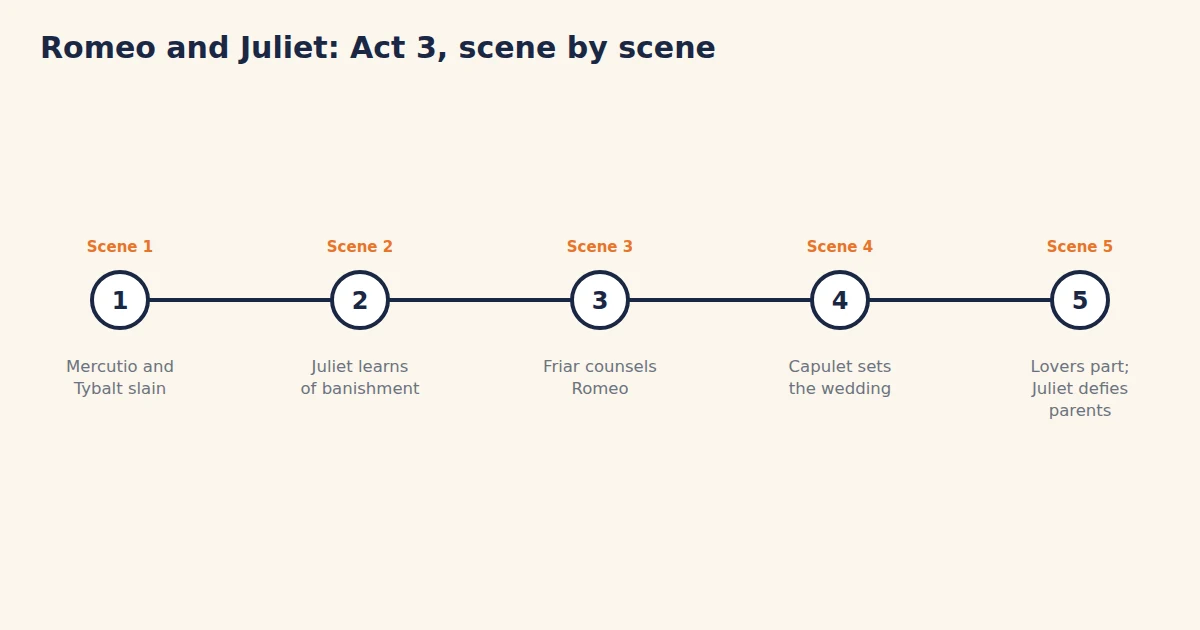
Act 3 begins with a fatal street brawl in which Tybalt kills Mercutio and Romeo then kills Tybalt, earning banishment from Prince Escalus. Juliet learns of both Tybalt's death and Romeo's exile, and struggles to reconcile her grief with her loyalty to her husband. Romeo hides at Friar Laurence's cell, where the Friar persuades him to visit Juliet before fleeing to Mantua. The lovers share one night together before parting at dawn. Meanwhile, Capulet, without consulting Juliet, arranges her marriage to Paris for Thursday. When Juliet refuses, her father threatens to disown her, her mother withdraws support, and even the Nurse advises her to accept Paris. Isolated and desperate, Juliet resolves to seek Friar Laurence's help. Act 3 transforms the play from a love story into a tragedy, setting every major character on a collision course with disaster.
Act 3, Scene 1: A public Place
On a hot afternoon, Benvolio urges Mercutio to leave the streets before the Capulets provoke a fight. Tybalt arrives looking for Romeo. When Romeo appears, he refuses to fight Tybalt, speaking of a secret love for him that Tybalt cannot yet understand. Mercutio, disgusted by what he calls Romeo's dishonourable submission, draws on Tybalt himself. Romeo tries to intervene and steps between them; Tybalt wounds Mercutio under Romeo's arm. Mercutio dies cursing both houses. Enraged, Romeo fights Tybalt and kills him, then flees. Prince Escalus arrives, hears Benvolio's account, and, despite Lady Capulet's demand for Romeo's death, sentences Romeo to banishment rather than execution.
“I am hurt.
A plague o’ both your houses. I am sped.”
Mercutio's dying curse on both families can be read as the voice of innocent bystanders destroyed by a feud they did not choose.
“O, I am fortune’s fool!”
Romeo's cry suggests he sees himself as a victim of fate rather than his own choices, a tension many readers find central to the play's tragic design.
Act 3, Scene 2: A Room in Capulet’s House
Juliet waits eagerly for Romeo, unaware of what has happened. The Nurse arrives with the rope ladder and, in her distress, gives a confused account that makes Juliet fear Romeo himself is dead. When the truth emerges — Tybalt is dead and Romeo is banished — Juliet first erupts in anger at Romeo, then quickly defends him, reasoning that Tybalt would have killed her husband. The word 'banished' devastates her more than Tybalt's death. She sends the Nurse to find Romeo and deliver her ring, asking him to come and say a final farewell.
“That ‘banished,’ that one word ‘banished,’
Hath slain ten thousand Tybalts.”
Juliet's insistence that the word 'banished' is worse than news of many deaths shows how completely her identity is now bound to Romeo.
“O serpent heart, hid with a flowering face!
Did ever dragon keep so fair a cave?
Beautiful tyrant, fiend angelical,
Dove-feather’d raven, wolvish-ravening lamb!
Despised substance of divinest show!
Just opposite to what thou justly seem’st,
A damned saint, an honourable villain!”
Juliet's string of oxymorons reflects her shock and can be read as an echo of Romeo's own lovesick wordplay, now charged with real anguish.
Act 3, Scene 3: Friar Lawrence’s cell
Friar Laurence tells Romeo that the Prince has sentenced him to banishment. Romeo reacts with utter despair, declaring banishment worse than death because it separates him from Juliet. He throws himself on the ground weeping. The Nurse arrives from Juliet and reports that Juliet is equally distraught. Romeo draws his dagger and threatens to stab himself; Friar Laurence stops him with a sharp rebuke, listing the reasons Romeo should be grateful. The Friar then lays out a plan: Romeo is to spend the night with Juliet, leave for Mantua before dawn, and wait there while the Friar works to have the marriage announced, the families reconciled, and the banishment pardoned.
“O, he is even in my mistress’ case.
Just in her case! O woeful sympathy!
Piteous predicament. Even so lies she,
Blubbering and weeping, weeping and blubbering.”
The Nurse's parallel between Romeo's grief and Juliet's offers a moment of dark comedy while underlining how completely the two lovers mirror each other.
Act 3, Scene 4: A Room in Capulet’s House
Late the same night, Capulet speaks with Paris and apologises for not having had time to discuss the marriage proposal with Juliet, citing her grief over Tybalt. Capulet then abruptly decides to move forward without Juliet's input, promising Paris that she will marry him on Thursday. He instructs Lady Capulet to inform Juliet of the plan that night. The scene is brief but pivotal: Capulet's earlier willingness to seek Juliet's consent has vanished entirely, and the wedding date is set without her knowledge.
“Sir Paris, I will make a desperate tender
Of my child’s love. I think she will be rul’d
In all respects by me; nay more, I doubt it not.”
Capulet's sudden shift from cautious father to commanding patriarch can be read as a sign that grief and social pressure have overridden his earlier concern for Juliet's wishes.
Act 3, Scene 5: An open Gallery to Juliet’s Chamber, overlooking the Garden
Romeo and Juliet part at dawn after their wedding night. Juliet tries to delay Romeo by insisting the birdsong is a nightingale, not the lark; Romeo finally insists he must go or die. After he descends, Lady Capulet enters and tells Juliet she is to marry Paris on Thursday. Juliet flatly refuses. Capulet arrives and, when he learns of her refusal, erupts in fury, threatening to drag her to the church and to disown her entirely if she disobeys. Lady Capulet refuses to intervene. The Nurse, Juliet's last confidante, advises her to accept Paris. Feeling utterly betrayed, Juliet dismisses the Nurse and resolves to seek Friar Laurence's counsel, vowing that if he cannot help her, she has the power to die.
“O God! I have an ill-divining soul!
Methinks I see thee, now thou art so low,
As one dead in the bottom of a tomb.”
Juliet's vision of Romeo as a figure in a tomb can be read as dramatic irony, foreshadowing the play's ending in a way she cannot yet understand.
Characters in Act 3
- Romeo: Kills Tybalt after Mercutio's death, is banished, spends one night with Juliet, then flees to Mantua.
- Juliet: Learns of Tybalt's death and Romeo's banishment, parts from Romeo at dawn, and refuses the forced marriage to Paris.
- Mercutio: Fights Tybalt in Romeo's place and dies of his wound, cursing both families.
- Tybalt: Kills Mercutio and is then killed by Romeo, his death triggering Romeo's banishment.
- Friar Laurence: Delivers the news of banishment to Romeo, talks him out of suicide, and devises a plan for the couple's future.
- Capulet: Arranges Juliet's marriage to Paris without her consent and threatens to disown her when she refuses.
- the Nurse: Carries messages between the lovers, then betrays Juliet's trust by advising her to accept Paris.
- Prince Escalus: Sentences Romeo to banishment instead of death after hearing accounts of the street brawl.
Frequently asked questions
What happens in Act 3 of Romeo and Juliet?
Act 3 is often seen as the play's turning point. Mercutio is killed by Tybalt, Romeo kills Tybalt in revenge and is banished by Prince Escalus, and the lovers spend one secret night together before parting. Capulet then orders Juliet to marry Paris on Thursday. When she refuses, her parents threaten to disown her and even the Nurse sides against her, leaving Juliet completely isolated.
Why does Romeo kill Tybalt in Act 3?
Romeo initially refuses to fight Tybalt because, having just married Juliet, he now considers Tybalt family. When Tybalt fatally wounds Mercutio while Romeo tries to intervene, Romeo's grief and rage overcome his restraint. He tells Tybalt that Mercutio's soul is waiting for company, then fights and kills him.
Why is Romeo's banishment considered worse than death in Act 3?
Both Romeo and Juliet treat banishment as a living death because it separates them from each other. Romeo argues that every creature in Verona can look on Juliet while he cannot, and Juliet says the word 'banished' kills more than the news of Tybalt's death ever could. For both of them, a world without the other is no world at all.
Essays on Romeo and Juliet
- Romeo and Juliet: Love or Infatuation in Shakespeare
- Love and Hate in Shakespeare's Romeo and Juliet
- Tchaikovsky's Romeo and Juliet Fantasy: A Romantic Analysis
- Pain and Joy of Love in Shakespeare's Romeo and Juliet
- Teaching Romeo and Juliet: Engaging Students With Shakespeare
- Romeo and Juliet: Teenage Love, Impulsiveness, and Tragedy
- Shot-by-Shot Analysis: Mercutio's Death in Romeo + Juliet 1996
- Love's Definition in Shakespeare's Romeo and Juliet