Romeo and Juliet Characters
Updated · Romeo and Juliet by William Shakespeare
Juliet
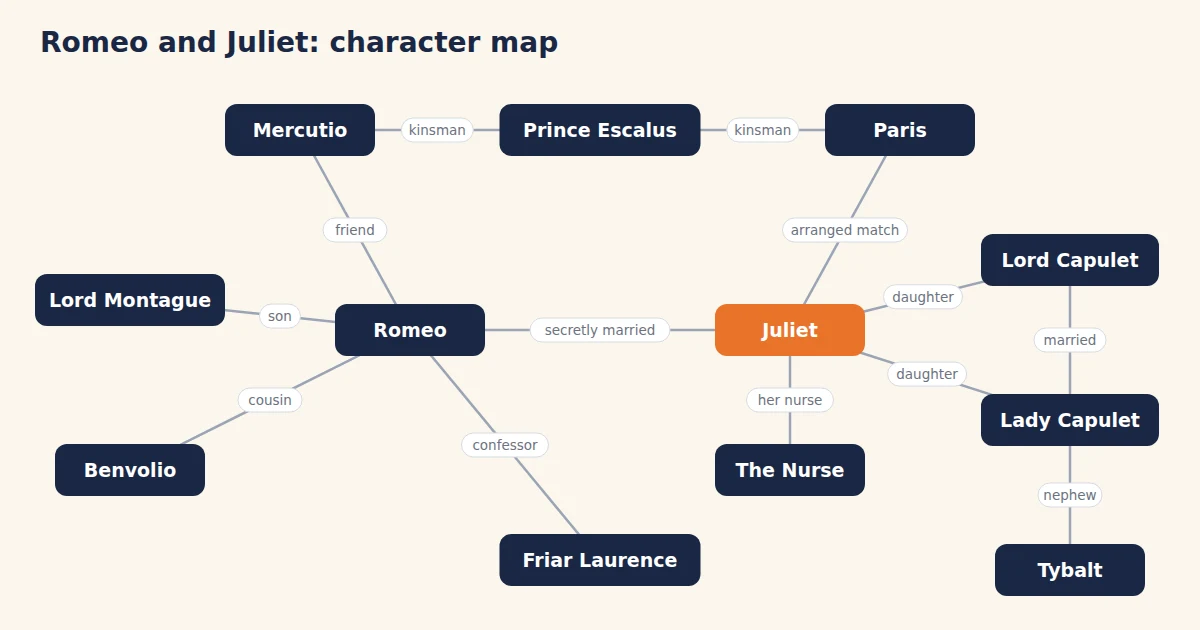
Juliet is the only daughter of Lord and Lady Capulet. In Act 1, Scene 3 the text establishes she is not yet fourteen. She meets Romeo at her father's feast in Act 1, Scene 5 and secretly marries him the following day in Act 2, Scene 6. When Romeo is banished and her parents press her to marry Paris, she turns to Friar Laurence for help, accepting his dangerous sleeping-potion plan in Act 4, Scene 1. Many readers see Juliet as the more clear-eyed and resolute of the two lovers — she questions the speed of their vows even as she commits to them fully. She wakes in the tomb to find Romeo dead and kills herself with his dagger in Act 5, Scene 3.
“What’s in a name? That which we call a rose
By any other name would smell as sweet;”
Romeo
Romeo is the only son of Lord Montague and a member of the family feuding with the Capulets. The play opens with him pining for Rosaline, a woman who has sworn to remain chaste. At the Capulet feast in Act 1, Scene 5 he falls instantly in love with Juliet. He kills Tybalt in Act 3, Scene 1 after Tybalt fatally wounds Mercutio, and is banished from Verona by Prince Escalus. In Act 5, Scene 1 he receives false news of Juliet's death, buys poison in Mantua, and returns to the Capulet tomb. He kills Paris there, then drinks the poison and dies beside Juliet. Many readers see his impulsiveness as both his most compelling and most destructive quality.
“shake the yoke of inauspicious stars
From this world-wearied flesh. Eyes, look your last.
Arms, take your last embrace! And, lips, O you
The doors of breath, seal with a righteous kiss
A dateless bargain to engrossing death.”
The Nurse
The Nurse has raised Juliet from infancy and is her closest confidante. Her long, affectionate monologue about Juliet's childhood in Act 1, Scene 3 establishes their bond. She acts as go-between for the lovers in Acts 2 and 3, carrying messages between Romeo and Juliet and helping arrange the rope ladder for Romeo's secret visit. After Romeo's banishment, however, she advises Juliet in Act 3, Scene 5 to forget him and marry Paris, which Juliet treats as a betrayal. Many readers see the Nurse as a figure of warm comedy in the early acts whose failure of loyalty sharpens the tragedy of the later ones.
“Wilt thou not, Jule?’ and, by my holidame,
The pretty wretch left crying, and said ‘Ay’”
Mercutio
Mercutio is a kinsman of Prince Escalus and Romeo's closest friend. He is neither Montague nor Capulet, which can be read as making his death the clearest symbol of the feud's indiscriminate destruction. His Queen Mab speech in Act 1, Scene 4 is one of the play's most celebrated passages. Quick-witted and combative, he draws his sword against Tybalt in Act 3, Scene 1 after Romeo refuses to fight. Romeo steps between them and Tybalt stabs Mercutio under Romeo's arm. Mercutio dies cursing both families. Many readers see his death as the turning point at which the play turns from romantic comedy to tragedy.
“No, ’tis not so deep as a well, nor so wide as a church door, but ’tis enough, ’twill serve. Ask for me tomorrow, and you shall find me a grave man.”
Tybalt
Tybalt is Lady Capulet's nephew and Juliet's cousin. He is defined throughout the play by his fierce hatred of the Montagues. In Act 1, Scene 1 he tells Benvolio he hates the word peace as he hates hell. At the Capulet feast in Act 1, Scene 5 he recognises Romeo and demands to fight him, but is restrained by Capulet. He sends a challenge to Romeo's father's house, which leads to the confrontation in Act 3, Scene 1 where he kills Mercutio and is then killed by Romeo. Many readers see Tybalt as the embodiment of the feud itself — a force of pure aggression with no interest in reconciliation.
“What, drawn, and talk of peace? I hate the word
As I hate hell, all Montagues, and thee:”
Benvolio
Benvolio is Romeo's cousin and a Montague. His name suggests goodwill, and he consistently tries to keep the peace: in Act 1, Scene 1 he attempts to stop the street brawl before Tybalt arrives, and in Act 3, Scene 1 he urges Mercutio to withdraw from the heat and the Capulets. He advises Romeo to look at other women to cure his infatuation with Rosaline, and accompanies him to the Capulet feast. He gives Prince Escalus an account of the fatal fight in Act 3, Scene 1. Benvolio does not appear after Act 3, Scene 1, which many readers find notable given his role as a voice of moderation.
“I do but keep the peace, put up thy sword,
Or manage it to part these men with me.”
Friar Laurence
Friar Laurence is a Franciscan friar and Romeo's confessor and confidant. He agrees to marry Romeo and Juliet in Act 2, Scene 3, hoping the union will end the families' feud. He devises the sleeping-potion plan in Act 4, Scene 1 to save Juliet from the forced marriage to Paris, intending to send word to Romeo in Mantua. The letter fails to reach Romeo because Friar John is quarantined in Act 5, Scene 2 — a mishap which many readers see as sealing the tragedy. He arrives at the tomb too late, and flees when the watch approaches, leaving Juliet to kill herself. In Act 5, Scene 3 he gives the Prince a full account of events. Many readers debate whether he is a well-meaning man undone by circumstance or someone whose scheming bears moral responsibility for the deaths.
“These violent delights have violent ends,
And in their triumph die; like fire and powder,
Which as they kiss consume.”
Paris
Paris is a young nobleman and kinsman of Prince Escalus who seeks to marry Juliet. Capulet initially urges him to woo Juliet and win her heart in Act 1, Scene 2, but after Tybalt's death Capulet arranges the marriage without consulting Juliet. Paris appears genuinely to mourn Juliet, visiting her tomb at night to strew flowers in Act 5, Scene 3. When Romeo arrives, Paris challenges him, believing him a vandal and murderer. Romeo kills him in the fight, and Paris's dying wish is to be laid beside Juliet. Many readers see Paris as a largely sympathetic figure — a victim of the same circumstances that destroy the lovers.
“Sweet flower, with flowers thy bridal bed I strew.
O woe, thy canopy is dust and stones,
Which with sweet water nightly I will dew,
Or wanting that, with tears distill’d by moans.
The obsequies that I for thee will keep,
Nightly shall be to strew thy grave and weep”
Lady Capulet
Lady Capulet is Juliet's mother and Capulet's wife. She tells Juliet in Act 1, Scene 3 that Paris is an excellent match and urges her to consider marriage, noting she herself was a mother at roughly Juliet's age. After Tybalt's death she demands Romeo's execution from the Prince in Act 3, Scene 1 and even speaks of sending a man to Mantua to poison him in Act 3, Scene 5. When Juliet refuses to marry Paris, Lady Capulet withdraws entirely, telling her daughter she is done with her. Many readers see her as a cold or distant mother whose failure to support Juliet contributes to the tragedy.
“Prince, as thou art true,
For blood of ours shed blood of Montague.”
Lord Capulet
Lord Capulet is Juliet's father and head of the Capulet household. In Act 1, Scene 2 he tells Paris that Juliet is not yet fourteen and that her own consent matters to him. He welcomes Romeo at his feast in Act 1, Scene 5, restraining Tybalt's anger. After Tybalt's death, however, he abruptly arranges Juliet's marriage to Paris for Thursday and responds to her refusal in Act 3, Scene 5 with furious threats of disownment. Many readers see this shift as revealing a controlling nature beneath his earlier apparent reasonableness. At the play's end he offers Montague his hand in reconciliation.
“Hang thee young baggage, disobedient wretch!
I tell thee what,—get thee to church a Thursday,
Or never after look me in the face.”
Lord Montague
Lord Montague is Romeo's father and head of the Montague household. In Act 1, Scene 1 he describes Romeo's withdrawn, melancholy behaviour to Benvolio with evident concern. He defends Romeo before the Prince after Tybalt's death in Act 3, Scene 1, arguing that Romeo only did what the law would have done. In Act 5, Scene 3 he reveals that his wife has died of grief over Romeo's exile. He pledges to raise a golden statue of Juliet in Verona as a gesture of reconciliation with Capulet. Many readers see him as a relatively minor figure whose grief at the end mirrors Capulet's, underlining the shared cost of the feud.
Prince Escalus
Prince Escalus is the ruler of Verona and kinsman of both Mercutio and Paris. He appears at three key moments of public crisis. In Act 1, Scene 1 he warns the feuding families that any further brawling will be punished by death. In Act 3, Scene 1, after Mercutio and Tybalt are killed, he exiles Romeo rather than executing him. In Act 5, Scene 3 he presides over the final reckoning, hears Friar Laurence's account, and acknowledges that his own leniency contributed to the disaster. Many readers see him as a figure of civic authority whose power proves insufficient to contain the destructive force of the feud.
Frequently asked questions
Who kills Tybalt in Romeo and Juliet?
Romeo kills Tybalt in Act 3, Scene 1. After Tybalt fatally wounds Mercutio — stabbing him under Romeo's arm as Romeo tries to part them — Romeo pursues Tybalt and they fight. Tybalt falls and dies. Romeo is then banished from Verona by Prince Escalus as punishment.
How old is Juliet in Romeo and Juliet?
The play states clearly in Act 1, Scene 3 that Juliet has not yet turned fourteen. The Nurse says she will be fourteen on Lammas Eve, and when the Nurse asks how long it is to Lammas-tide, Lady Capulet answers “A fortnight and odd days.” (Act 1, Scene 3). The play never states Romeo's age.
Why does Mercutio curse both families when he is dying?
Mercutio belongs to neither the Montagues nor the Capulets — he is a kinsman of Prince Escalus. He is wounded because Romeo stepped between him and Tybalt, and he sees his death as the direct result of a quarrel that was never his own. His repeated curse in Act 3, Scene 1 can be read as the play's sharpest condemnation of the feud.
What is Friar Laurence's role in the tragedy?
Friar Laurence marries Romeo and Juliet secretly, hoping to reconcile the two families. He later devises the sleeping-potion plan to save Juliet from marrying Paris. The plan fails when his letter to Romeo is never delivered. He arrives at the tomb too late and flees when the watch comes, leaving Juliet to take her own life.
Essays on Romeo and Juliet
- Romeo and Juliet: Love or Infatuation in Shakespeare
- Love and Hate in Shakespeare's Romeo and Juliet
- Tchaikovsky's Romeo and Juliet Fantasy: A Romantic Analysis
- Pain and Joy of Love in Shakespeare's Romeo and Juliet
- Teaching Romeo and Juliet: Engaging Students With Shakespeare
- Romeo and Juliet: Teenage Love, Impulsiveness, and Tragedy
- Shot-by-Shot Analysis: Mercutio's Death in Romeo + Juliet 1996
- Love's Definition in Shakespeare's Romeo and Juliet