Romeo and Juliet Act 5 Summary
Updated · Romeo and Juliet by William Shakespeare
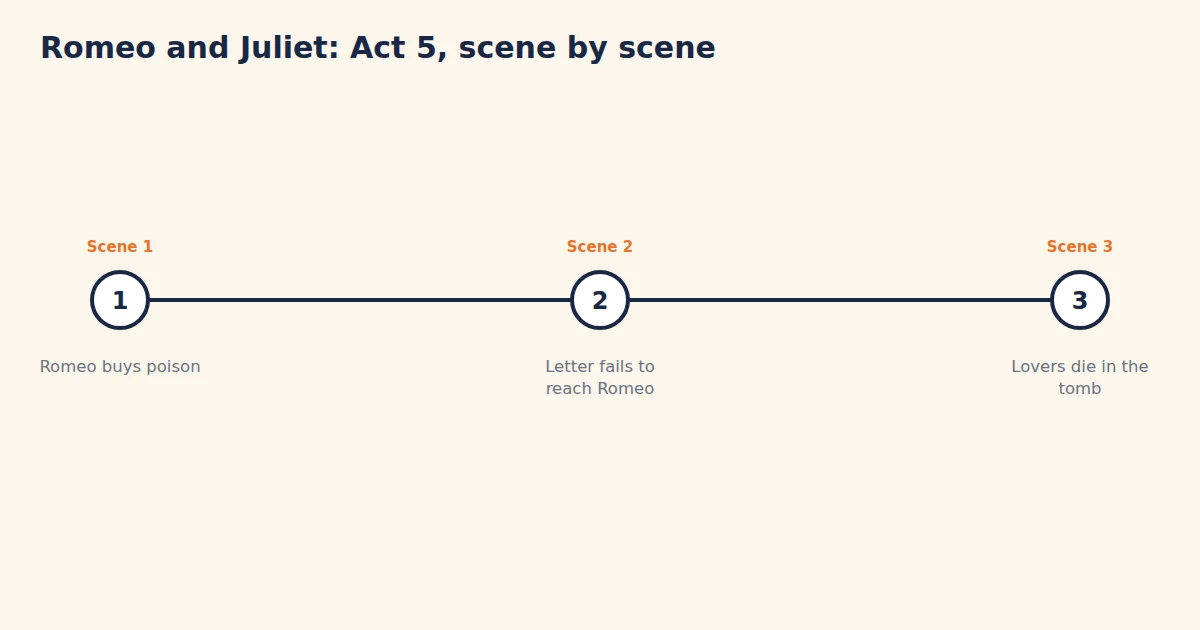
Act 5 summary
Act 5 brings the tragedy to its conclusion across three scenes. In Mantua, Romeo receives the false news that Juliet is dead and resolves to return to Verona and die beside her. He buys poison from an apothecary and sets out. Meanwhile, Friar Laurence discovers that his crucial letter never reached Romeo because Friar John was quarantined. He rushes to the Capulet tomb alone. At the tomb, Romeo encounters Paris, kills him in a fight, then enters the monument. Finding Juliet apparently lifeless, he drinks the poison and dies. Juliet wakes moments later to find Romeo dead. When Friar Laurence flees at the sound of the watch, she refuses to leave. She kisses Romeo's lips hoping for poison, then seizes his dagger and kills herself. Prince Escalus, the Capulets, and Montague arrive. Friar Laurence confesses everything. Romeo's letter confirms the account. The two fathers, shamed by their children's deaths, finally end their feud and pledge to honor the lovers with gold statues.
Act 5, Scene 1: Mantua. A Street
Romeo is in Mantua in good spirits, having dreamed of Juliet. His servant Balthasar arrives with the news that Juliet has been laid in the Capulet tomb. Romeo immediately declares he will return to Verona that night. He asks whether any letters have come from Friar Laurence; Balthasar says no. Romeo seeks out a poor apothecary and, exploiting the man's desperate poverty, persuades him to sell a fast-acting poison despite the law forbidding it. Romeo pays him and declares he will go to Juliet's grave to die beside her.
“Is it even so? Then I defy you, stars!”
Romeo's defiant cry against fate signals his decision to take his destiny into his own hands, a choice that will seal his doom.
“There is thy gold, worse poison to men’s souls,
Doing more murder in this loathsome world
Than these poor compounds that thou mayst not sell.
I sell thee poison, thou hast sold me none.”
Romeo's bitter reflection on gold as a greater poison than the drug he buys can be read as a comment on wealth, corruption, and the world's moral disorder.
Act 5, Scene 2: Friar Lawrence’s Cell
Friar John returns to Friar Laurence's cell and explains that he was unable to deliver the letter to Romeo in Mantua. Health inspectors, fearing plague, sealed the house where Friar John was staying and would not let him leave or send a messenger. Friar Laurence is alarmed, recognizing that the undelivered letter could have deadly consequences. He sends Friar John to fetch a crowbar and resolves to go to the Capulet tomb alone, intending to be there when Juliet wakes and to keep her safe at his cell until he can contact Romeo.
“Unhappy fortune! By my brotherhood,
The letter was not nice, but full of charge,
Of dear import, and the neglecting it
May do much danger.”
Friar Laurence's alarm at the undelivered letter underlines how a single accident of circumstance sets the tragedy's final catastrophe in motion.
Act 5, Scene 3: A churchyard; in it a Monument belonging to the Capulets
Paris arrives at the Capulet tomb to mourn Juliet and scatter flowers. Romeo and Balthasar arrive; Romeo sends Balthasar away and begins to open the tomb. Paris confronts him, believing Romeo has come to desecrate the dead. They fight and Paris is killed, asking with his dying breath to be laid beside Juliet. Romeo honors the request, then enters the tomb. Seeing Juliet, he marvels at her beauty, drinks the poison, kisses her, and dies. Friar Laurence arrives moments too late and finds both Romeo and Paris dead. Juliet wakes and Friar Laurence urges her to flee, but he runs when he hears the watch approaching. Juliet finds Romeo dead, tries to find poison on his lips, then stabs herself with his dagger and dies. The watch, Prince Escalus, the Capulets, and Montague gather. Friar Laurence confesses the full story, confirmed by Romeo's letter. Prince Escalus rebukes both families. Capulet and Montague shake hands and each promises to raise a gold statue of the other's child in Verona.
“And shake the yoke of inauspicious stars
From this world-wearied flesh. Eyes, look your last.
Arms, take your last embrace! And, lips, O you
The doors of breath, seal with a righteous kiss
A dateless bargain to engrossing death.”
Romeo's farewell speech frames his death as a deliberate act of love, and many readers see his calm resolve as a tragic dignity that contrasts with the chaos surrounding him.
“For never was a story of more woe
Than this of Juliet and her Romeo.”
The Prince's closing couplet serves as the play's epitaph, suggesting that the lovers' story is defined above all by its sorrow.
Characters in Act 5
- Romeo: Learns of Juliet's death, buys poison, kills Paris, and dies in the tomb beside Juliet.
- Juliet: Wakes in the tomb to find Romeo dead and kills herself with his dagger rather than live without him.
- Friar Laurence: Discovers his letter was never delivered, rushes to the tomb too late, and confesses the full plan to Prince Escalus.
- Balthasar: Brings Romeo the mistaken news of Juliet's death (he believes it) and accompanies him to the Capulet tomb.
- Paris: Comes to mourn Juliet at the tomb, confronts Romeo, and is killed in the fight that follows.
- Prince Escalus: Presides over the discovery of the bodies, hears testimony, and rebukes both families for their fatal feud.
- Capulet: Arrives at the tomb, learns the truth of his daughter's secret marriage, and agrees to end the feud with Montague.
- Montague: Arrives to find his son dead and his wife already died of grief; pledges a gold statue of Juliet to mark the reconciliation.
Frequently asked questions
What happens in Act 5 of Romeo and Juliet?
Romeo hears that Juliet is dead and buys poison in Mantua. Friar Laurence's explanatory letter never arrives because Friar John was quarantined. Romeo returns to Verona, kills Paris at the tomb, and drinks poison beside Juliet. She wakes moments after he dies, refuses to flee, and stabs herself. The families are finally reconciled over the lovers' bodies.
Why does Romeo not receive Friar Laurence's letter in Act 5?
Friar John, who was carrying the letter to Mantua, was detained by city health officials who suspected he had been in a house infected with plague. They sealed the doors and would not let him leave or send the letter by another messenger, so it was returned undelivered to Friar Laurence.
How do Romeo and Juliet die in Act 5?
Romeo drinks a fast-acting poison he purchased from an apothecary in Mantua, dying in the Capulet tomb beside what he believes is Juliet's corpse. Juliet, waking to find him dead, tries to draw poison from his lips, then takes his dagger and stabs herself, dying on his body.
Essays on Romeo and Juliet
- Romeo and Juliet: Love or Infatuation in Shakespeare
- Love and Hate in Shakespeare's Romeo and Juliet
- Tchaikovsky's Romeo and Juliet Fantasy: A Romantic Analysis
- Pain and Joy of Love in Shakespeare's Romeo and Juliet
- Teaching Romeo and Juliet: Engaging Students With Shakespeare
- Romeo and Juliet: Teenage Love, Impulsiveness, and Tragedy
- Shot-by-Shot Analysis: Mercutio's Death in Romeo + Juliet 1996
- Love's Definition in Shakespeare's Romeo and Juliet