Romeo and Juliet Act 4 Summary
Updated · Romeo and Juliet by William Shakespeare
Act 4 summary
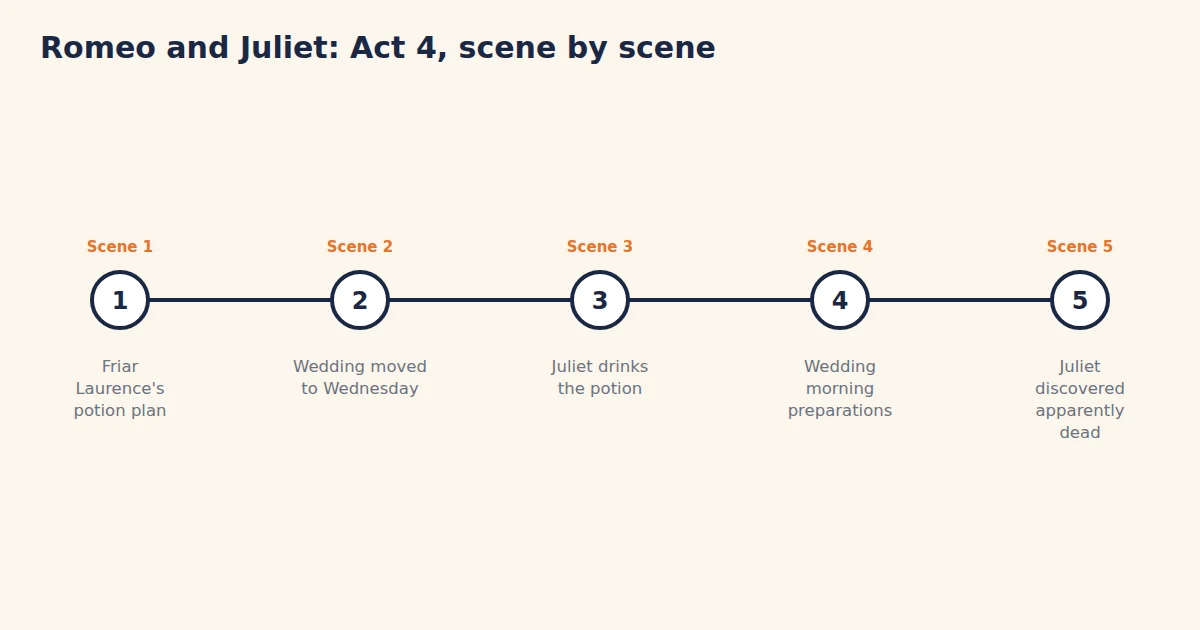
Act 4 centers on Juliet's crisis and her bold attempt to escape the forced marriage to Paris. When Juliet arrives at Friar Laurence's cell and finds Paris there discussing the wedding, she speaks carefully to avoid revealing her true feelings. Alone with the friar, she threatens to kill herself rather than marry Paris, and he offers her a plan: a potion that will simulate death for about forty-two hours. She returns home and tells her father she has changed her mind, which delights him so much that he moves the wedding forward to Wednesday. That night, alone in her chamber, Juliet drinks the potion despite her fears. The next morning the Nurse discovers her apparently lifeless body, and the household erupts in grief. Friar Laurence urges the family to carry her to the Capulet vault, and the wedding preparations are transformed into funeral rites.
Act 4, Scene 1: Friar Lawrence’s Cell
Paris is at Friar Laurence's cell discussing the hasty Thursday wedding when Juliet arrives. She and Paris exchange carefully guarded words before the friar sends Paris away. Juliet then breaks down, threatening to kill herself with a knife rather than marry Paris. Friar Laurence reveals a plan: she should consent to the marriage, then on the night before the wedding drink a potion that will make her appear dead for about forty-two hours. She will be laid in the Capulet vault, Romeo will be informed by letter, and he will come to take her away to Mantua when she wakes.
“O shut the door, and when thou hast done so,
Come weep with me, past hope, past cure, past help!”
Juliet's desperation is immediate and total; her words show she sees no hope at all without the friar's intervention.
“And in this borrow’d likeness of shrunk death
Thou shalt continue two and forty hours,
And then awake as from a pleasant sleep.”
The friar's description of the potion's effect establishes the central mechanism of the plan and the precise time frame on which everything depends.
Act 4, Scene 2: Hall in Capulet’s House
Capulet is busy organizing the wedding feast when Juliet returns from the friar's cell with a composed, obedient manner. She tells her father she has repented her disobedience and is now willing to be ruled by him. Capulet is so pleased that he immediately moves the wedding forward from Thursday to Wednesday. He sends for Paris, praises Friar Laurence, and begins directing the household preparations with great energy, declaring he will not go to bed that night.
“Send for the County, go tell him of this.
I’ll have this knot knit up tomorrow morning.”
Capulet's swift decision to advance the wedding date tightens the timeline dangerously, leaving Juliet and the friar's plan even less room for error.
Act 4, Scene 3: Juliet’s Chamber
Juliet sends the Nurse and Lady Capulet away so she can be alone. Once by herself, she faces her fears about drinking the potion. She worries it may not work at all, leaving her to wake and face the wedding. She fears it may actually be poison that Friar Laurence has prepared to avoid the scandal of having married her to Romeo. She imagines waking too early in the vault, surrounded by bones and the newly dead Tybalt, and going mad with terror. Steeling herself, she drinks the potion, calling out to Romeo, and falls upon her bed.
“Farewell. God knows when we shall meet again.
I have a faint cold fear thrills through my veins
That almost freezes up the heat of life.
I’ll call them back again to comfort me.
Nurse!—What should she do here?
My dismal scene I needs must act alone.”
Juliet's decision to act alone underscores her courage and isolation; she knows this moment cannot be shared with anyone.
“What if it be a poison, which the Friar
Subtly hath minister’d to have me dead,
Lest in this marriage he should be dishonour’d,
Because he married me before to Romeo?
I fear it is. And yet methinks it should not,
For he hath still been tried a holy man.”
Her momentary doubt about the friar's motives can be read as a realistic portrayal of the terror and loneliness of her situation.
Act 4, Scene 4: Hall in Capulet’s House
In the early hours of the morning, Capulet and the Nurse bustle about the house making preparations for the wedding feast. Lady Capulet and the Nurse tease Capulet about staying up all night. Capulet sends the Nurse to wake Juliet and get her ready, while he goes to speak with Paris, who has arrived with musicians. The scene is full of busy, cheerful domestic activity, creating a sharp contrast with what is about to be discovered.
“Come, stir, stir, stir! The second cock hath crow’d,
The curfew bell hath rung, ’tis three o’clock.”
The precise time of three o'clock emphasizes how close the household is to the moment of discovery, heightening dramatic tension.
Act 4, Scene 5: Juliet’s Chamber; Juliet on the bed
The Nurse goes to wake Juliet and finds her unresponsive in her bed. She quickly realizes Juliet appears to be dead and raises the alarm. Lady Capulet, Capulet, and then Friar Laurence and Paris all arrive to find her seemingly lifeless. Each mourns in turn, with Capulet, Lady Capulet, Paris, and the Nurse all lamenting in heightened, grief-stricken language. Friar Laurence urges them to stop their weeping, reminding them that Juliet is now in heaven, and directs them to carry her body to the church. The scene ends with a brief comic exchange between Peter and the musicians, who decide to wait for the mourners and stay for dinner.
“Death lies on her like an untimely frost
Upon the sweetest flower of all the field.”
Capulet's image of death as an untimely frost on the sweetest flower is widely read as capturing the play's broader theme of youth destroyed before its time.
“Peace, ho, for shame. Confusion’s cure lives not
In these confusions. Heaven and yourself
Had part in this fair maid, now heaven hath all,
And all the better is it for the maid.”
Friar Laurence comforts the family over a death he knows is false, a moment of dramatic irony that many readers see as showing how far his deception now reaches.
Characters in Act 4
- Juliet: Faces forced marriage, threatens suicide, courageously drinks the sleeping potion alone
- Friar Laurence: Devises the sleeping-potion plan and directs the household after Juliet is discovered
- Paris: Discusses the wedding with the friar and mourns when Juliet is found apparently dead
- Capulet: Moves the wedding forward to Wednesday and leads the household's grief at Juliet's apparent death
- Lady Capulet: Helps prepare for the wedding and mourns alongside Capulet when Juliet is found
- the Nurse: Discovers Juliet's apparently lifeless body and raises the alarm in Act 4, Scene 5
Frequently asked questions
What happens in Act 4 of Romeo and Juliet?
Juliet goes to Friar Laurence for help avoiding her marriage to Paris and receives a sleeping potion that will make her appear dead. She returns home, pretends to agree to the wedding, and that night drinks the potion alone. The next morning the Nurse finds her seemingly lifeless, and the household's wedding preparations turn into funeral arrangements.
Why does Juliet agree to marry Paris in Act 4?
Juliet does not genuinely agree to marry Paris. She pretends to consent after Friar Laurence gives her the sleeping potion plan, telling her father she has repented her disobedience. Her apparent change of heart is part of the deception needed to carry out the friar's scheme.
What fears does Juliet have before drinking the potion?
Juliet worries the potion may not work, leaving her to wake and face the wedding. She also fears the friar may have given her actual poison to protect himself from scandal. Most vividly, she imagines waking too early in the vault, surrounded by bones and the newly dead Tybalt, and going mad with terror before Romeo arrives.
Essays on Romeo and Juliet
- Romeo and Juliet: Love or Infatuation in Shakespeare
- Love and Hate in Shakespeare's Romeo and Juliet
- Tchaikovsky's Romeo and Juliet Fantasy: A Romantic Analysis
- Pain and Joy of Love in Shakespeare's Romeo and Juliet
- Teaching Romeo and Juliet: Engaging Students With Shakespeare
- Romeo and Juliet: Teenage Love, Impulsiveness, and Tragedy
- Shot-by-Shot Analysis: Mercutio's Death in Romeo + Juliet 1996
- Love's Definition in Shakespeare's Romeo and Juliet