Romeo and Juliet Act 1 Summary
Updated · Romeo and Juliet by William Shakespeare
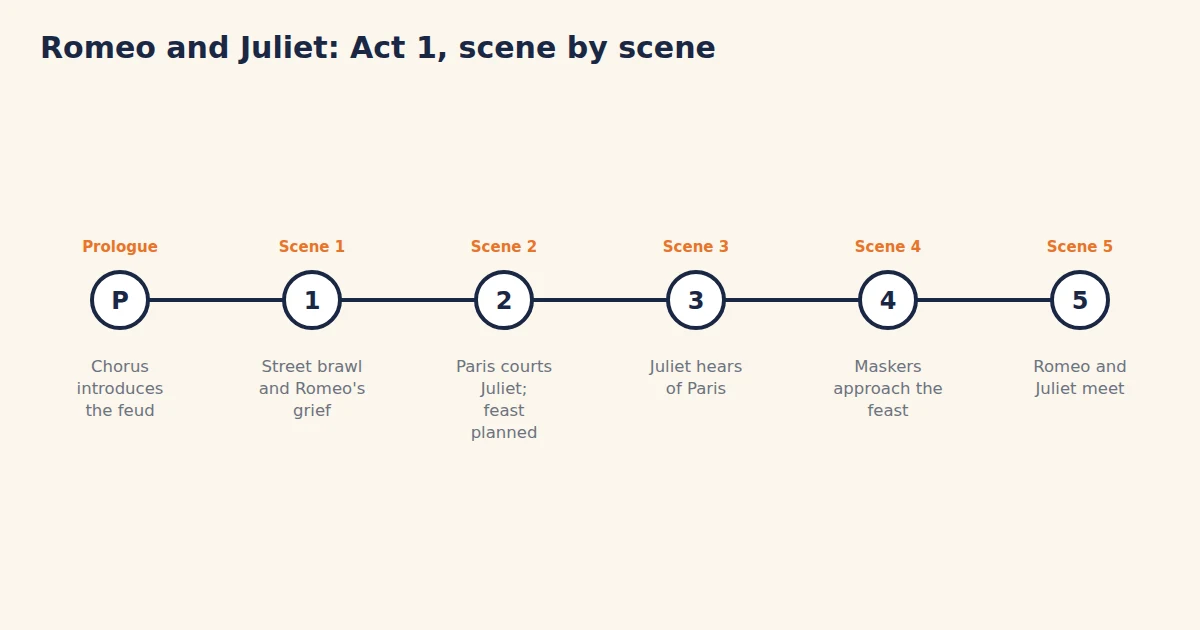
Act 1 summary
Act 1 opens with a street brawl between servants of the rival Capulet and Montague households. Prince Escalus intervenes and threatens death to anyone who disturbs the peace again. Romeo is revealed to be pining for a woman named Rosaline, who has sworn to remain chaste. His cousin Benvolio urges him to look at other women. Capulet, meanwhile, discusses his daughter Juliet's future with the nobleman Paris, inviting him to a feast that evening. Lady Capulet and the Nurse tell Juliet about Paris's interest, and Juliet agrees to observe him at the party. Before the feast, Romeo and his friends decide to attend in disguise. Romeo has a sense of foreboding but goes anyway. At the feast, Romeo sees Juliet and is immediately captivated, forgetting Rosaline entirely. The two exchange words and kiss. Only afterward does each learn the other's identity: Romeo is a Montague, and Juliet is a Capulet.
Prologue
The Chorus delivers a fourteen-line prologue that sets the scene in Verona and outlines the entire story in brief. Two noble households are locked in an ancient feud. From these families, a pair of ill-fated lovers will be born, and only their deaths will end their parents' quarrel. The Chorus describes the performance as lasting about two hours and invites the audience to listen patiently.
“Two households, both alike in dignity,
In fair Verona, where we lay our scene,”
Establishes Verona as the setting and frames both families as equal in social standing, which many readers see as underlining the senselessness of their conflict.
“From forth the fatal loins of these two foes
A pair of star-cross’d lovers take their life;”
The phrase 'star-cross'd lovers' is widely interpreted as signaling that fate, not merely human choice, drives the tragedy from the very beginning.
Act 1, Scene 1: A public place
Servants of the Capulet household, Sampson and Gregory, pick a quarrel with Montague servants in a public street. Benvolio, a Montague, tries to stop the fighting, but Tybalt, a Capulet, attacks him. The brawl grows until Prince Escalus arrives and stops it, warning that any further disturbance will be punished by death. Afterward, Montague and Lady Montague ask Benvolio about Romeo, who has been seen walking alone before dawn and shutting himself in his room. Benvolio speaks with Romeo, who admits he is in love with a woman who does not return his feelings. That woman is Rosaline, who has vowed to live chastely. Benvolio advises Romeo to look at other women, but Romeo insists no one can surpass her.
“Love is a smoke made with the fume of sighs;
Being purg’d, a fire sparkling in lovers’ eyes;
Being vex’d, a sea nourish’d with lovers’ tears:
What is it else? A madness most discreet,
A choking gall, and a preserving sweet.”
Romeo's string of paradoxes about love suggests his feelings for Rosaline are more performance than genuine passion, which many readers contrast with his later love for Juliet.
Act 1, Scene 2: A Street
Capulet walks with Paris, who has asked to marry Juliet. Capulet says Juliet is not yet fourteen and asks Paris to wait two more years, though he invites him to a feast that night to court her. A servant is sent out with a guest list but cannot read it. He encounters Romeo and Benvolio and asks Romeo to read the names aloud. Romeo sees that Rosaline is among the invited guests. Benvolio seizes on this as a chance to show Romeo other beautiful women and persuade him that Rosaline is not unrivaled. Romeo agrees to attend the feast, though only, he says, to admire Rosaline.
“My child is yet a stranger in the world,
She hath not seen the change of fourteen years;
Let two more summers wither in their pride
Ere we may think her ripe to be a bride.”
Capulet's caution about Juliet's age and his wish for Paris to win her heart can be read as showing a more considerate side of his character, which contrasts with his behavior later.
“One fairer than my love? The all-seeing sun
Ne’er saw her match since first the world begun.”
Romeo's certainty that no one can match Rosaline is ironic to readers who know he will forget her entirely within the same evening.
Act 1, Scene 3: Room in Capulet’s House
Lady Capulet asks the Nurse to call Juliet. The Nurse launches into a long, affectionate reminiscence about Juliet's childhood, recalling that Juliet will turn fourteen on Lammas Eve. Lady Capulet tells Juliet that Paris wishes to marry her and describes him in glowing terms, comparing him to a beautiful book. She asks Juliet whether she can love him. Juliet gives a careful, obedient answer, saying she will look at Paris at the feast and see whether she can like him, but will not let her feelings go further than her mother's approval allows. A servant arrives to announce that the guests have come and supper is ready.
“She’s not fourteen.”
Lady Capulet's statement that Juliet is not yet fourteen matters for understanding how young she is when the events unfold; Capulet also says it in Act 1, Scene 2.
“I’ll look to like, if looking liking move:
But no more deep will I endart mine eye
Than your consent gives strength to make it fly.”
Juliet's measured reply suggests she is dutiful and cautious at this point, which many readers see as making her later boldness with Romeo all the more striking.
Act 1, Scene 4: A Street
Romeo, Mercutio, Benvolio, and their companions prepare to enter the Capulet feast in disguise as maskers. Romeo says he is too heavy-hearted to dance and will carry a torch instead. Mercutio tries to lift his spirits and delivers the famous Queen Mab speech, a long, fantastical description of the fairy who brings dreams to sleeping people. Romeo cuts him off, and Mercutio admits he has been talking of nothing. As they approach the house, Romeo expresses a sense of dread, feeling that something beginning this night will end badly for him, but he resolves to go forward.
“I fear too early: for my mind misgives
Some consequence yet hanging in the stars,
Shall bitterly begin his fearful date
With this night’s revels; and expire the term
Of a despised life, clos’d in my breast
By some vile forfeit of untimely death.”
Romeo's premonition of untimely death can be read as foreshadowing the tragedy to come and as suggesting that fate is already at work before he even enters the feast.
Act 1, Scene 5: A Hall in Capulet’s House
At the Capulet feast, the host welcomes his guests warmly. Romeo catches sight of Juliet and is immediately struck by her beauty, declaring he has never seen true beauty until this night. Tybalt recognizes Romeo's voice and is furious that a Montague has entered uninvited, but Capulet orders him to leave Romeo alone, praising Romeo as a well-governed youth. Tybalt withdraws, vowing to settle the matter later. Romeo approaches Juliet, and the two exchange a playful conversation using the imagery of pilgrims and saints, during which Romeo kisses her twice. The Nurse then calls Juliet away. Romeo learns from the Nurse that Juliet is a Capulet, and Juliet learns from the Nurse that Romeo is a Montague. Both are dismayed to find they have fallen in love with an enemy.
“My only love sprung from my only hate!
Too early seen unknown, and known too late!
Prodigious birth of love it is to me,
That I must love a loathed enemy.”
Juliet's discovery that Romeo is a Montague introduces the central conflict of the play at the moment of her falling in love, suggesting that joy and danger are inseparable for her.
Characters in Act 1
- Romeo: A young Montague, lovesick over Rosaline until he meets and falls instantly in love with Juliet at the feast.
- Juliet: Capulet's daughter, not yet fourteen, who meets Romeo at the feast and discovers he is her family's enemy.
- Benvolio: Romeo's cousin and friend, who tries to stop the street brawl and encourages Romeo to forget Rosaline.
- Mercutio: Romeo's witty companion, who delivers the Queen Mab speech and urges Romeo to enjoy the feast.
- Tybalt: Juliet's hot-tempered cousin, who recognizes Romeo at the feast and vows revenge for the intrusion.
- Capulet: Juliet's father, who hosts the feast, discusses her marriage to Paris, and restrains Tybalt from attacking Romeo.
- the Nurse: Juliet's devoted caretaker, who shares memories of Juliet's childhood and relays information about Paris's interest.
- Prince Escalus: The ruler of Verona, who stops the street brawl and threatens death to anyone who disturbs the peace again.
Frequently asked questions
What happens in Act 1 of Romeo and Juliet?
Act 1 establishes the feud between the Montague and Capulet families through a street brawl, introduces Romeo as lovesick over Rosaline, and brings Romeo to the Capulet feast in disguise. There he meets Juliet, and the two fall in love and kiss before each discovers the other belongs to the enemy household.
Why does Romeo go to the Capulet feast?
Benvolio persuades Romeo to attend so that he can compare Rosaline with other beautiful women and see that she is not unrivaled. Romeo agrees to go, though he claims it is only to admire Rosaline. Once there, he forgets Rosaline entirely upon seeing Juliet.
How old is Juliet in Act 1?
The play states clearly in Act 1, Scene 3 that Juliet has not yet turned fourteen. The Nurse says she will be fourteen on Lammas Eve, and when the Nurse asks how long it is to Lammas-tide, Lady Capulet answers “A fortnight and odd days.” (Act 1, Scene 3).
Essays on Romeo and Juliet
- Romeo and Juliet: Love or Infatuation in Shakespeare
- Love and Hate in Shakespeare's Romeo and Juliet
- Tchaikovsky's Romeo and Juliet Fantasy: A Romantic Analysis
- Pain and Joy of Love in Shakespeare's Romeo and Juliet
- Teaching Romeo and Juliet: Engaging Students With Shakespeare
- Romeo and Juliet: Teenage Love, Impulsiveness, and Tragedy
- Shot-by-Shot Analysis: Mercutio's Death in Romeo + Juliet 1996
- Love's Definition in Shakespeare's Romeo and Juliet