The Odyssey by Homer: Summary, Story and Plot
Updated · The Odyssey by Homer
The Odyssey is an ancient Greek epic poem, traditionally credited to Homer, about the hero Odysseus and his long struggle to get home to Ithaca after the fall of Troy. While he battles monsters, storms and the anger of the sea god Poseidon, his wife Penelope and son Telemachus hold out against more than a hundred suitors in his palace, until he returns in disguise, kills the suitors and wins back his family and his kingdom.
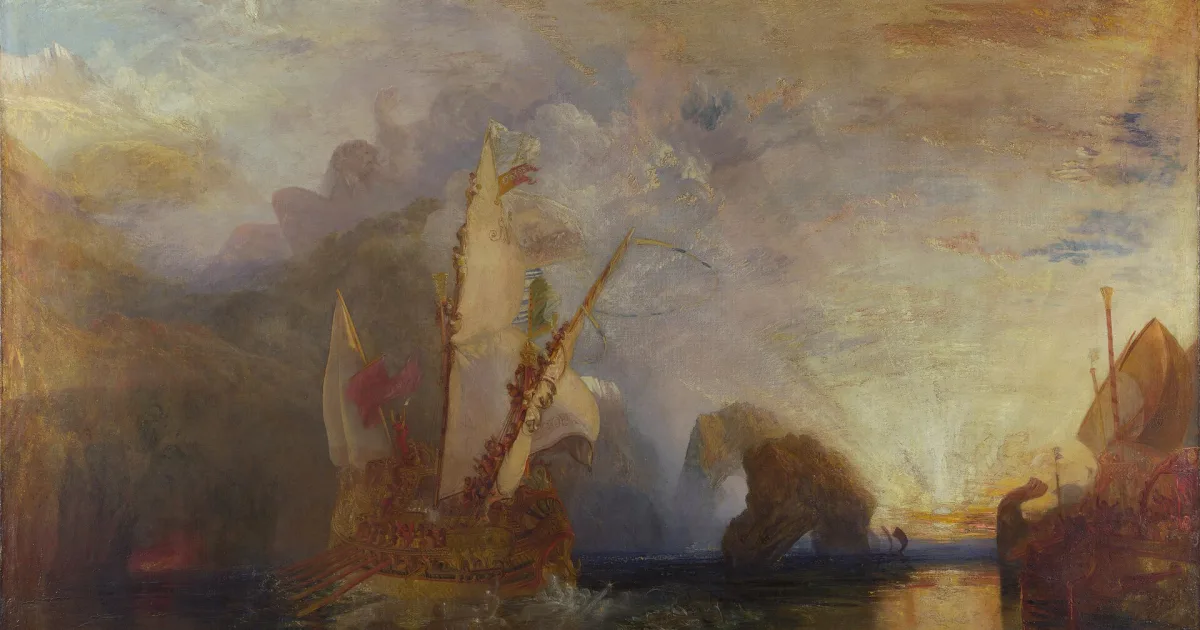
The Odyssey story in brief
“Tell me, O Muse, of the man of many devices, who wandered full many ways after he had sacked the sacred citadel of Troy.”
In plain English: The poet asks the Muse, the goddess of song, to tell the story of a clever, much-travelled man who wandered for a long time after he helped destroy Troy.
When the poem opens, every other leader who survived the war at Troy has either reached home or died on the way, but Odysseus is still held on the island of the nymph Calypso. On Olympus, Athena persuades Zeus to let him go, and she visits Ithaca in disguise to rouse his son Telemachus, whose house is overrun by men competing to marry his mother, Penelope.
Telemachus sails to the mainland to ask Nestor and Menelaus for news of his father. Meanwhile Hermes carries the gods' order to Calypso, Odysseus builds a raft, and after a storm sent by Poseidon he washes up in the land of the Phaeacians, where the princess Nausicaa helps him and King Alcinous holds a feast in his honor.
At that feast Odysseus at last tells everyone who he is and describes his wanderings: the Lotus-eaters, the Cyclops Polyphemus, the bag of winds from Aeolus, the man-eating Laestrygonians, the goddess Circe, a visit to the land of the dead, the Sirens, Scylla and Charybdis, and the cattle of the sun god, whose slaughter by his crew costs him his last ship and every one of his men.
The Phaeacians carry him home to Ithaca, where Athena disguises him as an old beggar. He stays with his loyal swineherd Eumaeus, reveals himself to Telemachus, and enters his own palace to find out who has stayed faithful. Penelope then sets the suitors a contest with his great bow. Only the beggar can string it, and with Telemachus and two loyal herdsmen he kills the suitors, proves who he is to Penelope through the secret of their bed, and with Athena's help makes peace in Ithaca.
How the Odyssey plot is built
The plot does not run in order. Homer begins close to the end of the story, with the hero stranded and his household in crisis, and lets Odysseus tell his earlier adventures himself, as an after-dinner story for the Phaeacians. The opening books follow Telemachus rather than his father, so the poem runs on two strands that only meet when father and son find each other in the swineherd's hut in Book 16.
Because Odysseus narrates Books 9–12 himself, everything in them, from the one-eyed giant to the Sirens, reaches us through a man whom Athena herself praises as a master of tricks and invented tales. Some readers take this as an invitation to wonder how much of his account to believe.
The guide divides the poem into six parts:
- Books 1–4: Telemachus searches for news of his father.
- Books 5–8: Odysseus leaves Calypso and reaches the Phaeacians.
- Books 9–12: Odysseus tells the story of his wanderings.
- Books 13–16: home on Ithaca in disguise, with Eumaeus and Telemachus.
- Books 17–20: the beggar in his own palace.
- Books 21–24: the contest of the bow, the death of the suitors, the reunion and the peace.
Who wrote the Odyssey, and when was it written?
The ancient Greeks credited the Odyssey, like the Iliad, to a poet called Homer, but almost nothing certain is known about him. Scholars today generally place him in the 8th century BCE in the eastern Greek world, possibly on the island of Chios or at Smyrna, and they are careful to call this an estimate. “Homer’s precise dates are no easier to ascertain than his birthplace.”
The best evidence comes from inside the poems. They describe weapons and city life that archaeologists say did not exist before roughly 900 to 700 BCE, and they refer to almost nothing after about 700 BCE, which suggests that they were finished by then. They were made for oral performance by singers who worked with a stock of traditional phrases, and how they reached their written form is still not fully understood. So the most honest answer to when the Odyssey was written is: probably in the eighth century BCE, by a poet working within a long oral tradition. It was never published in the modern sense.
How long is the Odyssey?
The Odyssey is divided into 24 books. In the Greek text used for this guide's line references, those books add up to 12,107 lines of verse; other editions give slightly different totals. In A. T. Murray's English prose translation the whole poem runs to roughly 132,000 words, about the size of a long modern novel.
When and where does the Odyssey take place?
The story is set in the age of heroes, after the Achaeans have sacked Troy. Odysseus left Ithaca for the war, and the action of the poem falls in the twentieth year after he sailed: nine years of fighting with Troy taken in the tenth, then years of wandering and captivity at sea. The main action itself is short. From Athena's visit to Telemachus to the final peace, the poem covers only a few weeks, and the earlier adventures arrive as a flashback.
It moves between Ithaca, a small rocky island; the mainland palaces of Nestor at Pylos and Menelaus at Lacedaemon; the far islands of Calypso and Circe; and the land of the Phaeacians. Many of the places in the wanderings cannot be matched with real geography.
The Iliad vs the Odyssey
The two poems tell different parts of the same legend. The Iliad stays at Troy and covers a few weeks near the end of the war, built around the anger of Achilles against Agamemnon. The Odyssey begins after the war is over and follows one survivor home.
The Iliad is a poem of battle, honor and grief among warriors and kings. The Odyssey is a poem of travel, disguise and households, in which cleverness often matters more than strength, and in which women such as Penelope, Calypso, Circe and Nausicaa play large parts. Both are traditionally credited to Homer.
Does Odysseus die in the Odyssey?
No. The poem ends with Odysseus alive, home, and at peace with the families of the dead suitors. What it does give is a prophecy: in the land of the dead the seer Teiresias tells him how his life will end.
“And death shall come to thee thyself far from the sea, a death so gentle, that shall lay thee low when thou art overcome with sleek old age, and thy people shall dwell in prosperity around thee.”
In plain English: Teiresias promises Odysseus a peaceful death, away from the sea, when he is worn out by a comfortable old age, with his people living well around him.
Odysseus repeats this prophecy to Penelope in Book 23. How he actually died was told only in later poems. A lost epic called the Telegony, known from later summaries, told that Telegonus, the son Odysseus had with Circe, came looking for his father and killed him. The mythographer Apollodorus gives the same story in more detail: Telegonus struck him with a spear tipped with the spine of a stingray, and only recognised him afterwards. These are later traditions, not part of Homer's poem.
Frequently asked questions
Does Odysseus die in the Odyssey?
No. He is alive at the end of the poem, back with Penelope and his father, Laertes, after Athena ends the fighting on Ithaca. The poem only foretells his death, through the prophecy of Teiresias in Book 11.
How does Odysseus die?
Homer does not say. Teiresias predicts a gentle death far from the sea in old age. Later tradition, recorded by Apollodorus and in summaries of the lost Telegony, says that Telegonus, his son by Circe, killed him without knowing who he was.
How long was Odysseus gone?
Twenty years. He comes home in the twentieth year after he left: nine years of war at Troy and the city's fall in the tenth, then the voyage home, which includes seven years with Calypso and a full year with Circe.
How long is the Odyssey?
It has 24 books, totalling 12,107 lines in the Greek text used for this guide (editions give slightly different totals). Murray's prose translation runs to roughly 132,000 words.
When was the Odyssey written or published?
No one knows exactly. Scholars generally date the poems to the 8th century BCE, when Homer is thought to have lived, and they seem to have been complete by about 700 BCE. The Odyssey was composed for oral performance and written down later, so it was never published in the modern sense.
When does the Odyssey take place?
After the Trojan War. The action falls in the twentieth year after Odysseus left for Troy, and the main events take only a few weeks; his earlier adventures are told as a flashback.
What is the difference between the Iliad and the Odyssey?
The Iliad tells of a few weeks of the war at Troy, centred on the anger of Achilles. The Odyssey follows Odysseus home after the war and is about travel, cunning, disguise and family.
More on PaperDue
Quotations are cited as (book.lines). The line numbers are those of the Greek text, which the translation marks about every fifth line, so a reference gives the marked lines around the passage.
Other sources: Homer, The Odyssey, translated by A. T. Murray (Loeb Classical Library, 1919) (Perseus Digital Library, Tufts University); Homer, The Iliad, translated by A. T. Murray (Loeb Classical Library, 1924–1925) (Perseus Digital Library, Tufts University); Homer (EBSCO Research Starters) (EBSCO Research Starters); Hesiod, the Homeric Hymns, and Homerica, translated by Hugh G. Evelyn-White (1914) (Project Gutenberg); Apollodorus, The Library, Epitome (translated by J. G. Frazer, 1921) (Theoi Classical Texts Library)