The Odyssey Books 1–4 Summary: The Telemachy
Updated · The Odyssey by Homer
Books 1–4 of the Odyssey follow Telemachus, the son of Odysseus, rather than Odysseus himself. Athena urges him to stand up to the suitors who are consuming his father's wealth, and he sails to Pylos and Sparta to ask Nestor and Menelaus for news of his father, while the suitors plot to kill him on his way home.
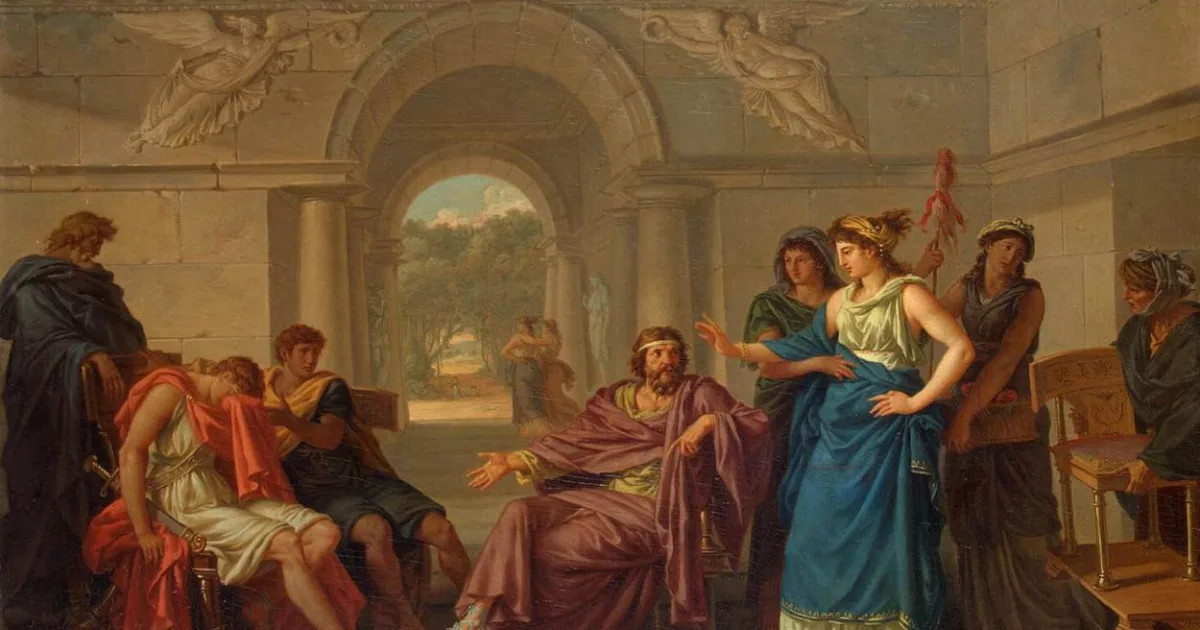
Odyssey Book 1 summary: Athena visits Telemachus
The poem opens by asking the Muse to sing of a man of many devices who wandered widely after the sack of Troy. Every other Greek leader who survived the war has reached home or died, but Odysseus is held by the nymph Calypso on her island, and Poseidon is still angry with him because he blinded the Cyclops Polyphemus, the god's son.
“Tell me, O Muse, of the man of many devices, who wandered full many ways after he had sacked the sacred citadel of Troy.”
In plain English: The poet asks the Muse to tell the story of a clever, resourceful man who travelled far after he helped destroy the city of Troy.
On Olympus, Zeus reflects on human blame. He points to Aegisthus, who seduced the wife of Agamemnon and killed the king when he came home, and who was then killed in turn by Orestes. The story of Agamemnon's family returns again and again in the poem as a warning and a contrast to the house of Odysseus.
“Look you now, how ready mortals are to blame the gods. It is from us, they say, that evils come, but they even of themselves, through their own blind folly, have sorrows beyond that which is ordained.”
In plain English: Zeus complains that people blame the gods for their troubles, when much of their suffering comes from their own foolish choices.
Athena persuades Zeus to send Hermes to Ogygia to order Calypso to release Odysseus, and she herself goes to Ithaca disguised as Mentes, a chief of the Taphians. She finds the house overrun by suitors who feast on the family's flocks while they compete to marry Penelope. Telemachus, sitting sadly among them, welcomes the stranger. Athena tells him to call an assembly, then to sail to Pylos and Sparta for news of his father. After she leaves, he realizes that his visitor was a god.
Book 2: the assembly in Ithaca
Telemachus summons the people of Ithaca and complains that the suitors are eating up his inheritance. Antinous, the boldest of them, blames Penelope instead and describes how she tricked them with a burial shroud for Laertes, the father of Odysseus.
“Then day by day she would weave at the great web, but by night would unravel it, when she had let place torches by her.”
In plain English: Penelope wove the cloth during the day and secretly undid it by torchlight at night, so the work never ended.
Zeus sends two eagles over the assembly, and the old seer Halitherses reads the sign as a warning that Odysseus is near and that the suitors face ruin. The suitors mock him, and Leocritus breaks up the meeting. Athena, now in the shape of Mentor, an old friend of the family, finds a ship and a crew. Telemachus asks the nurse Eurycleia to pack wine and barley meal, makes her promise to keep his journey from his mother, and slips away by night.
Book 3: Nestor at Pylos
At sandy Pylos the travellers find Nestor and his people sacrificing to Poseidon on the shore. His son Peisistratus welcomes them warmly, a model of the hospitality the suitors abuse. Telemachus is shy about speaking to so old and wise a king, but Athena encourages him.
Nestor has no news of Odysseus. He tells how the Greek leaders quarrelled and scattered after the fall of Troy, and he gives the fullest account yet of how Aegisthus murdered Agamemnon and how Orestes took revenge. He praises Orestes and urges Telemachus to be just as brave.
“Yet verily he paid the reckoning therefor in terrible wise, so good a thing is it that a son be left behind a man at his death, since that son took vengeance on his father's slayer, the guileful Aegisthus, for that he slew his glorious father.”
In plain English: Aegisthus was punished: Orestes killed him for murdering his father, which shows how valuable a loyal son is to a family.
Athena leaves in the form of a bird, and Nestor recognizes the goddess. He sends Telemachus on by chariot to Sparta, with Peisistratus as his companion.
Book 4: Menelaus and Helen in Sparta
In Sparta, Menelaus is holding a double wedding feast for his son and his daughter Hermione. He and Helen, now back at home after the war, receive the young men generously. Menelaus has already noticed the young man's likeness to his father, but Helen is the first to say aloud that the guest is the son of Odysseus. When talk of the lost hero brings everyone to tears, she quietly adds something to their wine.
“Straightway she cast into the wine of which they were drinking a drug to quiet all pain and strife, and bring forgetfulness of every ill.”
In plain English: Helen secretly mixed a medicine into the wine that took away pain and anger and made people forget their sorrows.
Helen and Menelaus then tell stories of Odysseus at Troy. Helen recalls how he slipped into the city in disguise as a beggar, and Menelaus remembers how he kept his fellow chieftains silent inside the wooden horse when Helen walked around it imitating their wives' voices. The two stories sit uneasily together, and readers often notice that Helen's account flatters her while Menelaus's shows her aiding the Trojans.
Menelaus also describes his own wanderings. Stranded in Egypt, he caught Proteus, the old man of the sea, and forced him to speak. Proteus told him how Agamemnon died and revealed that Odysseus is alive but held on an island by the nymph Calypso, with no ship to carry him home.
Back in Ithaca, the suitors learn that Telemachus has really gone. Antinous takes a ship and twenty men to lie in wait for him on the strait between Ithaca and Samos. The herald Medon tells Penelope, who is overcome with fear until Athena sends her a comforting dream.
Why the Odyssey begins with Telemachus
Readers often call these opening books the Telemachy, because their hero is Telemachus. They show Ithaca without its king: an unprotected wife, a son who is not yet a man, an assembly that cannot act, and a crowd of young nobles who treat another family's house as their own. That picture can be read as the problem the rest of the poem has to solve.
The journey also changes Telemachus. He begins too shy to address Nestor and ends speaking easily with kings, and the visits teach him what his father was like through the memories of men who fought beside him. The repeated story of Orestes suggests the choice in front of him: a son who stands up for his father's house earns praise.
The two palaces he visits also set a standard. Nestor and Menelaus feed and honour strangers before asking their names, which makes the suitors' behaviour at home look even worse. By the time Odysseus finally appears in Book 5, readers already know what is waiting for him in Ithaca.
Frequently asked questions
Why does Telemachus leave Ithaca?
Athena, disguised as Mentes, tells him to visit Nestor in Pylos and Menelaus in Sparta to ask for news of his father, and to decide what to do about the suitors.
Where is Odysseus at the start of the Odyssey?
He is on the island of Ogygia, kept there by the nymph Calypso, who wants him as her husband. Athena asks Zeus to send Hermes to set him free.
What is Penelope's trick with the web?
She told the suitors she would choose a husband once she had finished weaving a shroud for Laertes, then undid her work every night. One of her maids gave the secret away.
Who is Mentor in the Odyssey?
Mentor is an old friend whom Odysseus left in charge of his house. Athena takes his form to guide Telemachus on his voyage to Pylos.
What do the suitors plan in Book 4?
Antinous sets an ambush with twenty men on the strait between Ithaca and Samos, intending to kill Telemachus as he sails home.
Quotations are cited as (book.lines). The line numbers are those of the Greek text, which the translation marks about every fifth line, so a reference gives the marked lines around the passage.