The Odyssey Themes and Symbols
Updated · The Odyssey by Homer
The main themes of the Odyssey are homecoming, hospitality, cunning, loyalty, disguise and recognition, and the justice of the gods. Its best-known symbols are the great bow, the bed built around a living olive tree, Penelope's web, the scar on Odysseus's leg and the old dog Argos, each of which ties a person to home and identity.
Themes in the Odyssey
The Odyssey is a story about getting home, and almost every theme grows out of that. To return, Odysseus needs cleverness more than force; to be welcomed, he depends on the way strangers treat guests; and to take back his house, he has to find out who stayed faithful while he was away. Over all of this the gods watch, and the poem asks whether suffering is their fault or ours.
Homecoming
The Greek word for a homecoming, nostos, sums up the poem. Odysseus turns down a goddess and the promise of an ageless life because he longs for Ithaca and for Penelope, even though he admits that she cannot match Calypso in beauty.
“But even so I wish and long day by day to reach my home, and to see the day of my return.”
In plain English: Odysseus tells Calypso that, in spite of everything she offers, he still wants every day to go home.
Home here is more than a place: it means his family, his position as king and his own name. The poem sets his return against the homecoming of Agamemnon, who was murdered as soon as he reached his palace, so the danger of coming back is always present.
Hospitality and how strangers are treated
Hospitality, the duty of hosts to feed and protect travellers and of guests to respect their hosts, is the moral measuring stick of the poem. Nausicaa and the Phaeacians, Nestor, Menelaus and the poor swineherd Eumaeus treat strangers well. The Cyclops eats his guests, and the suitors abuse both the absent host and the beggar at the door.
“for from Zeus are all strangers and beggars, and a gift, though small, is welcome.”
In plain English: Nausicaa tells her maids that all strangers and beggars are under the protection of Zeus, so even a small gift to them matters.
Seen this way, the killing of the suitors is not only revenge but punishment for breaking one of the oldest rules of Homer's world, and the poem keeps reminding us that a beggar might be a god or a king in disguise.
Cunning and strength
Odysseus wins by brains. He beats the Cyclops with a false name and the rams, wins back his house through disguise and a planned ambush, and survives by telling invented life stories. Athena, the goddess of good counsel, loves him for exactly this quality.
“Bold man, crafty in counsel, insatiate in deceit, not even in thine own land, it seems, wast thou to cease from guile and deceitful tales, which thou lovest from the bottom of thine heart.”
In plain English: Athena teases Odysseus as a daring schemer who cannot stop telling clever lies, even now that he is home.
The poem also shows the risks of cleverness turning into pride. His boast to the blinded giant is the cause of years of suffering, and many readers see the second half of the poem as Odysseus learning patience: he lets himself be insulted and kicked in his own hall until the moment is right.
Loyalty and testing
Because no one in Ithaca knows whether Odysseus is alive, loyalty is tested everywhere. Penelope keeps the suitors waiting with her trick at the loom; Eumaeus and the old nurse Eurycleia stay faithful; some servants go over to the suitors. Odysseus in turn tests almost everyone before he trusts them, even his wife and his father.
In the underworld scene of the last book, the ghost of Agamemnon praises Penelope and contrasts her with his own murderous wife.
“Therefore the fame of her virtue shall never perish, but the immortals shall make among men on earth a pleasant song in honor of constant Penelope.”
In plain English: Agamemnon's ghost says that the gods will make sure that Penelope's faithfulness is celebrated in song for ever.
Disguise and recognition
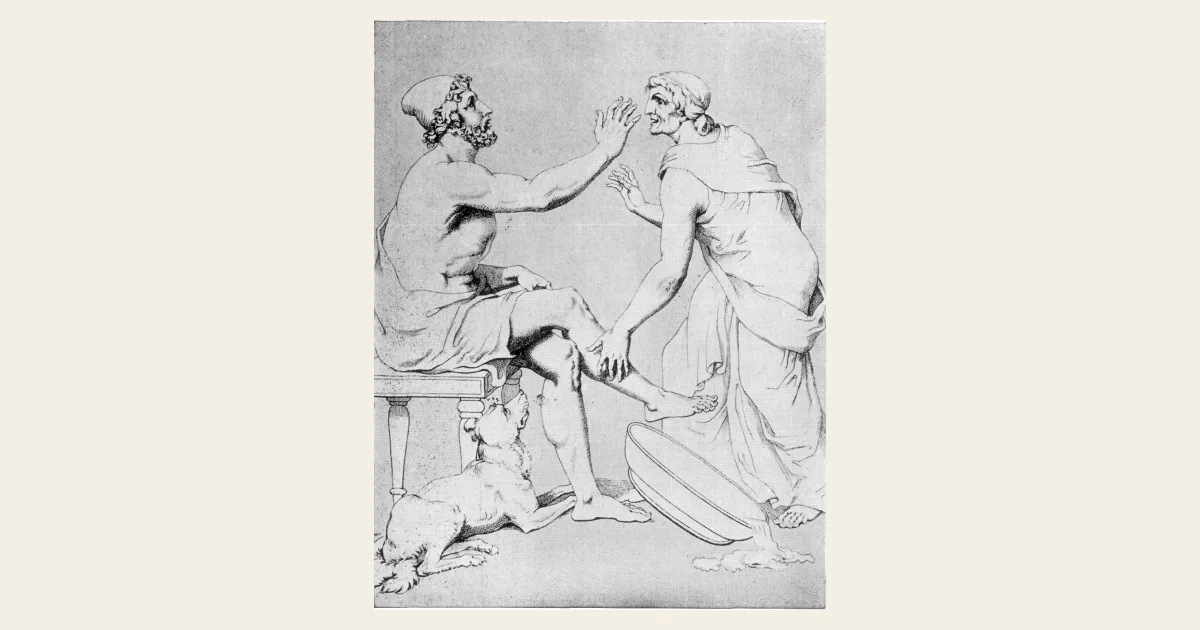
The second half of the poem is built from a chain of recognitions. Telemachus learns who the beggar is in the swineherd's hut; the dog Argos knows his master and dies; Eurycleia finds the boar scar while washing his feet; the herdsmen are shown the same scar; the bow proves his strength; Penelope tests him with the secret of their bed; and his father recognises him by the trees he was given as a boy.
Each scene asks what really makes someone who they are: a body, a memory, a skill, or a secret shared with the people who love them.
The gods and justice
The poem opens with Zeus complaining that humans blame the gods for troubles they bring on themselves, and the plot seems built to prove him right. The crew die because they eat the sun god's cattle against every warning, and the suitors die because they ignore warnings and omens in their greed.
“Look you now, how ready mortals are to blame the gods.”
In plain English: Zeus complains that humans are quick to blame the gods for their own troubles.
The gods are not simply fair, though. Poseidon pursues Odysseus out of personal anger, and Athena favours him partly because she likes him. Many readers find in the poem a mix of moral order and divine favouritism.
Temptation and self-control
Many episodes in the wanderings test whether the travellers can hold back. The Lotus-eaters' fruit makes men forget home; Circe's feast turns them into swine; the Sirens' song draws sailors to their deaths; the cattle of the sun god tempt the hungry crew. Odysseus survives because he plans ahead, as when he has himself tied to the mast, while his men repeatedly give in.
Symbols in the Odyssey
- The bow: only its true owner can string it, so it stands for Odysseus's identity and his right to rule.
- The bed: built around the trunk of a living olive tree, it cannot be moved, like the marriage it belongs to.
- Penelope's web: the shroud she weaves by day and unpicks by night stands for her cleverness and her faithfulness.
- The scar: a wound from a boar hunt in his youth, it ties the man who comes home to the boy his nurse brought up.
- Argos the dog: neglected and dying, he still knows his master, a picture of loyalty and of everything that has decayed in his absence.
- The sea: the domain of Poseidon, it stands for everything that keeps Odysseus from home.
“A bush of long-leafed olive was growing within the court, strong and vigorous, and girth it was like a pillar.”
In plain English: Odysseus explains that he built their bedroom around a thick olive tree that grew in the courtyard, which is why the bed cannot be moved.
Frequently asked questions
What are the main themes of the Odyssey?
Homecoming, hospitality, cunning versus strength, loyalty, disguise and recognition, the justice of the gods, and temptation and self-control.
Why is hospitality important in the Odyssey?
It is the poem's main test of good and bad behaviour. Good hosts such as the Phaeacians and Eumaeus are rewarded, while the Cyclops and the suitors, who abuse guests and hosts, are punished.
What does the bed symbolize in the Odyssey?
The bed is built around a rooted olive tree, so it cannot be moved. Only Odysseus and Penelope know this, which is why Penelope uses it to test him, and it stands for their fixed, faithful marriage.
What does the bow symbolize in the Odyssey?
The bow belongs to Odysseus, and none of the suitors can string it. When the beggar strings it easily, it proves who he is and marks his return as king.
More on PaperDue
Quotations are cited as (book.lines). The line numbers are those of the Greek text, which the translation marks about every fifth line, so a reference gives the marked lines around the passage.