Calypso in the Odyssey: Who She Is and Why She Keeps Odysseus
Updated · The Odyssey by Homer
Calypso is a goddess, the daughter of Atlas, who lives alone on the island of Ogygia and keeps Odysseus there for seven years because she wants him as her husband. In Book 5 the gods send Hermes to order his release, and she helps him build a raft and sail for home, even though he has turned down her offer to make him immortal.
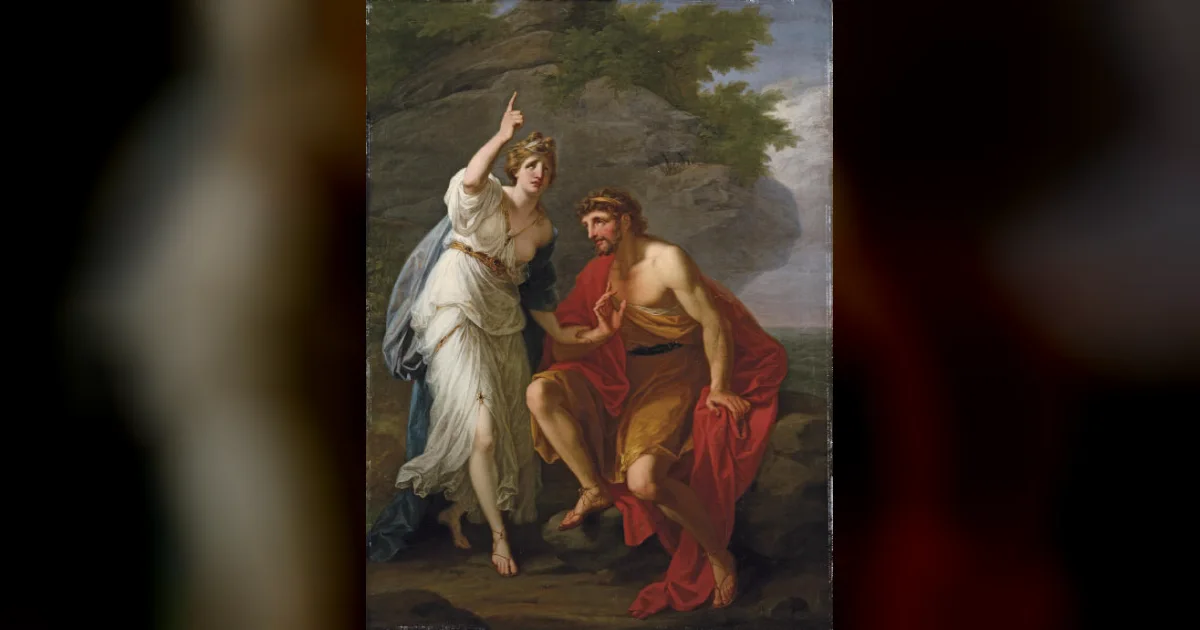
Who is Calypso in the Odyssey?
Calypso is a nymph and a goddess. The poem calls her the daughter of Atlas, the being who holds up the pillars that keep earth and sky apart, and it places her on Ogygia, an island far out in the sea where neither gods nor people come to visit. When the story opens, every other surviving hero of the war at Troy has reached home, but Odysseus is stuck in her caves, longing for his wife and his own country.
Athena describes the situation to Zeus in the first assembly of the gods. In her account Calypso holds the hero against his will and tries to talk him out of his memories of home:
“His daughter it is that keeps back that wretched, sorrowing man; and ever with soft and wheedling words she beguiles him that he may forget Ithaca.”
In plain English: Athena tells Zeus that Calypso is holding the unhappy Odysseus and keeps sweet-talking him so that he will stop thinking about Ithaca.
Calypso therefore stands at the very start of the plot. The poem begins in the last stretch of his captivity, and the opening part of the poem follows Telemachus while his father is still out of reach on her island.
How long was Odysseus with Calypso?
Odysseus himself gives the length of his stay when he tells his story to the Phaeacian king and queen in Book 7. After Zeus destroyed his last ship, he clung to the keel and drifted for nine days before the gods carried him to Ogygia on the tenth night. He then lived with Calypso for seven years, and in the eighth she sent him away. Readers often note that this is the longest single stop of his whole twenty years away from Ithaca.
His own summary of the welcome he received sets out both her kindness and her plan:
“She took me to her home with kindly welcome, and gave me food, and said that she would make me immortal and ageless all my days; but she could never persuade the heart in my breast.”
In plain English: Calypso treated him well and promised to make him a god who would never age or die, but she could never change what he wanted.
Calypso's offer: immortality
What Calypso offers is far more than a comfortable home. She promises to make Odysseus a god who will never grow old or die, if only he will stay with her. That evening, after Hermes has gone, she tries one last time, telling him that if he knew the suffering still ahead he would remain, and asking whether a mortal wife could really be more beautiful than she is.
His answer is careful and tactful. He does not argue with her about beauty at all:
“I know full well of myself that wise Penelope is meaner to look upon than thou in comeliness and in stature, for she is a mortal, while thou art immortal and ageless.”
In plain English: Odysseus admits that Penelope cannot match a goddess in looks, because she is human and Calypso can never die or grow old.
“But even so I wish and long day by day to reach my home, and to see the day of my return.”
In plain English: Even so, he still wants every day to get home and see the day he comes back.
The choice is one of the clearest statements of his character. Many readers see it as the moment that defines the poem: he chooses an ordinary human life, with old age and death at the end of it, because it is his own life, with his own wife, house and people.
Why does Calypso let Odysseus go?
She does not release him by her own choice. In Book 5 Athena raises his case again before the gods, and Zeus sends Hermes to her island with an order: Odysseus must leave on a raft and reach Scheria, the land of the Phaeacians. Hermes finds Calypso singing at her loom inside a cave that smells of burning cedar, while Odysseus sits on the shore staring at the sea in tears, as he did every day.
Calypso obeys, but first she accuses the gods of a double standard. Male gods take mortal lovers freely, she says, while goddesses are punished for it, and she lists earlier cases in which the gods killed the mortal partner of a goddess:
“Cruel are ye, O ye gods, and quick to envy above all others, seeing that ye begrudge goddesses that they should mate with men openly, if any takes a mortal as her dear bed-fellow.”
In plain English: Calypso accuses the gods of being harsh and jealous, because they do not allow a goddess to take a human lover openly.
Her complaint gives her a voice of her own. She is not simply an obstacle to be overcome; she is a goddess who loves a man she cannot keep, and the poem lets her protest before she gives way to Zeus.
How Calypso helps Odysseus leave
Once she has accepted the order, Calypso becomes generous. When she first tells Odysseus that he may go, he suspects a trap, so she swears by the water of the Styx, the oath the gods fear most, that she means him no harm. The next morning she gives him tools and leads him to the tallest trees on the island so that he can build his raft, and she supplies cloth for a sail. He works on the raft for four days, and on the fifth she sends him off: she loads the raft with wine, water and food, gives him fresh clothes, and sends a gentle wind behind him.
She also tells him how to steer by the stars, keeping the Bear on his left. He sails for seventeen days without sleeping before he sees the mountains of the Phaeacians, and only then does Poseidon notice him and wreck the raft in a storm.
What Calypso means in the poem
Calypso is often read alongside Circe as one of the two goddesses who delay the hero's return. Circe keeps him for a year and then helps him onward; Calypso keeps him far longer and offers him the greatest prize of all. In both cases the poem seems to test whether Odysseus will forget home, and in both cases he does not.
Her island can also be seen as a kind of pause between the world of war and wandering and the world of his household. When Odysseus finally tells Penelope the whole story in Book 23, Calypso is one of the episodes he includes, and the poem sums up her love and her failed offer briefly.
Frequently asked questions
Who is Calypso in the Odyssey?
Calypso is a goddess and nymph, the daughter of Atlas, who lives on the island of Ogygia. She keeps Odysseus with her for seven years and wants to make him her husband.
How long does Calypso keep Odysseus in the Odyssey?
Seven years. Odysseus tells the Phaeacians that he stayed seven years on her island and left in the eighth.
What does Calypso offer Odysseus?
She offers to make him immortal and free from old age if he stays with her as her husband. He refuses because he wants to go home to Penelope and his own land.
Why does Calypso let Odysseus leave?
Zeus sends Hermes to order his release. Calypso complains that the gods are jealous, but she obeys, swears she means him no harm, and helps him build a raft.
What is the name of Calypso's island in the Odyssey?
Her island is Ogygia, which Odysseus describes as lying far off in the sea.
More on PaperDue
Quotations are cited as (book.lines). The line numbers are those of the Greek text, which the translation marks about every fifth line, so a reference gives the marked lines around the passage.