The Odyssey Books 17–20 Summary: The Beggar in the Palace
Updated · The Odyssey by Homer
In Books 17–20 Odysseus enters his own palace disguised as a beggar, where his old dog Argos knows him and the suitors mock and strike him. His nurse Eurycleia recognises him by a scar while washing his feet, but Penelope does not, and she announces a contest with her husband's bow. Book 20 ends the night before the contest, with the suitors laughing at a feast while a seer sees death all around them.
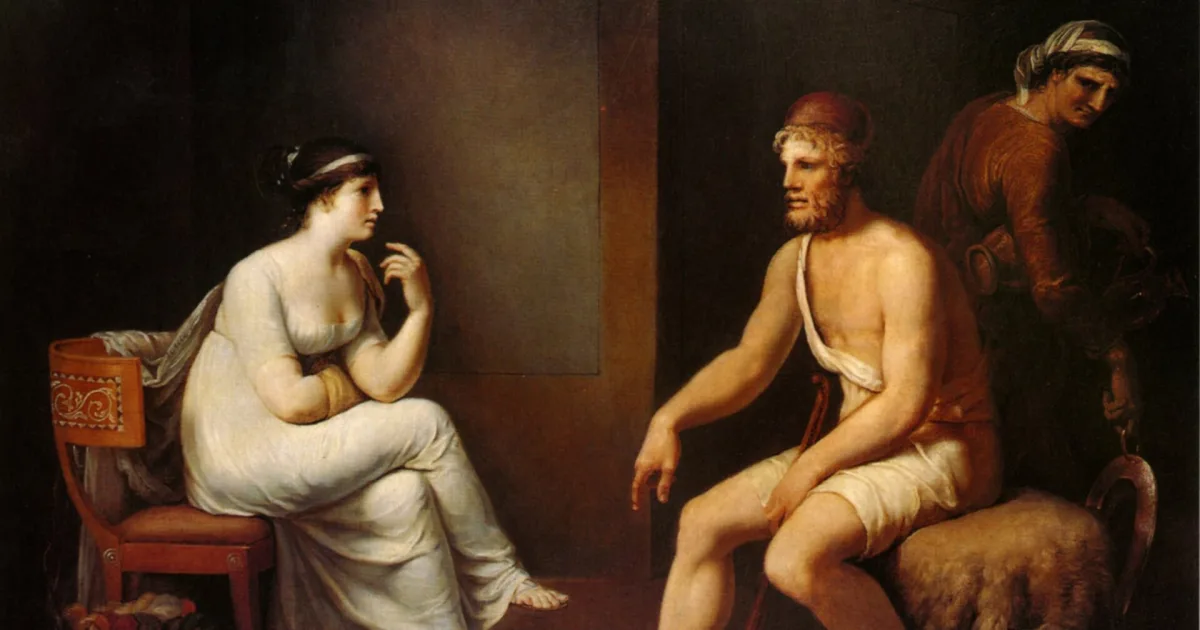
Odyssey Book 17 summary: Argos and the suitors
Telemachus returns to the palace, tells Penelope what he learned from Nestor and Menelaus, and brings in the seer Theoclymenus, who assures her that Odysseus is already on the island. Later Eumaeus leads the beggar into town. On the way the goatherd Melanthius insults Odysseus and kicks him, and Odysseus has to decide whether to strike back. He chooses to put up with it.
At the palace gate lies Argos, the hunting dog Odysseus raised before he left for Ilios, now old, neglected and lying on a heap of dung.
“There lay the hound Argos, full of vermin; yet even now, when he marked Odysseus standing near, he wagged his tail and dropped both his ears, but nearer to his master he had no longer strength to move.”
In plain English: The old dog, covered in fleas, knows his master at once and wags his tail, but is too weak to come to him.
Odysseus turns away so that Eumaeus will not see him wipe his eyes. The moment ends quickly and sadly.
“But as for Argos, the fate of black death seized him straightway when he had seen Odysseus in the twentieth year.”
In plain English: Argos dies right after seeing his master again at last.
Inside the hall, Odysseus begs from each suitor in turn. Most give him something. Antinous refuses, mocks Eumaeus for bringing in another mouth to feed, and finally hurls a footstool that hits the beggar on the shoulder. Even some of the other suitors warn him that a god might be walking among them in disguise. Penelope, hearing of the insult, asks to speak with the stranger, and he agrees to come after sunset.
Odyssey Book 18 summary: the fight with Irus
A real beggar named Arnaeus, nicknamed Irus because he runs errands, tries to drive the newcomer from the doorway. The suitors set up a boxing match for their entertainment. Odysseus holds back his strength so as not to give himself away, yet a single blow to the neck leaves Irus bleeding in the dust, and Odysseus drags him outside.
Amphinomus, the most decent of the suitors, toasts the beggar. Odysseus, perhaps hoping to save him, gives him a warning about how quickly fortune can turn.
“Nothing feebler does earth nurture than man, of all things that on earth are breathing and moving.”
In plain English: Of every living creature on earth, human beings are the most fragile.
Amphinomus is troubled but stays, and the poem notes that Athena has already marked him for death. Penelope then comes down, made more beautiful by Athena while she sleeps, and shames the suitors into bringing her gifts. The maid Melantho and the suitor Eurymachus both insult the beggar, and Eurymachus throws a footstool that misses him and hits the wine steward instead.
Odyssey Book 19 summary: Penelope, the stranger and the scar
After the suitors leave, Odysseus and Telemachus carry the weapons out of the hall while Athena lights their way. Then Penelope sits down with the stranger. She tells him how she has held the suitors off, including the trick of the loom.
“First some god breathed the thought in my heart to set up a great web in my halls and fall to weaving a robe—”
In plain English: Penelope says a god gave her the idea of weaving a large cloth on her loom as a way to delay the suitors.
She says she unpicked the weaving every night until her maids betrayed her. The stranger answers with yet another invented life, claiming to come from Crete and to have once entertained Odysseus there, and he describes the clothes Odysseus wore so exactly that she weeps. He swears that her husband will be home very soon.
Penelope orders the old nurse Eurycleia to wash his feet. Odysseus turns away from the fire, afraid of what she might see, but she finds the scar a boar left on him when he was young and hunting on Parnassus with the sons of Autolycus, his mother's father.
“Verily thou art Odysseus, dear child, and I knew thee not, till I had handled all the body of my lord.”
In plain English: Eurycleia realises it is really Odysseus, and admits she did not know him until she touched him.
He seizes her by the throat and makes her promise silence. Penelope, distracted by Athena, notices nothing. She then describes a dream in which an eagle kills her geese, and decides to set a test: she will marry whichever suitor can string the bow of Odysseus and shoot an arrow through a line of axes, as her husband used to do.
Odyssey Book 20 summary: the last feast
Odysseus lies awake, furious at the maids who sleep with the suitors, and talks himself into patience by remembering an even harder test.
“Endure, my heart; a worse thing even than this didst thou once endure on that day when the Cyclops, unrestrained in daring, devoured my mighty comrades;”
In plain English: Odysseus tells himself to be patient, because he once survived something worse, when the Cyclops ate his men.
Athena comforts him, and in the morning Zeus sends thunder from a clear sky while a woman grinding grain prays that this will be the suitors' last meal. The cowherd Philoetius arrives and speaks warmly of his missing master, while Melanthius sneers again. At the feast Ctesippus throws an ox hoof at the beggar, and Telemachus openly warns the suitors.
Then Athena makes the suitors laugh uncontrollably, with blood on their meat and tears in their eyes, and Theoclymenus describes what he sees.
“Shrouded in night are your heads and your faces and your knees beneath you;”
In plain English: The seer tells the suitors he sees them wrapped in darkness, a sign that they are about to die.
The suitors laugh at him, and he leaves the house. The scene is often read as the poem's darkest omen before the killing begins.
Themes in Books 17–20: disguise, testing and patience
This part of the poem is a long series of tests. Odysseus tests the people of his household by watching how they treat a poor stranger, and nearly everyone reveals their character. The dog, the nurse, the swineherd and the cowherd show loyalty, while Melanthius, Melantho, Antinous and Eurymachus show cruelty. Readers often note how carefully the poem sorts the guilty from the innocent before the violence of Book 22.
Odysseus himself is tested too. Again and again he is insulted and struck and has to hold back his anger. His self-control is arguably as heroic here as his strength was at Troy.
Penelope's long conversation with the beggar raises a question that readers still debate: does she suspect who he is? She weeps at his description of her husband and chooses that very night to set the contest, which may suggest that part of her already hopes. The poem never says directly.
Frequently asked questions
Who recognises Odysseus first when he returns home?
His old dog Argos knows him first, in Book 17, and dies right after. His nurse Eurycleia is the first person in the house to recognise him, by a scar on his leg, in Book 19.
What happens to Argos in the Odyssey?
Argos, the dog Odysseus raised before leaving for Troy, lies neglected on a dung heap. He recognises his master, wags his tail and drops his ears, but is too weak to move, and he dies moments after seeing him.
How does Eurycleia recognise Odysseus?
While washing his feet she feels the scar a boar gave him on a hunt at Parnassus with the sons of Autolycus. She drops his foot into the basin, and he makes her swear to keep quiet.
What is the contest Penelope sets for the suitors?
She will marry whoever can string the bow of Odysseus and shoot an arrow through a line of axes set up in the hall, a feat her husband used to perform.
More on PaperDue
Quotations are cited as (book.lines). The line numbers are those of the Greek text, which the translation marks about every fifth line, so a reference gives the marked lines around the passage.