The Odyssey Books 13–16 Summary: Odysseus Returns to Ithaca
Updated · The Odyssey by Homer
In Books 13–16 the Phaeacians carry the sleeping Odysseus home to Ithaca, where Athena hides his identity by turning him into a ragged old beggar. He shelters with his loyal swineherd Eumaeus while Telemachus sails back from Sparta and slips past the ambush the suitors have set for him. In the swineherd's hut Odysseus finally reveals himself to his son, and the two begin to plan their revenge.
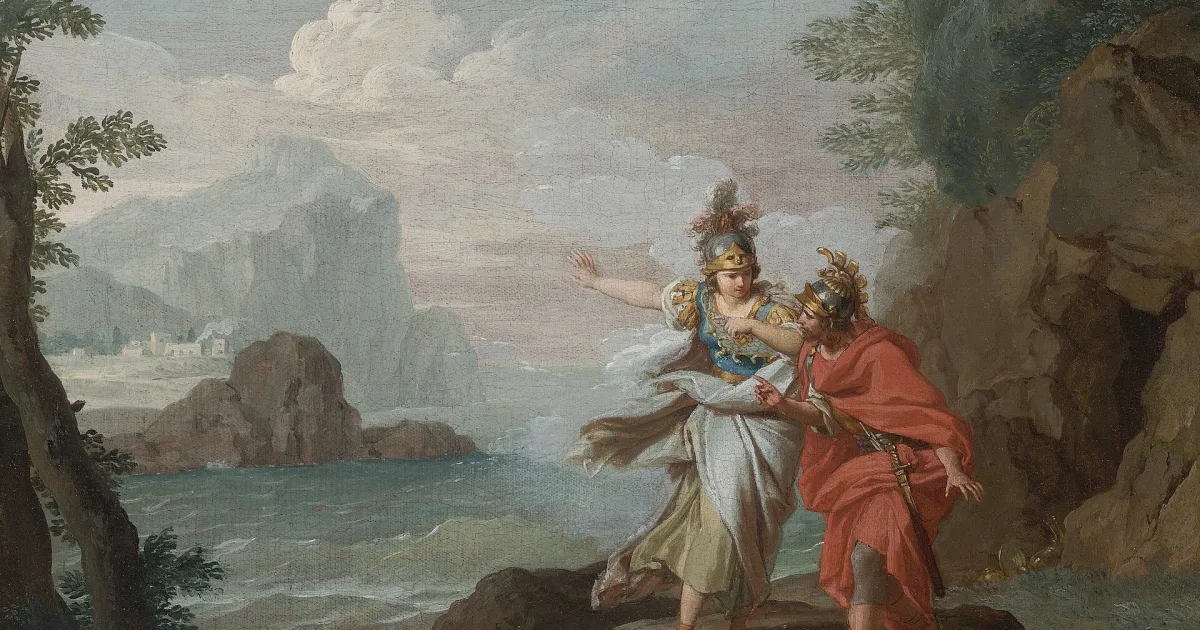
Odyssey Book 13 summary: Odysseus wakes on Ithaca
Alcinous, king of the Phaeacians, loads the ship with gifts, and the crew set out at dawn. As soon as they start rowing, Odysseus falls into a deep sleep on the deck, and he is still asleep when they lay him on the sand of a harbor on Ithaca beside an olive tree and a cave of the Naiads. They stack his treasure out of sight of passers-by and sail away.
“And as soon as they leaned back, and tossed the brine with their oarblades, sweet sleep fell upon his eyelids, an unawakening sleep, most sweet, and most like to death.”
In plain English: Once the rowers got going, Odysseus sank into a sleep so deep that it was almost like being dead.
Poseidon has not forgiven the Phaeacians for helping the man who blinded his son. With the agreement of Zeus, he waits for their ship off Scheria and, in full view of the city, petrifies it just before it reaches harbor.
“Then near her came the Earth-shaker and turned her to stone, and rooted her fast beneath by a blow of the flat of his hand, and then he was gone.”
In plain English: Poseidon struck the ship of the Phaeacians with his hand, turned it to rock and fixed it to the sea floor.
Odysseus wakes and does not recognise his own island, because Athena has wrapped it in mist. She meets him disguised as a young herdsman, and he immediately invents a false life story, claiming to be a fugitive from Crete. Athena laughs, takes her true shape and teases him for never giving up his tricks, even at home.
“Cunning must he be and knavish, who would go beyond thee in all manner of guile, aye, though it were a god that met thee.”
In plain English: Athena says that anyone hoping to out-trick Odysseus would need to be a master deceiver, even a god.
Together they hide his gifts in the cave of the nymphs. Athena then explains what is waiting for him: the suitors have occupied his house and are pressing Penelope to marry. To keep him safe until he can strike, she transforms him.
“I will shrivel the fair skin on thy supple limbs, and destroy the flaxen hair from off thy head, and clothe thee in a ragged garment, such that one would shudder to see a man clad therein.”
In plain English: Athena promises to age his skin, take away his hair and dress him in rags that people will shudder to see.
She sends him to the hut of his swineherd and flies off to Lacedaemon to bring Telemachus home.
Odyssey Book 14 summary: the swineherd's welcome
Eumaeus, the swineherd who has kept faith with his absent master, drives off his dogs, gives the beggar a seat on a goatskin and feeds him before asking a single question. When the stranger thanks him, Eumaeus answers that turning away a guest would be wrong.
“for from Zeus are all strangers and beggars, and a gift, though small, is welcome from such as we;”
In plain English: Strangers and beggars are under the protection of Zeus, so even a small gift to them matters.
Eumaeus speaks bitterly about the suitors, who eat his master's pigs every day, and he refuses to believe the stranger's promise that Odysseus will soon return. Odysseus answers with another invented story: he is a man from Crete of mixed birth who fought at Troy, raided Egypt, was betrayed by a trader from Phoenicia and heard news of Odysseus in the land of the Thesprotians. Eumaeus believes almost all of it except the part he most wants to hear. He has been fooled before by wanderers who told Penelope comforting lies.
That night a storm blows in, and Odysseus tells a tale about a cold night outside Troy to see whether his host will lend him a cloak. Eumaeus does, then goes out to sleep beside the pigs to guard them. Many readers see this book as a picture of what a good household looks like, set against the greed in the palace.
Odyssey Book 15 summary: Telemachus sails home
Athena appears to Telemachus in Lacedaemon and urges him to go home before Penelope is pushed into a new marriage, warning him that the suitors are lying in wait between Ithaca and Same. Menelaus gives him a silver mixing bowl and Helen gives him a robe for his future bride. When an eagle carrying a goose flies past, Helen reads it as a sign that Odysseus will come home and take revenge.
Telemachus avoids a long stay with Nestor at Pylos and takes on board a fugitive seer, Theoclymenus. Meanwhile, in the hut, Odysseus asks Eumaeus about his own life. The swineherd was born a prince on the island of Syria, the son of Ctesius, but a Phoenician nurse helped traders kidnap him as a child.
“Now the wind, as it bore them, and the wave, brought them to Ithaca, where Laertes bought me with his wealth.”
In plain English: The kidnappers' ship was carried to Ithaca, where Laertes paid for the boy and took him into his household.
Telemachus lands safely on a quiet stretch of coast, sends his ship on to the city and walks to the swineherd's hut. A hawk tearing at a dove flies by on his right, and Theoclymenus says it means that the family of Odysseus will rule Ithaca for ever.
Odyssey Book 16 summary: father and son
The dogs fawn on Telemachus instead of barking, and Eumaeus greets him like a son back from the dead. Telemachus sends the swineherd to tell Penelope that he is safe. Left alone with the beggar, he sees Athena restore his father's true appearance, and he takes him for a god.
“Be sure I am no god; why dost thou liken me to the immortals? Nay, I am thy father, for whose sake thou dost with groaning endure many griefs, and submittest to the violence of men.”
In plain English: Odysseus tells his son that he is not a god but the father whose absence has caused him so much suffering.
Both of them weep. Telemachus tells his father how many suitors there are, from Dulichium, Same, Zacynthus and Ithaca, and doubts that two men can fight them all. Odysseus says that Athena and Zeus will be on their side, and he lays out a plan: Telemachus must go back to the palace, say nothing to anyone, not even Penelope or Laertes, and later remove the weapons from the hall.
In town the suitors' ship returns from its failed ambush. Antinous, the son of Eupeithes, proposes that they kill Telemachus before he can turn the people against them, but Amphinomus persuades them to wait for a sign from the gods. Penelope, who has heard of the plot from the herald Medon, confronts Antinous in front of everyone, calling him insolent and a plotter of harm.
Eurymachus smoothly promises to protect Telemachus while secretly plotting his death. By evening Odysseus is a beggar again, so that Eumaeus will not recognise him when he returns.
What Books 13–16 mean for the story
These books slow the action down on purpose. After the fantastic adventures, the poem returns to ordinary places such as a harbor, a pig farm and a stone hut, and the hero has to win back his home by patience and disguise rather than by strength alone.
Two ideas run through this part of the poem:
- Hospitality as a test. Eumaeus welcomes a stranger who seems to have nothing, while the suitors consume a house that is not theirs. The contrast suggests how the poem judges its characters.
- Disguise and recognition. Odysseus lies to Athena, to Eumaeus and at first to his son. Only when the moment is safe does he reveal himself, and the scene with Telemachus is often read as the emotional turning point of the second half.
The partnership between Odysseus and Athena is also clearest here. She praises his cunning as a quality the two of them share, and from this point she plans the return with him almost step by step.
Frequently asked questions
What happens in Book 13 of the Odyssey?
The Phaeacians bring the sleeping Odysseus to Ithaca and leave him on the shore with his gifts. Poseidon turns their ship to stone on its way home, and Athena helps Odysseus hide his treasure and disguises him as an old beggar.
Who is Eumaeus in the Odyssey?
Eumaeus is the swineherd of Odysseus. Born a prince on the island of Syria, he was kidnapped as a child and sold to Laertes. He stays loyal to his master and shelters the disguised Odysseus in his hut.
When does Telemachus find out who his father is?
In Book 16, inside the swineherd's hut. Athena restores Odysseus to his own appearance, and he tells his son that he is not a god but his father, come home in the twentieth year.
Why does Athena disguise Odysseus as a beggar?
So that no one, including the suitors and his own wife, will recognise him before he is ready. The disguise lets him enter his own house safely, test who has stayed loyal and plan the attack on the suitors.
More on PaperDue
Quotations are cited as (book.lines). The line numbers are those of the Greek text, which the translation marks about every fifth line, so a reference gives the marked lines around the passage.