The Odyssey Characters: Odysseus, Telemachus, Athena and More
Updated · The Odyssey by Homer
The main character of the Odyssey is Odysseus, king of Ithaca, a hero famous less for strength than for cunning, endurance and skill with words. Around him are his son Telemachus, his wife Penelope, his protector the goddess Athena, the suitors led by Antinous, and the gods, monsters and hosts he meets on his way home.
The character of Odysseus in the Odyssey
Odysseus is the son of Laertes and the king of Ithaca. The opening lines of the poem do not call him strong or brave but a man of many devices, and that is the key to his character: he survives by thinking, planning and talking. When he finally reveals himself to the Phaeacians, he introduces himself in exactly those terms.
“I am Odysseus, son of Laertes, who am known among men for all manner of wiles, and my fame reaches unto heaven.”
In plain English: He names himself and boasts that the whole world knows him for his tricks and that his reputation is sky-high.
He is also a man of feeling. He weeps on Calypso's shore for home, weeps again when the minstrel sings of Troy, and grieves for the comrades he loses. His great aim is not glory but return: to see his wife, his son, his father and his own land.
Odysseus's characteristics
- Cunning: he escapes the Cyclops with a false name and a plan, and wins back his house through disguise.
- Endurance: he holds back his anger in his own hall, telling his heart to bear it as it once bore the Cyclops' cave.
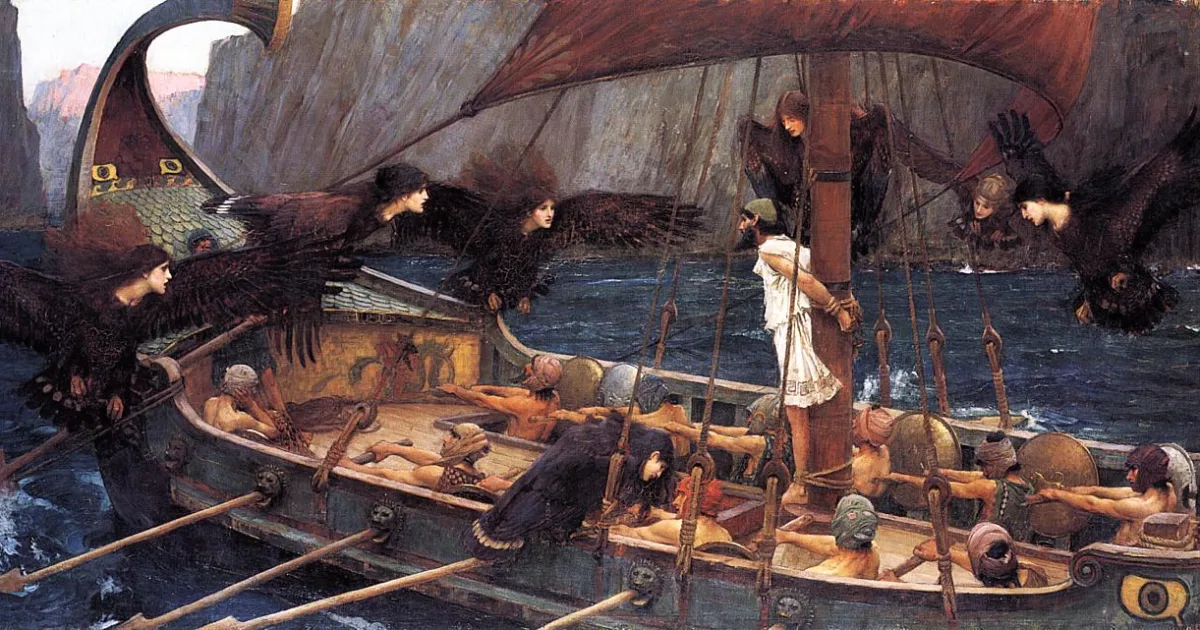
- Holding back: he has himself bound to the mast so that he can hear the Sirens without wrecking his ship.
- Curiosity and pride: he insists on staying to see the Cyclops, and his boast as he sails away brings the curse of Poseidon down on him.
- Persuasion and lying: he invents false life stories again and again, which Athena herself admires.
- Faithful to home: he refuses Calypso's offer of an immortal life so that he can go home to Penelope.
“Endure, my heart; a worse thing even than this didst thou once endure on that day when the Cyclops, unrestrained in daring, devoured my mighty comrades; but thou didst endure until craft got thee forth from the cave where thou thoughtest to die.”
In plain English: Odysseus tells himself to hold on: he survived worse in the Cyclops' cave, and only cleverness got him out.
His faults are real. He does not keep his crew alive: some die through their own folly, as the opening lines say, but his boasting at the Cyclops and his sleep at the wrong moment by the bag of winds also cost them dearly. Readers often see the poem as a study of a clever man learning when to keep quiet.
Telemachus
Telemachus, the son of Odysseus and Penelope, was a baby when his father left for Troy and is a young man when the poem begins. At first he is unsure of himself and unable to control the suitors who are eating up his inheritance; he even doubts that he is really his father's son.
“My mother says that I am his child; but I know not, for never yet did any man of himself know his own parentage.”
In plain English: Telemachus says his mother tells him he is Odysseus's son, but no one can really know who his father is.
Encouraged by Athena, he calls an assembly, sails to Pylos and Lacedaemon, and comes back more confident. In the second half of the poem he becomes his father's partner: he meets him at the swineherd's hut, hides the weapons, and fights beside him against the suitors.
Athena in the Odyssey
Athena, the daughter of Zeus, is the goddess who watches over Odysseus and his family. She pleads his case on Olympus, visits Telemachus disguised as the stranger Mentes, and later travels with him in the shape of Mentor. On Ithaca she meets Odysseus disguised as a young shepherd, hides the island from him in a mist, and then changes him into an old beggar so that no one will know him.
“Cunning must he be and knavish, who would go beyond thee in all manner of guile, aye, though it were a god that met thee.”
In plain English: Athena says that anyone, even a god, would need to be a real trickster to outwit Odysseus.
She is not a distant goddess. She teases Odysseus about his lies and praises him for them, because cunning is something they share. In the final book she stops the fighting between Odysseus and the suitors' families and makes both sides swear to keep the peace.
Antinous in the Odyssey
Antinous, son of Eupeithes, is the boldest and most insulting of the suitors who are courting Penelope and feasting in Odysseus's palace. He mocks Telemachus in the assembly and in the hall, and when the young man sails for news of his father, Antinous plans to ambush and kill him on his way home.
When Odysseus arrives as a beggar, Antinous treats him with contempt. He scolds Eumaeus for bringing him, throws a footstool at him, and sets him to fight the beggar Irus for the amusement of the suitors.
“Notorious swineherd, why, pray, didst thou bring this man to the city?”
In plain English: Antinous rudely asks the swineherd why he has brought yet another beggar into town.
He is also the first to die. As he raises a gold cup to drink, Odysseus shoots him through the throat with an arrow, and the killing of the other suitors follows. In the last book his father leads the families of the dead against Odysseus and is himself killed by Laertes.
Helen in the Odyssey
Helen, whose flight with a Trojan prince caused the war, appears in the Odyssey back at home with her husband Menelaus in Lacedaemon. When Telemachus visits, Menelaus has already noticed the young man's likeness to his father, but Helen is the first to say aloud that the guest is the son of Odysseus, and she calls herself shameless for her part in the war.
To stop everyone grieving, she mixes a drug from Egypt into their wine, and then tells how Odysseus once slipped into Troy disguised as a beaten beggar, and how she recognised him and kept his secret. Menelaus answers with a story of her standing outside the horse and calling to the hidden warriors. In Book 15 she gives Telemachus a robe for his future bride and reads an omen of his father's return.
“Straightway she cast into the wine of which they were drinking a drug to quiet all pain and strife, and bring forgetfulness of every ill.”
In plain English: Helen secretly mixes a medicine into the wine that takes away grief and makes people forget their troubles.
The Sirens in the Odyssey
The Sirens are two singers who sit in a meadow by the sea, surrounded by the bones of men who stopped to listen to them. Circe warns Odysseus that no one who hears their voice ever comes home, and tells him how to pass them: his men must stop their ears with wax, and if he wants to listen he must be tied to the mast.
As the ship approaches, the Sirens call to Odysseus by name and promise him knowledge of everything that happened at Troy and everything on earth. He begs to be set free, but his men only tie him tighter and row on.
“Come hither, as thou farest, renowned Odysseus, great glory of the Achaeans; stay thy ship that thou mayest listen to the voice of us two.”
In plain English: The Sirens flatter Odysseus as the pride of the Achaeans and urge him to stop his ship and listen to their singing.
The episode is often read as a picture of temptation, and of the self-control Odysseus shows here and fails to show elsewhere.
Odysseus and the Cyclops
The Cyclops Polyphemus, a one-eyed giant and a son of Poseidon, is the most famous monster in the poem. Odysseus and twelve of his men wait in his cave to see him, and he traps them and eats them two at a time. Odysseus gets him drunk on strong wine, tells him his name is Noman, and blinds him with a sharpened stake of olive wood.
“Noman is my name, Noman do they call me—my mother and my father, and all my comrades as well.”
In plain English: Odysseus gives the giant a fake name, meaning nobody, which will make the giant's later cries for help sound like nonsense.
When the blinded giant shouts for help, the other Cyclopes ask who is hurting him, and he answers that Noman is. Odysseus and his men escape by clinging under the bellies of his rams. But as he sails away Odysseus cannot resist shouting his real name, and Polyphemus prays to his father Poseidon to punish him, which explains the sea god's anger for the rest of the poem.
“Cyclops, if any one of mortal men shall ask thee about the shameful blinding of thine eye, say that Odysseus, the sacker of cities, blinded it, even the son of Laertes, whose home is in Ithaca.”
In plain English: Safe at sea, Odysseus can't resist telling the giant his real name and home, which lets the Cyclops curse him.
Other characters in the Odyssey
- Penelope: Odysseus's wife, who holds off the suitors with her trick at the loom and tests her husband with the secret of their bed.
- Laertes: Odysseus's old father, who lives on his farm and fights beside his son and grandson at the end.
- Eumaeus: the loyal swineherd who takes in the disguised Odysseus.
- Eurycleia: the old nurse who recognises Odysseus by the scar on his leg.
- Eurymachus: the smooth-talking leader of the suitors after Antinous.
- Calypso: the nymph who keeps Odysseus on her island and offers to make him immortal.
- Circe: the goddess who turns his men into swine and later helps him on his way.
- Nausicaa and Alcinous: the Phaeacian princess and her father, who help Odysseus home.
- Nestor and Menelaus: Greek kings from the war whom Telemachus visits.
- Poseidon: the sea god who hounds Odysseus after the blinding of his son.
- Zeus: the king of the gods, who agrees to let Odysseus return.
- Argos: Odysseus's old dog, who knows him after twenty years and then dies.
Frequently asked questions
Who is the main character of the Odyssey?
Odysseus, king of Ithaca. Much of the first part follows his son Telemachus, but the poem is about Odysseus's return home.
What are Odysseus's main character traits?
Cunning, endurance, self-control and skill with words, together with curiosity and pride that sometimes put him and his men in danger.
Who is Antinous in the Odyssey?
The most arrogant of Penelope's suitors, son of Eupeithes. He plots to kill Telemachus, abuses the disguised Odysseus, and is the first suitor Odysseus kills.
Which god is angry with Odysseus?
Poseidon, the god of the sea, because Odysseus blinded his son, the Cyclops Polyphemus.
Who helps Odysseus in the Odyssey?
Above all Athena, along with Hermes, the Phaeacians, the swineherd Eumaeus, the nurse Eurycleia and his son Telemachus.
More on PaperDue
- Homework help: what role did Odysseus's cleverness play on his journey home? →
- Study guide: Odysseus's intelligence, pride and glory →
Quotations are cited as (book.lines). The line numbers are those of the Greek text, which the translation marks about every fifth line, so a reference gives the marked lines around the passage.