Circe in the Odyssey: Who She Is and What She Does
Updated · The Odyssey by Homer
Circe is a goddess and enchantress, a daughter of the sun god Helius, who lives on the island of Aeaea and turns half of Odysseus's crew into pigs with a drugged drink. With the help of Hermes and a magic herb called moly, Odysseus resists her spell, frees his men, and stays with her for a full year before she sends him to consult the dead and warns him about the dangers on his route home.
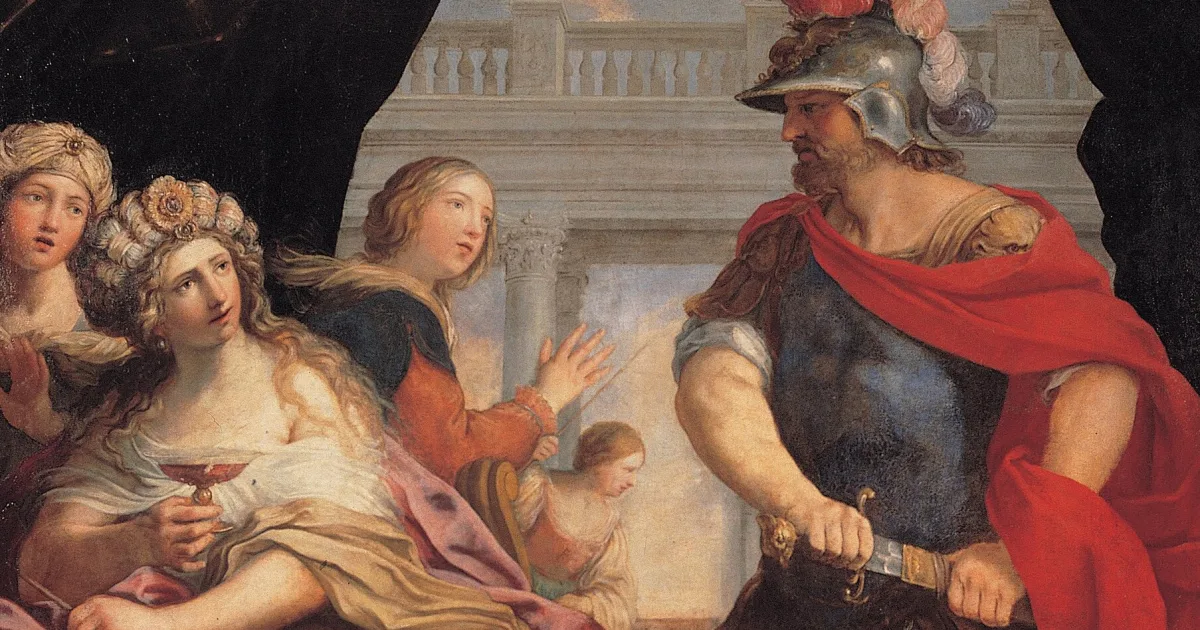
Who is Circe in the Odyssey?
Circe appears in Book 10, in the part of the poem where Odysseus tells his hosts about his wanderings. After the disaster with the Laestrygonians, his single surviving ship reaches the island of Aeaea. Homer introduces Circe as a dread goddess who speaks with a human voice, the sister of Aeetes and a child of Helius and of Perse, whose own father was Oceanus.
She lives in a house of polished stone in a clearing in the woods. Around it roam wolves and mountain lions that she has tamed with her drugs; instead of attacking the visitors, they fawn on them like dogs greeting their master. Inside, Circe sings as she works at a great loom, a detail that recalls Calypso on her island and Penelope in Ithaca.
Circe turns Odysseus's men into pigs
Odysseus divides his crew in two and the lot falls on Eurylochus to lead a scouting party to the house. Circe welcomes the men warmly and serves them a mixture of cheese, barley meal, honey and wine, into which she has stirred her drugs so that they forget their homeland. Then she strikes them with her wand and shuts them in her sties. Only Eurylochus, who suspected a trick and stayed outside, escapes to bring the news.
The poem stresses that the change affects their bodies but not their minds. They look and sound like animals, but they still understand what has happened to them:
“So they were penned there weeping, and before them Circe flung mast and acorns, and the fruit of the cornel tree, to eat, such things as wallowing swine are wont to feed upon.”
In plain English: Locked in the pigsty and crying, the men are fed acorns and berries by Circe, the food that pigs usually eat.
Hermes and the herb moly
Odysseus sets out alone to rescue his men, and on the way the god Hermes meets him, disguised as a youth. Hermes explains how Circe's magic works and gives him a protective herb with a black root and a milk-white flower. He also tells him what to do: when Circe strikes him with her wand, he must draw his sword and rush at her as if to kill her, and he must make her swear an oath before he goes to her bed.
“Moly the gods call it, and it is hard for mortal men to dig; but with the gods all things are possible.”
In plain English: The gods' name for the plant is moly; humans struggle to pull it up, but the gods can do anything.
Everything happens as Hermes said. The drink has no effect, Odysseus draws his sword, and Circe falls at his knees. She realises at once who he must be, because Hermes had told her long before that this man would eventually come to her island:
“Amazement holds me that thou hast drunk this charm and wast in no wise bewitched.”
In plain English: Circe is astonished that her potion has had no effect on him at all.
Circe then invites him to her bed. Odysseus refuses until she swears not to plot further harm against him, and only after she has sworn does he accept.
A year on Circe's island
Odysseus will not eat until his crew is free. Circe smears the pigs with a different ointment, and the men become human again, looking younger, taller and better than before. The reunion is one of the most emotional scenes in the poem, and it even moves the goddess herself:
“They knew me, and clung to my hands, each man of them, and upon them all came a passionate sobbing, and the house about them rang wondrously, and the goddess herself was moved to pity.”
In plain English: The men recognise Odysseus, hold on to him and weep so loudly that the whole house echoes, and even Circe feels sorry for them.
Circe now turns from enemy to host. She invites all the men to stay, and they remain with her for a full year, feasting on meat and wine. In the end it is the crew, not their captain, who remember the journey. They take Odysseus aside and urge him to think of home:
“Strange man, bethink thee now at last of thy native land, if it is fated for thee to be saved, and to reach thy high-roofed house and thy native land.”
In plain English: His crew tell him it is time to remember his home, if he is ever going to get back there.
What Circe tells Odysseus to do
When Odysseus asks to leave, Circe agrees but gives him a shock: before he can sail home he must travel to the house of Hades and Persephone and ask the spirit of the blind prophet Teiresias for directions. She explains how to reach the edge of the world, what offerings to make and how to keep the other ghosts away from the blood until Teiresias has drunk. As the crew leaves, young Elpenor, still heavy with wine, falls from her roof and dies.
After the visit to the dead, the ship goes back to her island to bury Elpenor, and Circe gives Odysseus a detailed account of the route ahead in Book 12. She warns him about the Sirens and how to hear them safely, about the choice between Scylla and Charybdis, and about the sun god's cattle on Thrinacia, which his men must not touch:
“To the Sirens first shalt thou come, who beguile all men whosoever comes to them.”
In plain English: Circe says the first danger will be the Sirens, who lure in every man who comes near them.
Her advice proves accurate in every detail. Odysseus has himself bound to the mast to hear the Sirens, loses men to Scylla as she predicted, and loses the rest of his crew after they kill the sun god's cattle.
How to read Circe
Circe is a figure of two halves. In the first half of her episode she is one of the poem's most dangerous threats, a goddess who can strip men of their human form. In the second half she is generous and wise, and her instructions are the reason Odysseus survives the next stage of his journey. Many readers see this shift as typical of the Odyssey, where a dangerous host can become a helpful one once the right rules are followed.
She is also often compared with Calypso. Both are goddesses who live alone, sing at their looms and take Odysseus as a lover, and both eventually help him leave. Circe, however, is defeated by cunning and divine help rather than by an order from Zeus, and the year he spends with her seems to be a rest that his crew, not he, has to end. Her drink, which makes men forget home, may also be read as a stronger version of the temptation the Lotus-eaters offered earlier, a test of whether the travellers will lose their wish to return.
Frequently asked questions
Who is Circe in the Odyssey?
Circe is a goddess who lives on the island of Aeaea. She is the daughter of Helius and Perse and the sister of Aeetes, and she uses drugs and a wand to turn people into animals.
What does Circe turn Odysseus's men into?
She turns them into pigs. They have the bodies and voices of swine but keep their human minds, and she later changes them back.
How does Odysseus resist Circe's magic?
Hermes gives him the herb moly, which protects him from her drink. When her wand fails, Odysseus draws his sword and makes her swear an oath not to harm him.
How long does Odysseus stay with Circe?
A full year. His men finally remind him of home and persuade him to ask her to let them go.
Why does Circe send Odysseus to the underworld?
She tells him he must ask the spirit of the prophet Teiresias how to get home, so he sails to the house of Hades before returning to her island for further advice.
Does Odysseus have a son with Circe?
Not in the Odyssey. A later tradition, recorded by Apollodorus, says that Circe bore him a son named Telegonus.
More on PaperDue
Quotations are cited as (book.lines). The line numbers are those of the Greek text, which the translation marks about every fifth line, so a reference gives the marked lines around the passage.
Other sources: Apollodorus, The Library, Epitome (translated by J. G. Frazer, 1921) (Theoi Classical Texts Library)