Penelope in the Odyssey: Character, Loyalty and the Bed Test
Updated · The Odyssey by Homer
Penelope is the wife of Odysseus and the mother of Telemachus, who waits faithfully in Ithaca for twenty years while suitors crowd her house and press her to remarry. She holds them off with clever delays, such as weaving and secretly unweaving a burial shroud, and when Odysseus finally returns in disguise she tests him with the secret of their bed before she accepts him.
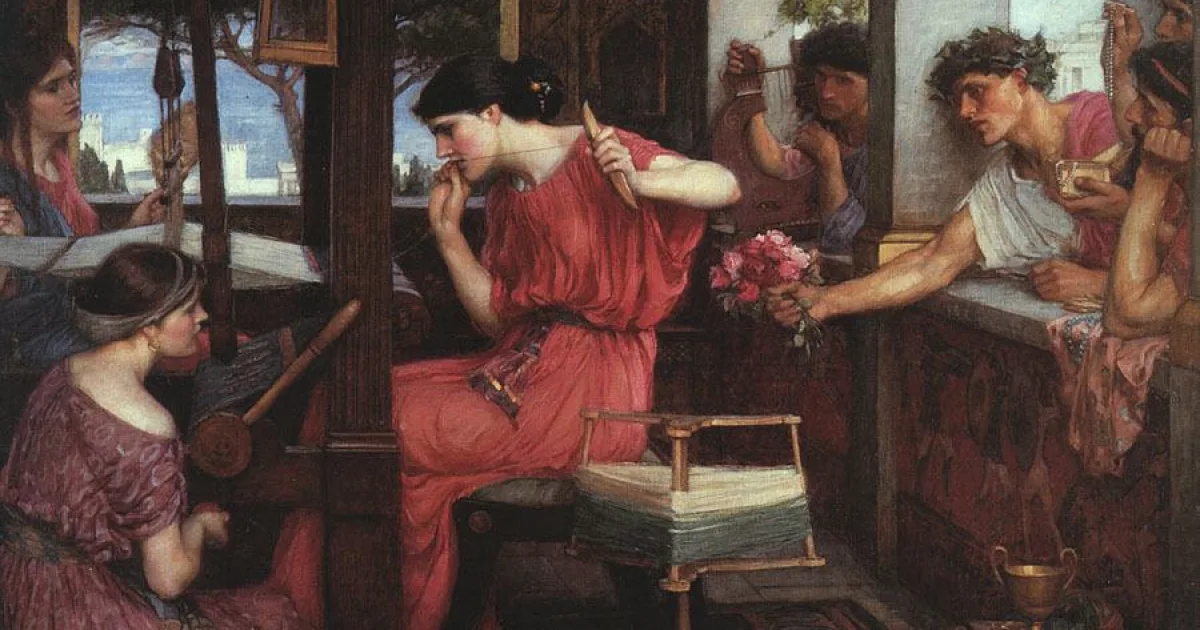
Who is Penelope in the Odyssey?
Penelope is the daughter of Icarius, the queen of Ithaca and the wife Odysseus left behind when he sailed for Troy. When the poem opens, she has not seen her husband for nearly twenty years. More than a hundred young nobles from Ithaca and the nearby islands have moved into her house, eating her livestock and drinking her wine while they wait for her to choose one of them as her new husband.
She first appears in Book 1, coming down from her upper room in tears to ask the singer Phemius to stop his song about the Achaeans' sad homecoming from Troy, because it reminds her of the husband she has lost. Telemachus, newly confident after Athena's visit, sends her back upstairs. The scene shows both her grief and the tension in a house where her son is starting to take charge.
Penelope's weaving trick
Penelope's most famous trick is described three times in the poem, first by the suitor Antinous in Book 2. She told the suitors she would choose a husband once she had finished a shroud for Odysseus's father, Laertes, so that he would have a fitting burial cloth when he died:
“Young men, my wooers, since goodly Odysseus is dead, be patient, though eager for my marriage, until I finish this robe”
In plain English: Penelope asks the suitors to wait until she has finished weaving a robe, since they claim Odysseus is dead.
“Then day by day she would weave at the great web, but by night would unravel it, when she had let place torches by her.”
In plain English: She wove the cloth during the day and secretly took it apart again at night by torchlight.
The trick worked for three years. In the fourth year one of her maids betrayed her, the suitors caught her undoing the cloth, and she was forced to finish it. Antinous tells the story as a complaint, but to the reader it shows that Penelope is a match for her husband in cunning. When she later tells the same story to the disguised Odysseus in Book 19, it becomes her own account of how long she has managed to resist.
Penelope and the suitors
Penelope never says yes to a suitor, but she does not shut them out entirely either. In Book 18 Athena makes her more beautiful, and she comes down to the hall and asks the suitors for gifts, as a proper suitor should give, instead of eating her property. Odysseus, watching in disguise, is pleased that she draws gifts out of them while her mind is set on something else.
Her position is difficult. Her son is coming of age, the estate is shrinking, and her family wants her to remarry. Some readers see her as torn between loyalty and practical pressure, and the poem lets her waver: in Book 19 she says she can no longer avoid a marriage, and she decides to hold a contest with her husband's great bow.
Penelope's dream and the contest of the bow
In Book 19 Penelope talks at night with the disguised Odysseus, who claims to have met her husband long ago. She asks him to explain a dream: an eagle swooped down and killed her geese, then told her it was her husband come home to kill the suitors. She then says that dreams come through two gates, one of horn and one of ivory, and only the dreams from the gate of horn come true.
The next day she brings out the bow of Odysseus and promises to marry whoever can bend and string it and send an arrow cleanly through the row of axe heads, as her husband once could. Whether she suspects the stranger's identity at this point is one of the most debated questions in the poem. Some readers think she has guessed and sets the contest to give him a weapon; others think she has truly given up and that the timing is fate or Athena's doing.
Odysseus and Penelope: the bed test
After the suitors are killed, the old nurse Eurycleia runs upstairs to tell Penelope that her husband is home. Penelope refuses to believe it and comes down to sit across from him in silence, while Telemachus scolds her for her hard heart. She explains that if this really is Odysseus, the two of them have secret signs that only they know. Then she sets her test, pretending to give an order to her maid:
“Yet come, Eurycleia, strew for him the stout bedstead outside the well-built bridal chamber which he made himself.”
In plain English: Penelope tells the nurse to make up a bed for him outside the bedroom that Odysseus built.
The order is a trap, because their bed cannot be moved. Odysseus built it himself around the trunk of a living olive tree, and the post is the root of the tree. His furious reaction is exactly the proof she needs:
“Woman, truly this is a bitter word that thou hast spoken.”
In plain English: Odysseus is hurt and angry at what she has just said about moving the bed.
Only someone who had built the bed could know the secret, so his anger reveals who he is. Penelope breaks down, runs to him and throws her arms around him. She asks him not to be angry that she did not welcome him at once, explaining that she has always feared being tricked by a stranger:
“Be not vexed with me, Odysseus, for in all else thou wast ever the wisest of men.”
In plain English: Penelope asks him not to be angry with her, saying that in everything else he has always been the wisest of men.
Why Penelope matters
Penelope is often seen as the moral centre of the Odyssey. In the underworld scene of Book 24, the ghost of Agamemnon praises her loyalty and sets her against his own wife, who murdered him:
“Therefore the fame of her virtue shall never perish, but the immortals shall make among men on earth a pleasant song in honor of constant Penelope.”
In plain English: Agamemnon says Penelope's goodness will never be forgotten, because the gods will make a song about her faithfulness.
Readers often point out that the poem gives Penelope the same qualities it praises in her husband: patience, self-control, caution and skill at deception. The bed test shows that she can outwit even the man known for his cunning. The olive tree bed may also be read as a symbol of the marriage itself, rooted in one place and impossible to move.
Frequently asked questions
Who is Penelope in the Odyssey?
Penelope is the wife of Odysseus, the mother of Telemachus and the queen of Ithaca. She waits faithfully for her husband while suitors try to force her to remarry.
How does Penelope trick the suitors?
She promises to marry once she finishes a burial shroud for Laertes, then weaves it by day and secretly unravels it by night. The trick lasts until one of her maids gives her away.
How does Penelope test Odysseus?
She orders the maid to move their bed out of the bedroom. Odysseus angrily replies that the bed cannot be moved because he built it around a living olive tree, and that secret proves his identity.
Is Penelope faithful to Odysseus?
Yes. She refuses every suitor during his absence, and in Book 24 the ghost of Agamemnon praises her loyalty as something that will be remembered in song.
Does Penelope know the beggar is Odysseus?
The poem does not say clearly. She talks with him at length and sets up the contest of the bow just in time, so some readers think she suspects him, but she does not accept him until the bed test.
More on PaperDue
Quotations are cited as (book.lines). The line numbers are those of the Greek text, which the translation marks about every fifth line, so a reference gives the marked lines around the passage.