Achilles in the Odyssey: The Underworld Meeting and His Funeral
Updated · The Odyssey by Homer
Achilles is already dead when the Odyssey begins, so he appears only as a ghost: in Book 11 Odysseus meets his spirit in the underworld, and in Book 24 the ghost of Agamemnon describes his funeral at Troy. His most famous moment in the Odyssey is his reply to Odysseus, saying he would rather be a poor man's hired laborer on earth than king over all the dead.
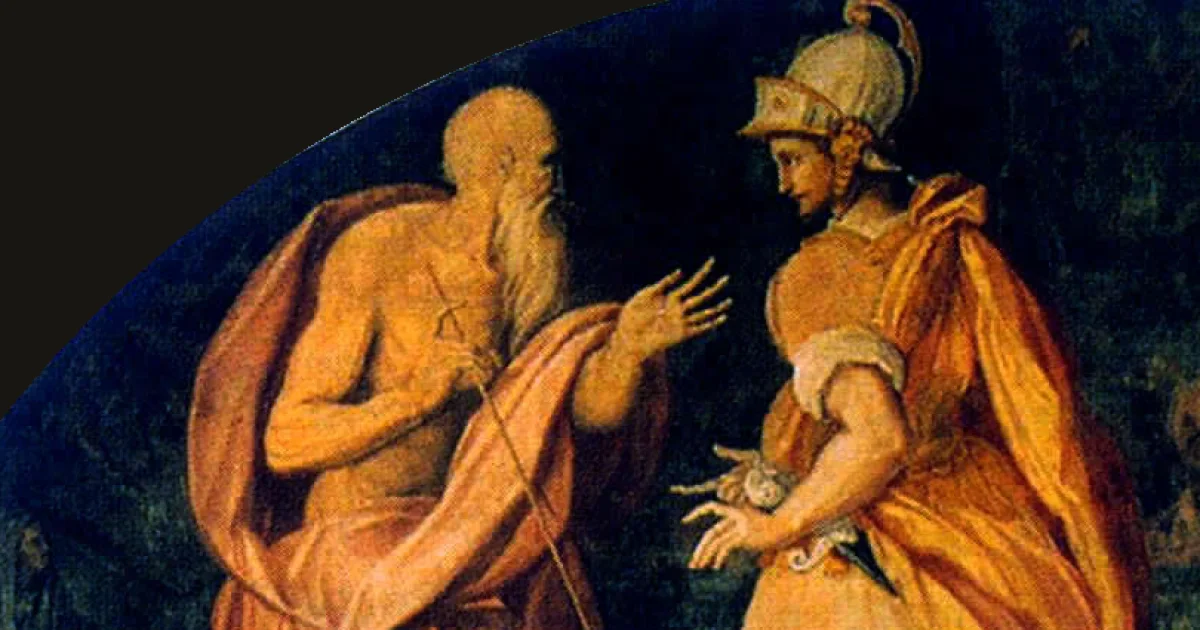
Achilles in the Odyssey: what this page covers
Achilles is the hero of the Iliad, but in the Odyssey he is a figure from the past. This page covers only what the Odyssey itself says about him: the meeting in the land of the dead in Book 11, the account of his funeral in Book 24, and a few shorter mentions elsewhere. For his life, his death at Troy and the later stories about him, see the link to our homework-help answer at the end of the page.
Achilles is mentioned early on. In Book 3 old Nestor, remembering the war at Troy, lists the great men who died there, Achilles among them, along with Aias, Patroclus and his own son Antilochus. In Book 4 Menelaus is sending his daughter to marry the son of Achilles. In Book 8 the singer Demodocus performs a song about a quarrel between Odysseus and Achilles at a feast, which brings Odysseus to tears.
Achilles in Book 11: the meeting in the underworld
In Book 11 Odysseus sails to the edge of the world to consult the prophet Teiresias. After talking with Teiresias, his mother and the ghost of Agamemnon, he sees the spirit of Achilles arrive with Patroclus, Antilochus and Aias. Achilles recognises him at once and asks how he dared to come down among the dead.
Odysseus answers with a compliment. He says that he himself is still wandering and suffering, while no man has ever been more fortunate than Achilles, who was honored like a god in life and now holds power among the dead:
“For of old, when thou wast alive, we Argives honored thee even as the gods, and now that thou art here, thou rulest mightily among the dead.”
In plain English: Odysseus tells Achilles that the Argives respected him like a god while he lived, and that he now has great power in the underworld.
Achilles rejects the comfort completely and tells Odysseus not to speak soothingly of death. His reply is one of the most quoted passages in the poem:
“I should choose, so I might live on earth, to serve as the hireling of another, of some portionless man whose livelihood was but small, rather than to be lord over all the dead that have perished.”
In plain English: Achilles says he would prefer to be a poor farmer's hired worker and alive, rather than king over every dead person.
Why Achilles' words matter
The reply is striking because of who says it. In the Iliad Achilles chose a short, glorious life over a long, quiet one. In the Odyssey his ghost seems to say that the choice was not worth it, and that even the humblest life above ground is better than any rank among the dead. Many readers see this as a deliberate contrast with Odysseus, the hero who keeps choosing survival and home over glory, and who has just turned down immortality offered by a goddess.
Not everyone reads the speech as regret. Some point out that Achilles' grief is partly about being unable to help his father Peleus, who may be dishonored now that he is old, and about not knowing what has become of his son. On this reading, what he misses is not his own glory but the chance to protect his family, a concern that also drives Odysseus.
Achilles asks about his son
Achilles asks for news of his son Neoptolemus and of his father Peleus. Odysseus has no news of Peleus, but he describes how he himself brought Neoptolemus from Scyros to Troy, where the young man spoke well in council and fought bravely in battle. He killed the warrior Eurypylus, and he was one of the leaders who hid inside the horse built by Epeus, where he never showed fear and came through the sack of the city without a wound.
“So I spoke, and the spirit of the son of Aeacus departed with long strides over the field of asphodel, joyful in that I said that his son was preeminent.”
In plain English: Achilles walks off across the underworld meadow, glad to hear that his son was outstanding among the warriors.
The scene ends on a note of pride. Even in death, the poem suggests, the reputation of a son can give comfort to his father. Right afterwards Odysseus meets the ghost of Aias, still angry that Odysseus won the arms of Achilles in a contest after his death, and Aias turns away without a word.
Achilles in Book 24: his funeral
Achilles appears once more in the final book. Hermes leads the spirits of the dead suitors down to the meadow of asphodel, where the ghosts of Achilles and Agamemnon are talking. Achilles pities Agamemnon for his shameful death at home, and Agamemnon replies by describing the honor Achilles received when he fell at Troy:
“Fortunate son of Peleus, godlike Achilles, that wast slain in the land of Troy far from Argos, and about thee others fell, the best of the sons of the Trojans and Achaeans, fighting for thy body;”
In plain English: Agamemnon calls Achilles lucky to have died at Troy, far from home, with the best fighters on both sides dying in the struggle for his body.
Agamemnon tells how the Achaeans carried the body back to the ships, how Thetis rose from the sea with the sea nymphs to mourn her son, and how the Muses sang his dirge. The army mourned him for well over two weeks before they burned his body, and then gathered his bones in a golden urn. Thetis also set out splendid prizes for the funeral games held in his honor.
“In this lie thy white bones, glorious Achilles, and mingled with them the bones of the dead Patroclus, son of Menoetius, but apart lie those of Antilochus, whom thou didst honor above all the rest of thy comrades after the dead Patroclus.”
In plain English: His bones lie in the urn mixed with those of his close friend Patroclus, while the bones of Antilochus, his next dearest friend, are kept separately.
The speech sets the glorious funeral of Achilles against the murder of Agamemnon at his own table, and both against the return of Odysseus, whose story ends not with a tomb but with his family restored.
Frequently asked questions
Is Achilles in the Odyssey?
Yes, but only as a ghost. Odysseus meets his spirit in the underworld in Book 11, and in Book 24 his ghost talks with the ghost of Agamemnon.
What does Achilles say to Odysseus in the underworld?
He tells Odysseus not to make light of death and says he would rather work as a hired hand for a poor man on earth than rule over all the dead. Then he asks for news of his son and his father.
What book is Achilles in the Odyssey?
Achilles appears in Book 11, when Odysseus visits the dead, and in Book 24, when Agamemnon describes his funeral. He is also mentioned in Books 3, 4 and 8.
How does Achilles die in the Odyssey?
The Odyssey does not narrate his death. Agamemnon's ghost says only that he fell in the land of Troy and that the best of the Trojans and Achaeans died fighting over his body.
Where are Achilles' bones buried in the Odyssey?
In a golden urn together with the bones of Patroclus, under a great mound on a headland by the Hellespont, according to Agamemnon's ghost in Book 24.
More on PaperDue
- Who was Achilles? His life, death and the stories beyond the Odyssey →
- Study guide: Achilles' regret in Book XI of the Odyssey →
Quotations are cited as (book.lines). The line numbers are those of the Greek text, which the translation marks about every fifth line, so a reference gives the marked lines around the passage.